
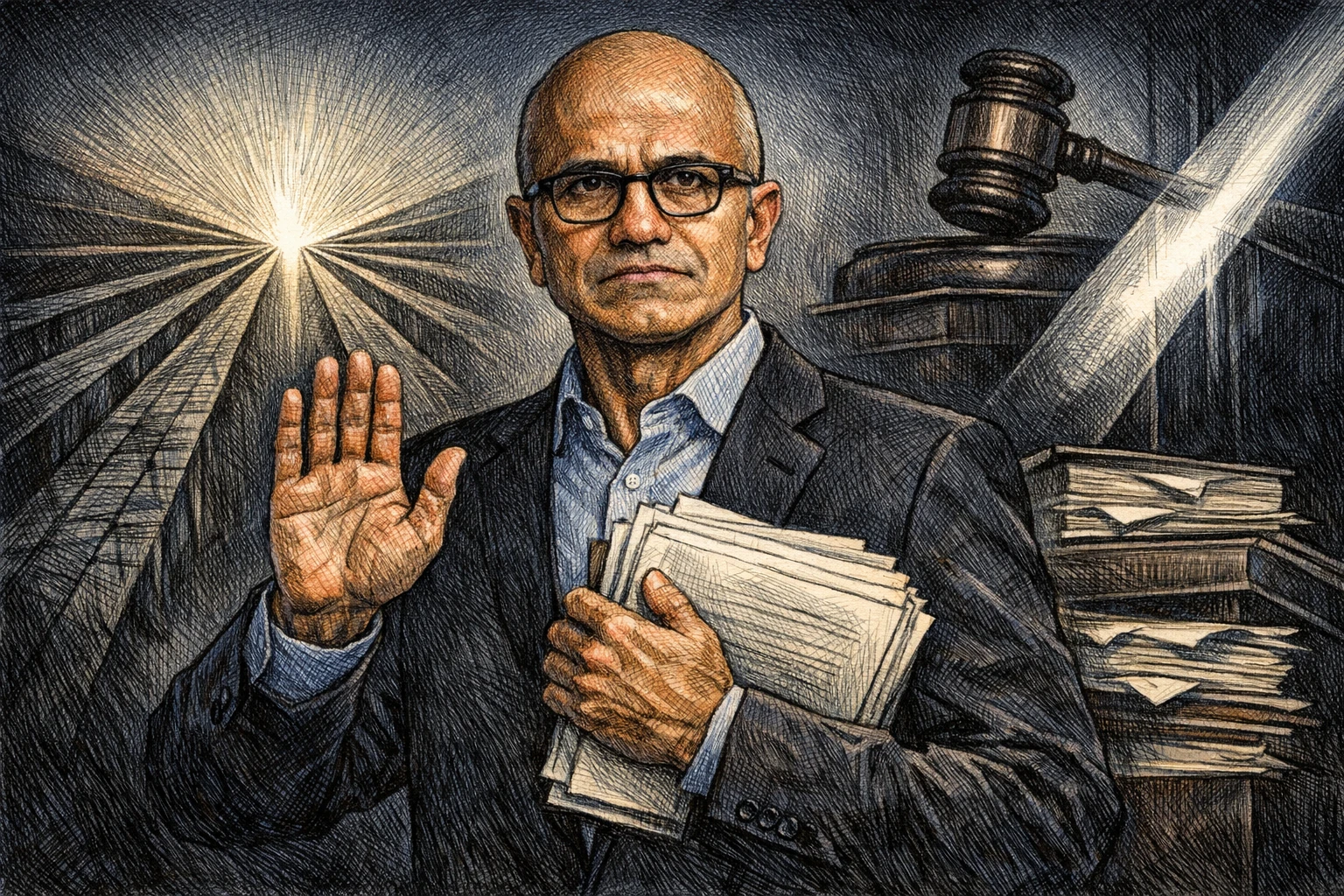
Microsoft CEO Satya Nadella said in a post on X that the AI industry risks repeating the worst effects of globalization if most of the value ends up concentrated in a handful of dominant models. His warning was blunt: companies should not rely only on rented AI capabilities from outside vendors, but should embed their own knowledge into systems they can keep and improve over time.
Two forms of capital at the center of enterprise AI
Nadella framed the issue around two ideas. The first is human capital — the judgment, customer relationships, domain expertise, and pattern recognition that employees build over years of work. The second is token capital, which he described as AI capability that a company trains, fine-tunes, or adapts for itself instead of leaving that layer entirely in the hands of external model providers.
His argument is that these two forms of capital do not compete with each other. As AI systems improve, the value of accumulated employee expertise can rise rather than fall. He proposed a practical test for whether a company’s AI strategy is working: can it swap out a general-purpose model without losing the institutional knowledge created by long-serving employees?
The real moat is a learning loop, not simple model access
That test points to a larger question. Does the company have its own learning loop? In Nadella’s framework, internal data, workflows, and operational knowledge should flow back into AI systems on an ongoing basis, allowing those systems to become smarter through repeated use inside the organization. If that loop does not exist, the company is effectively renting intelligence again and again from outside model vendors.
He wrote that the priority should be building a frontier ecosystem, not just a frontier model. In his view, value should be distributed across companies, industries, and countries instead of pooling at the base-model layer alone.
Globalization as the warning sign for AI centralization
To make the case, Nadella pointed to the first wave of globalization. He said whole industrial economies were hollowed out through outsourcing, even while headline GDP figures looked healthy on paper. The displacement was real, and the consequences are still visible. He argued AI now faces a similar structural risk: if the gains are captured mainly by a small number of foundational model companies, political and social tolerance for that outcome will not last.
The article also notes how this argument aligns with Microsoft’s own commercial position. If enterprises build directly on APIs from firms such as OpenAI or Anthropic, the intermediary value of Azure could narrow. Nadella’s defense of in-house AI capability is therefore also a defense of a broader enterprise and cloud-based ecosystem in which companies retain more control over their own data and expertise.