Microsoft says it has finished pretraining MAI-Base-2, a 2.8 trillion-parameter model

Microsoft says it has finished pretraining MAI-Base-2, a 2.8 trillion-parameter model

N
News Editor
2026-10-16 09:39:44
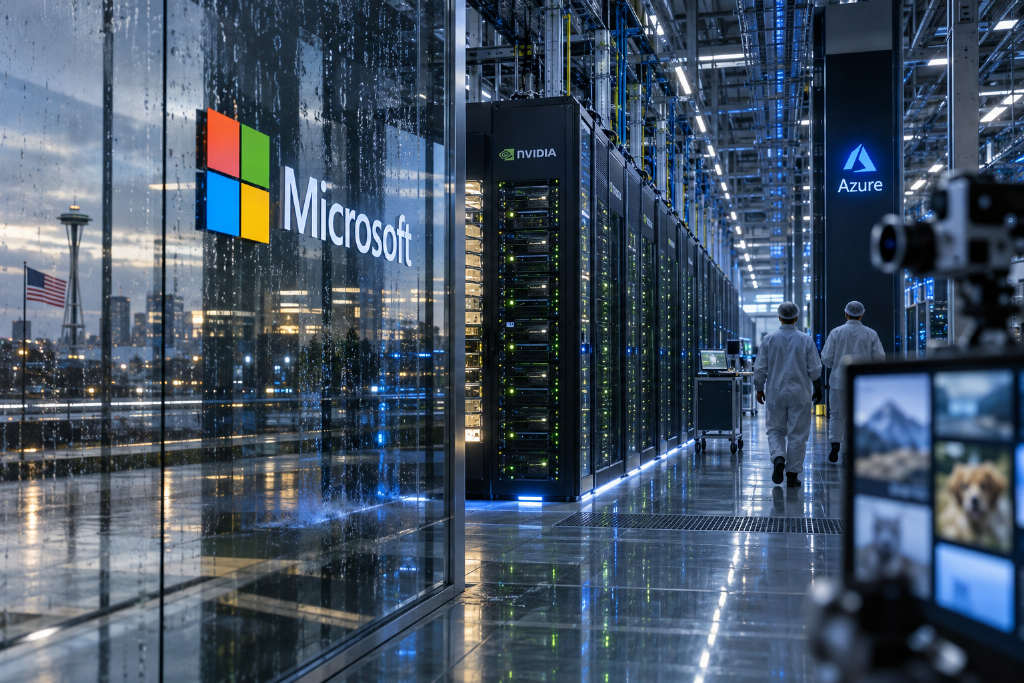
Microsoft said it has completed pretraining for MAI-Base-2, its latest in-house foundation model, with total parameters reaching 2.8 trillion. The model uses a mixture-of-experts, or MoE, architecture and activates 80 billion parameters per inference step. According to the company, training ran for 38 days across August and September on 16,000 NVIDIA GB200 GPUs and processed about 50 trillion tokens. Microsoft also said the model introduces native vision pretraining for the first time, with visual data accounting for 18% of the training mix. In internal testing disclosed by Microsoft, MAI-Base-2 outperformed models including DeepSeek-V4-Pro-Base, Kimi K3 and Qwen3.8 on text prediction benchmarks covering coding, question answering, mathematics and science and engineering subjects. Microsoft added that training a model at the same level as DeepSeek-V4-Pro-Base would require only about one-quarter to one-twelfth of the compute under its method, though it kept scaling MAI-Base-2 further. Mustafa Suleyman, Microsoft’s AI chief, said at an internal meeting on Oct. 15 that the pretrained base surpasses the OpenAI model behind GPT-5.6 Sol while using one-quarter of the training compute. The model remains in post-training, with deployment planned first in Microsoft products and later through Foundry to enterprise partners.

Microsoft said it has completed pretraining for MAI-Base-2, its new in-house model. The system has 2.8 trillion total parameters and uses a mixture-of-experts architecture, with 80 billion parameters activated at a time.

According to the company, Microsoft used 16,000 NVIDIA GB200 GPUs across August and September this year. Training lasted 38 days and processed about 50 trillion tokens. MAI-Base-2 also introduces native vision pretraining for the first time, and visual data accounted for 18% of the training load.

Internal benchmark claims and compute comparison

Microsoft said internal tests showed MAI-Base-2 outperforming models including DeepSeek-V4-Pro-Base, Kimi K3 and Qwen3.8 on text prediction metrics in coding, question answering, mathematics, and science and engineering subjects.

The company also said that if the goal were only to train a model at the same level as DeepSeek-V4-Pro-Base, its method would require about one-quarter to one-twelfth of the compute. Microsoft said it continued to spend more compute to make the model larger and stronger, and that MAI-Base-2’s actual training compute still exceeded DeepSeek’s.

Mustafa Suleyman, Microsoft’s AI chief, said at an internal meeting on Oct. 15 that the pretrained base of MAI-Base-2 is already stronger than the OpenAI model supporting GPT-5.6 Sol, while using one-quarter of the training compute.

Training methods and rollout plan

Microsoft said it improved MoE expert routing, the Muon optimizer, and data filtering methods to reduce wasted memory and improve stability in large-scale training.

The company also said all training data was processed internally and that it did not obtain capabilities by distilling other companies’ models.

MAI-Base-2 is still in the post-training stage. Microsoft plans to use it in its own products first, then license model weights to enterprise partners through Foundry.

This article was originally published by Bit.Fan. For more cryptocurrency news and market insights, visit www.bit.fan.
200

Disclaimer:

The market information, project data, and third-party content displayed on this platform are for industry information sharing only and do not constitute any form of investment advice or return commitment.

Cryptocurrency trading carries high risks. Users should fully assess their risk tolerance and make independent decisions. All profits, losses, and legal responsibilities are borne by the users themselves.