
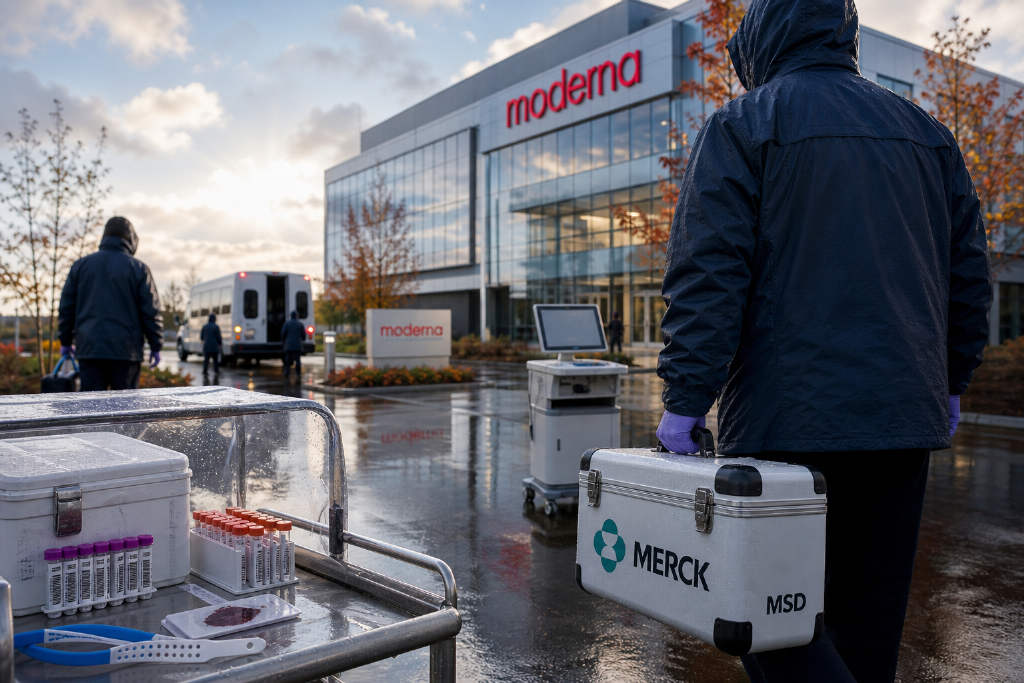
Moderna and Merck said on Aug. 19 that the Phase 3 INTerpath-001 study posted a positive topline result in resected Stage IIB-IV melanoma, comparing Intismeran plus Keytruda with Keytruda alone.
The trial enrolled 1,137 patients. According to the disclosed interim analysis, the combination achieved statistically significant and clinically meaningful improvement in recurrence-free survival, or RFS, and distant metastasis-free survival, or DMFS.
What is confirmed so far, and what is not
Two limits matter at this stage.
First, Moderna has not released the specific hazard ratios, the absolute difference in recurrence rates, or overall survival data from Phase 3. That means the market can say the late-stage study was positive, but it cannot directly carry over the efficacy figures reported earlier in Phase 2b.
In the previously reported five-year follow-up from Phase 2b, the combination reduced the risk of recurrence or death by 49% and reduced the risk of distant metastasis or death by 59% compared with Keytruda alone. Those figures belong to the earlier study and should not be treated as the full Phase 3 result.
Second, the study will not end early because of the positive interim readout. It will continue to track other endpoints, including overall survival.
A therapy built for each patient rather than one fixed formula
The unusual part of Intismeran is not simply that it is an mRNA therapy. It is that every patient does not receive the same formula.
The process begins by reading genetic information from a patient’s tumor and blood samples. Based on the mutation profile, the system selects as many as 34 neoantigens and then generates a personalized mRNA treatment.
Put simply, the workflow starts by identifying the biology of that patient’s cancer and then producing a drug for that patient. That setup requires sequencing, algorithms, neoantigen selection, mRNA design, manufacturing, quality control, and logistics to function as one chain rather than separate steps.
Maestro coordinates a global Phase 3 program at scale
Moderna has also built a digital system called Maestro to coordinate clinical operations, manufacturing, quality control, and logistics, while assigning separate production batches for different patients.
That matters because it shows that a system heavily dependent on sequencing, algorithms, and personalized manufacturing can support a global randomized Phase 3 trial involving more than 1,100 patients. For individualized therapies, the challenge is not only whether the design works but whether the full operating system can run in the real world.
Personalis sits upstream in tumor genomic analysis
Looking further upstream in the Intismeran workflow brings in Personalis. The company is not presented as the core AI model provider behind Intismeran. Its role comes earlier, in tumor genomic analysis.
From the early stage of the V940/mRNA-4157 program, Moderna and Merck have used Personalis’ tumor analysis platform. In 2024, Moderna extended its partnership with Personalis and continued using the ImmunoID NeXT Platform. Around the same period, Merck invested $50 million in Personalis.
In practical terms, Personalis converts tumor samples into high-quality molecular data that downstream algorithms can use. Moderna then analyzes that data within its own system, selects neoantigens, and designs the mRNA therapy.
Tempus AI plans to buy Personalis at about $1.5 billion enterprise value
Personalis also saw another major development this year. On July 20, Tempus AI said it would acquire Personalis in a deal valued at about $1.5 billion in enterprise value, with closing expected in late 2026 or early 2027.
The report says the acquisition is centered mainly on MRD, or minimal residual disease detection and long-term monitoring after cancer treatment. It is not described as a transaction undertaken specifically for Intismeran.
If more drugs in the future require a clear answer to what a given patient’s cancer actually looks like, then sequencing, MRD, and long-term molecular data may stop being only diagnostic tools and become part of the treatment and drug-development system itself.
Anthropic points to another route for AI in science
One day before Moderna released its result, Anthropic published a protein-design experiment. In de novo binder design across 15 protein targets, Claude Opus 4.8 and Mythos Preview produced binders that were confirmed in wet-lab testing for 14 of those targets.
The key point was not that Claude had become a new protein-design model on its own. According to the report, Claude still called specialized models for protein structure, sequence design, and co-folding. Its job was to read papers, identify design sites, choose tools, call different models, run multiple rounds of computation, and screen candidate outputs.
Those candidate proteins were then manufactured by Adaptyv Bio and Twist Bioscience and moved into lab testing. The division of labor is clear: a general AI model does not have to replace every specialist model directly. It can also work as a coordination layer connecting specialist models, lab equipment, data, and research workflows.
The article says Anthropic’s Claude Science, launched this year, is moving in that same direction by letting Claude connect with specialist life-science models as well as researchers’ existing data and tools.
Attention may be shifting beyond the model itself
For the past several years, the part of AI drug development that drew the most market attention was the model layer. Protein structure prediction, molecule generation, and drug design kept producing new benchmarks.
But the article argues that model capabilities are spreading quickly. The harder-to-copy assets in the next stage may sit outside the model itself: proprietary patient data, real experimental capacity, automated manufacturing systems, and clinical feedback.
Under that framing, Moderna shows one path. Patient tumor data enters an algorithmic system, the system determines a treatment design, the output becomes a real individualized drug, and clinical results test whether it works.
Anthropic shows another. A general AI model does not directly replace specialist scientific models; it uses specialist tools to generate candidates and then hands them to a real lab for validation.
Tempus’ acquisition of Personalis extends toward the data and clinical-feedback side of the chain.
The three companies are not doing the same thing, and the report does not treat them as one simple AI healthcare supply chain. The common thread is narrower and more concrete: AI is moving from stand-alone software into actual research, experimentation, manufacturing, and clinical workflows.