
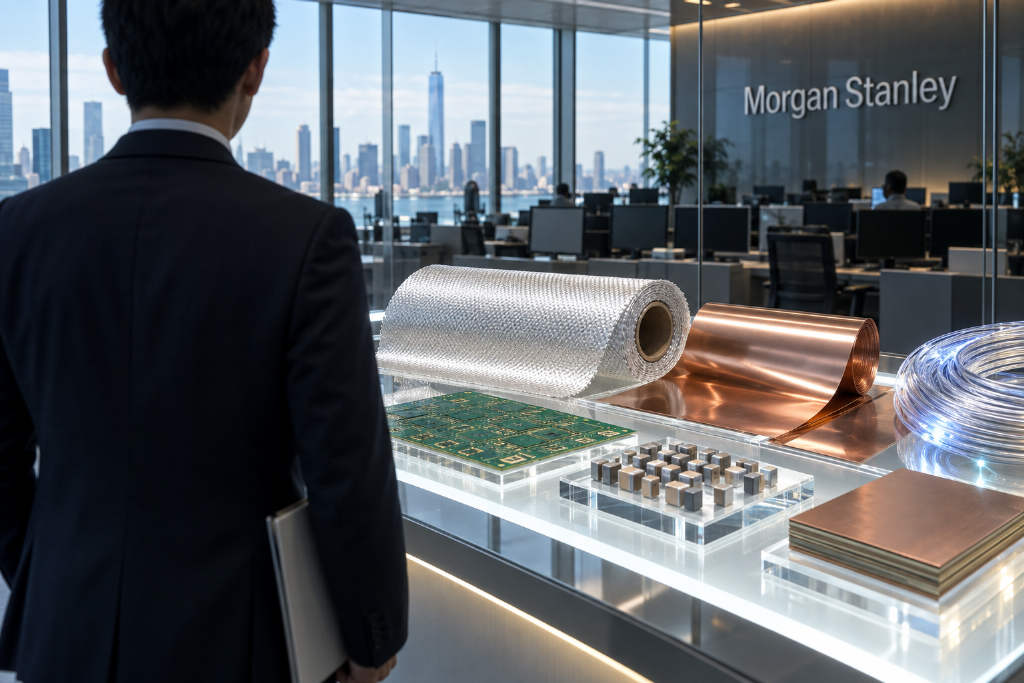
Morgan Stanley on September 13 published a semiconductor industry report titled AI Infrastructure: The Materials Super-cycle, shifting its AI lens away from downstream hardware such as GPUs and servers and back toward the upstream materials supply chain that supports the PCB and MLCC ecosystem. The report said the AI opportunities that have not yet been fully priced by the market are moving into bottleneck materials, particularly glass fiber cloth, copper foil and optical fiber.
The bank singled out names including Nittobo, Jinan (8358) and Corning, saying they have the most direct earnings sensitivity to upstream shortages.
Morgan Stanley reorders the AI materials trade after a sharp pullback
According to the report, AI materials stocks led by suppliers tied to PCB and CCL have climbed 91% over the past 12 months. As of September 10, though, the group had also fallen about 36% from the 52-week highs set in May and June.
Morgan Stanley said that retreat does not mark the end of the opportunity. It put AI materials stocks at about 26x estimated 2026 earnings, compared with roughly 35x for PCB and CCL names. By 2030, the bank expects AI and data center demand for PCB and CCL to rise by 6x to 7x, leaving room for that valuation gap to narrow.
The report ranked six bottleneck material groups in this order:
- High-end glass fiber cloth and HVLP4 copper foil, where supply is least flexible and pricing power is strongest.
- Optical fiber, where fundamentals remain strong, though the medium-term risk-reward profile is less attractive as previously announced capacity additions come online.
- CCL, described as a core holding because it benefits from both volume growth and process upgrades.
- Electronic-grade resin, where demand growth is clear but supply pressure is milder.
- Synthetic diamond, tungsten and molybdenum, which the bank described as selective, longer-cycle themes linked more to technology substitution.
High-end glass fiber cloth could face a 40% supply gap in 2027
Morgan Stanley called glass fiber cloth the tightest supply-demand segment among the major bottlenecks. The material is a necessary reinforcement layer for PCB laminates and advanced substrates.
The report said capacity growth is constrained by limited equipment supply from Toyota Industries in Japan, tight availability of high-end yarn feedstock and high technical barriers that make rapid expansion difficult. Spot prices in China have doubled this year, inventories remain severely depleted, and pricing pressure is still building.
Morgan Stanley estimated that the global supply gap for high-end glass fiber cloth could reach 40% in 2026, worsen in 2027 and only narrow to about 30% in 2028.
The names Morgan Stanley identified in this category were:
- Nittobo (3110.T)
- Asahi Kasei (3407.T)
- China Jushi (600176.SS)
- Taishan Fiberglass (002080.SZ)
- Honghe Technology (603256.SS)
- Kingboard Laminates (1888.HK)
HVLP4 copper foil demand for AI servers is projected to jump 260% in 2026
Copper foil is a key material for signal transmission quality in AI server PCBs, and HVLP4+ copper foil is emerging as a new bottleneck in the AI PCB supply chain.
Citing CBC Metals data, the report said demand for HVLP copper foil used in AI servers is expected to rise 260% year over year in 2026 and another 108% in 2027. At the same time, Chinese copper foil capacity is already running at a 90% utilization rate. Morgan Stanley’s model showed a supply gap of about 31% by 2027.
The beneficiaries cited in copper foil were:
- Mitsui Mining & Smelting (5706.T)
- Jinan (8358.TWO)
- Furukawa Electric (5801.T)
- Lotte Energy Materials (020150.KS)
- Jiangxi Copper (0358.HK)
Optical fiber prices are at a seven-year high
As AI infrastructure expands, data traffic inside data centers and between them is rising sharply. Morgan Stanley said that makes optical fiber one of the key bottleneck materials for next-generation connectivity.
The report said hyperscale AI data centers may use 5x to 10x as much optical fiber as traditional data centers. On that basis, Morgan Stanley forecast an AI-driven compound annual growth rate of more than 20% for optical fiber demand from 2025 to 2030. Strong demand has already pushed prices to a seven-year high, while supply remains tight.
The optical fiber names listed in the report were:
- Corning (GLW.N)
- Fujikura (5803.T)
- Furukawa Electric (5801.T)
- Yangtze Optical Fibre and Cable (6869.HK)
CCL and electronic-grade resin form the next layer of beneficiaries
Beyond the three primary bottlenecks, Morgan Stanley labeled CCL a core holding. It estimated that the global total addressable market for CCL will expand at roughly a 20% CAGR, from about $19 billion in 2025 to about $47 billion in 2030.
Within that total, AI and data center-related CCL demand is expected to rise from about $4 billion in 2025 to about $30 billion in 2030, an increase of more than 7x. The bank described that as the main growth engine for the CCL industry.
It also said the story is not only about volume. Process upgrades are lifting content value per unit, moving from Blackwell-generation M8 to Rubin-generation M8.5, with Feynman-generation products expected to reach M9 and M10 specifications.
The CCL-related names listed were:
- Murata Manufacturing (6981.T)
- Taiyo Yuden (6976.T)
On electronic-grade resin, Morgan Stanley described the segment as an emerging AI and advanced packaging beneficiary. Demand is being supported by AI/HPC and advanced packaging needs for BC and RDL materials, as well as growing penetration of low-loss CCL resins such as PPE/OPE, BMI and cyanate ester in high-speed transmission applications.
The electronic-grade resin names cited were:
- Mitsubishi Gas Chemical (4182.T)
- DIC Corporation (4631.T)
- Nippon Kayaku (4272.T)
- Godo Shigen? No
- Nippon Soda (4041.T)
- Denka (4061.T)
Synthetic diamond, tungsten and molybdenum were framed as longer-cycle options
The report also mentioned synthetic diamond, tungsten and molybdenum as materials that offer longer-cycle thematic optionality. Morgan Stanley said the certainty and timing of any price increase still depend on the pace of technology adoption and the speed of material substitution, leaving them as more marginal watchlist items with less visible near-term benefits.