
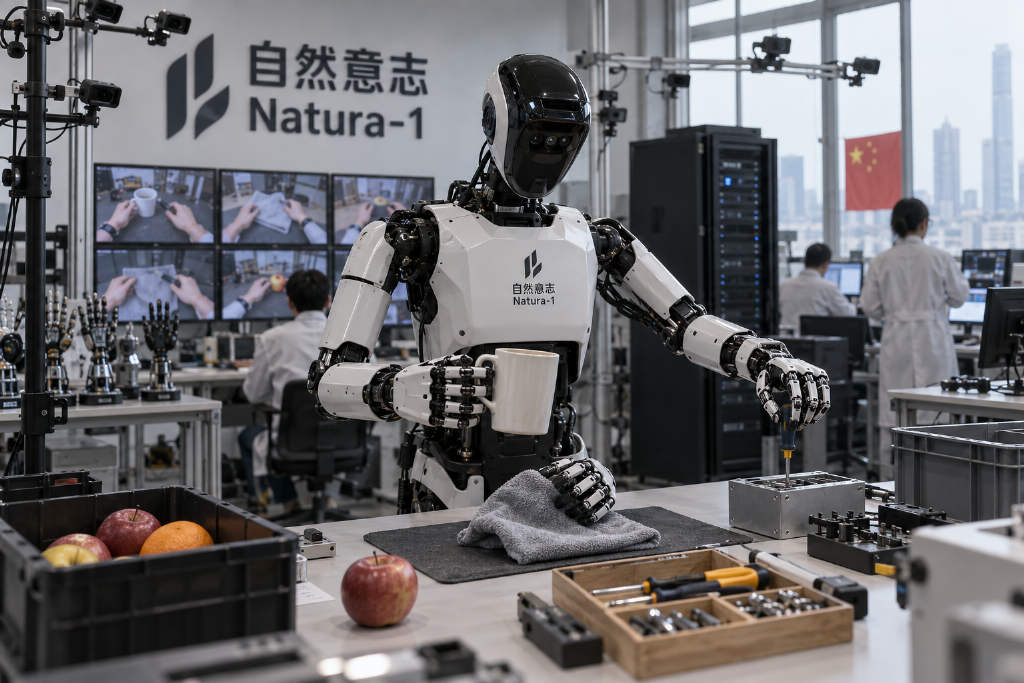
Embodied AI company Natura has released Natura-1, a 50 billion-parameter mixture-of-experts model designed to let robots carry out new tasks from instructions without being retrained for each one.
The company said conventional robot training has largely depended on teleoperating real machines to collect motion data, a process it described as costly and limited in scene coverage. Natura-1 takes a different route: it is first pretrained on 1 million hours of first-person human video, then adapted to dexterous hands with a smaller set of robot data.
According to the release, the dataset contains about 61.7 million action clips across more than 14,000 scenarios. Natura said it reconstructs 3D finger and body motion from video recordings, then annotates task goals and operation steps in multiple layers.
The model puts language, video, and action into a single Transformer and trains them jointly. It learns both what the hand should do next and how the visual scene should change after the action. That setup allows every step in a full operation sequence to serve as training signal, rather than relying only on isolated action snippets.
At runtime, Natura-1 can also use previous frames and real-time feedback to adjust its movements while directly controlling dexterous hands with 20 degrees of freedom on each hand. The team said latency from image capture to action output is kept under 100 milliseconds.
After being adapted to a general-purpose robot, Natura-1 can combine existing skills for new tasks without extra training, the team said. In one example, the training demonstration only showed how to pull out tissues and place them on a tray, but the robot was still able to follow an instruction to pull out a tissue, wipe up spilled water, and throw the tissue into a trash bin.
In another demonstration, the robot selected the correct bottle under a rule that excluded six colors. When picking up a playing card lying flat, it first pushed the card to the edge of the box and then lifted it from underneath.
The team said all of those demonstrations used the same model weights, with no task-specific fine-tuning. It also released a nearly 30-minute single-take video showing daily interactions.