
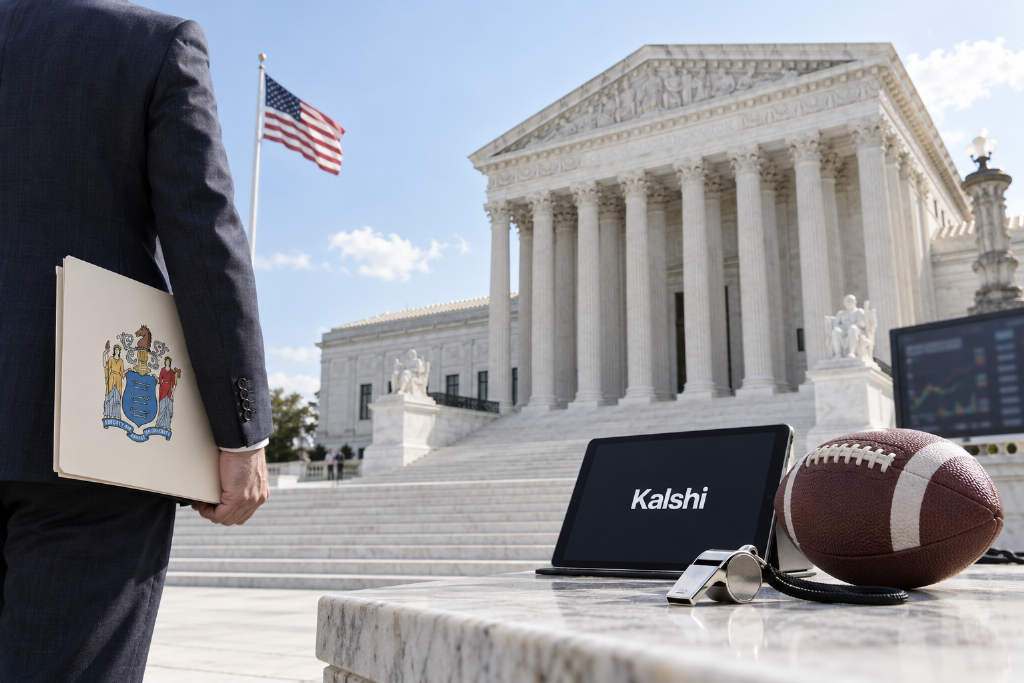
The National Football League told the U.S. Supreme Court on Thursday that sports contracts listed on prediction markets are gambling, not swaps, and asked the justices to take up the issue before another season passes.
The league filed an amicus brief backing New Jersey officials who petitioned the Court in Flaherty v. KalshiEX to review a Third Circuit ruling that favored Kalshi.
In its brief, the NFL said billions of dollars will be wagered on NFL games through prediction markets each season. Any delay by the Court, it wrote, would lead to growing consumer harm and greater risk to game integrity.
The legal question before the Court
The Third Circuit held that Kalshi’s sports contracts are swaps under the Dodd-Frank Act, placing them within the Commodity Futures Trading Commission’s exclusive jurisdiction.
The Sixth and Ninth Circuits reached the opposite conclusion. The NFL aligned itself with those two courts in its filing.
The league argued that Dodd-Frank’s definition of a swap covers instruments used to hedge existing risk, not wagers that create risk mainly for gambling purposes.
It also pointed to the size of the market. According to the brief, $1.8 billion of the $3.3 billion traded across prediction markets on the first Sunday of this NFL season was tied to the NFL.
What the NFL says it wants changed
The NFL said it has urged the CFTC and operators such as Kalshi to ban contracts that one person could easily manipulate, including contracts on whether a kicker will miss a field goal, as well as contracts tied to injuries and officiating.
So far, the league said, those requests have been declined.
The NFL also objected to the CFTC allowing 18-year-olds to trade sports contracts, while states generally set the minimum age at 21. It said the CFTC and exchanges have so far taken a more laissez-faire approach.
Kalshi has partnered with integrity firm IC360 to monitor prohibited bettors. The NFL said it remains unclear how that system could be effective without the league’s involvement.
Kalshi’s response
Kalshi said in a statement that protecting the integrity of its markets is its top priority. The company added that it works with every other major U.S. sports league and integrity partner, including Major League Baseball and the NHL.
Kalshi also said the CFTC is actively policing sports-related markets and that the agency’s ongoing rulemaking addresses many of the NFL’s stated concerns. Its rules, the company said, sit on top of the same broad federal enforcement system that protects trillions of dollars of transactions in U.S. markets.
Gensler and Dodd file briefs
Former CFTC Chair Gary Gensler and former Sen. Chris Dodd, a sponsor of Dodd-Frank, also filed briefs on Thursday.
In his filing, Gensler wrote that Congress did not transfer jurisdiction over sports betting from the states to the CFTC.
Dodd wrote that Congress did not intend to authorize nationwide sports betting through derivatives markets or displace decades of state and tribal primacy over gaming regulation.
Kalshi’s response to the petition is due Nov. 9.