


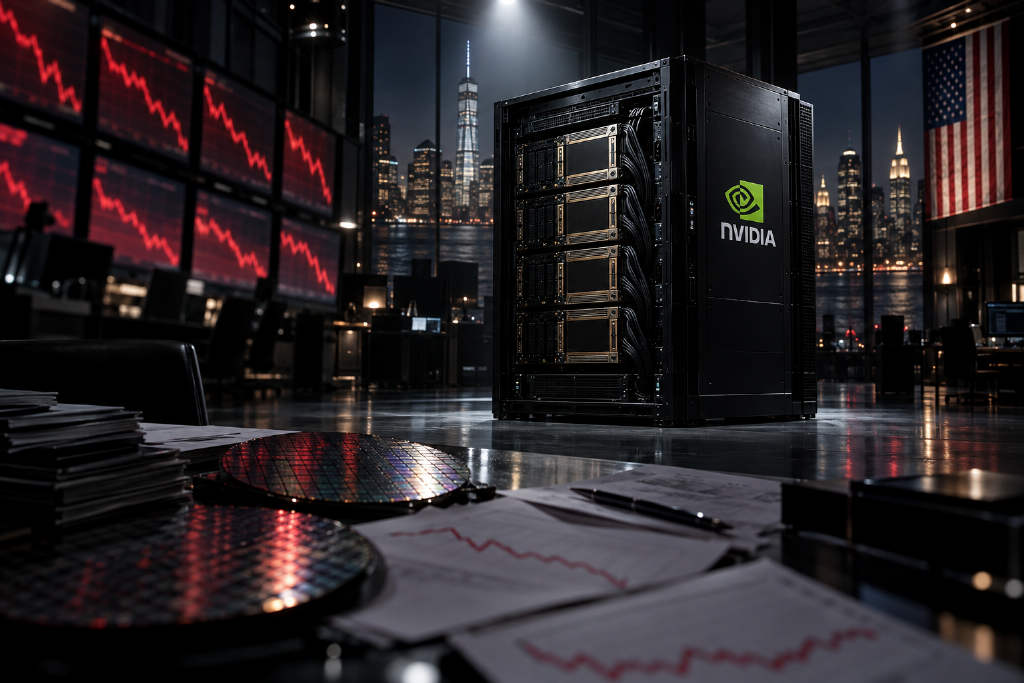
Nvidia is in the middle of a sharp valuation reset after years of enthusiasm around AI computing demand. By the close on Oct. 16, 2026, Nvidia shares were down about 12.02% from the record high reached on Oct. 6. Its market capitalization fell from roughly $5.76 trillion to $5.16 trillion, wiping out about $600 billion in nine trading days, or around 4 trillion yuan.
The weakness spread well beyond one stock. The broader semiconductor sector came under pressure as the Philadelphia Semiconductor Index logged its longest streak of eight straight daily declines since 2008. CNBC said that from Monday through Thursday, Oct. 12 to Oct. 15, the world’s 20 largest AI and semiconductor companies lost about $1 trillion in combined market value. As deleveraging pressure continued on Friday, swings across the sector widened.
The volatility hit multiple parts of the AI supply chain, from hardware suppliers such as Samsung Electronics and SK Hynix to newer compute-rental companies that rely on debt financing to build data centers. The selloff has pushed a familiar question back to the front of the market: after years of rapid expansion in AI infrastructure spending, can commercial revenue from AI companies support capital expenditure on this scale?
The market is repricing AI infrastructure expectations
The report says Nvidia’s latest pullback reflects several forces at once, including changing expectations for commercialization at downstream AI companies, higher macro financing costs, and deleveraging in capital markets. Together, they suggest investors are looking at the AI trade through a different lens.
One key issue is whether revenue growth at AI companies can keep supporting the huge capital outlays required across the upstream compute supply chain. OpenAI, one of the major drivers of demand for Nvidia’s computing products, has become a focal point in that discussion.
According to the Financial Times, OpenAI’s annualized revenue run rate was close to $50 billion as of the end of September 2026. That was about $18 billion below earlier market talk that had placed the figure in a range of $68 billion to $70 billion. The gap fueled debate over how AI companies count revenue and how far commercialization has actually progressed.
In a market still funding aggressive AI infrastructure expansion, weaker-than-expected revenue growth downstream can raise doubts about whether customers will maintain current levels of compute procurement and capital spending. That, in turn, affects judgments about future demand growth for Nvidia GPUs.
The report also notes that annualized revenue, cloud transaction volume, and channel-sharing metrics are not measured the same way across AI companies, so direct comparisons can be misleading. Bloomberg later reported that OpenAI’s annualized revenue could still reach $70 billion by year-end, helped by growth in enterprise business.
Even so, the discussion itself shows where investor attention has shifted. The market had been willing to pay a rich premium for fast growth in compute demand. Now it is paying closer attention to revenue growth, return on investment, and whether downstream income can support long-term expansion across the upstream supply chain.
Higher financing costs and memory supply rumors add pressure
A second source of pressure comes from the macro backdrop. U.S. inflation data came in above expectations, cooling hopes for rate cuts. Data center construction depends on heavy spending on chips, servers, and power infrastructure, so higher rates feed directly into funding costs.
The report uses CoreWeave as an example. The compute-rental company needs to keep investing in data centers, chips, and related infrastructure to expand its business. Its accumulated debt and lease liabilities have also put pressure on cash flow. As investors demand clearer returns from AI infrastructure spending, the financing capacity, debt-servicing ability, and cash-flow profile of highly leveraged companies are facing tougher scrutiny.
At the same time, rumors around memory-chip supply and demand have added another variable. Market discussion about technological progress by Chinese memory makers stirred concern over the future global supply picture. The report says high-bandwidth memory, or HBM, and standard DRAM differ sharply in technical specifications and use cases, and medium- to long-term supply-demand forecasts remain uncertain. Even so, the discussion has disturbed short-term market sentiment.
Deleveraging by institutions amplified the selloff
Changes in industry expectations were only part of the story. A broad reduction in risk exposure by institutional money appears to have magnified the decline in technology shares.
According to a client note issued on Oct. 16 by Goldman Sachs Prime Brokerage, global long-short funds had been net sellers of AI-related stocks for six straight trading days. For leveraged funds with diversified books, rising volatility and higher portfolio risk can trigger risk controls that force them to cut both long and short positions.
That process is commonly described as de-grossing. Over the past few years, as AI-linked stocks kept climbing, some institutions used leverage to amplify returns while pairing longs and shorts to hedge risk. When those stocks fall together and volatility rises, funds may cut both sides of the book to reduce total exposure.
That means even investors who still believe in Nvidia’s long-term growth may sell shares because they need to lower leverage or rebalance portfolios. When many firms do that in a short period, concentrated selling can push prices lower again and create a short-term negative loop.
Nvidia’s own insider trading activity has also drawn attention. Public filings show that some Nvidia executives and directors sold company stock over a prior period. Director Mark Stevens was among the largest insider sellers in the AI sector in the third quarter of 2026. U.S. Securities and Exchange Commission filings show that Stevens made several large stock sales in September alone.
The report adds an important caveat: insider sales often reflect prearranged 10b5-1 trading plans, personal asset allocation, or tax planning. On their own, they are not enough to conclude that management has turned negative on the company’s outlook.
New platform strategy moves ahead, but growth still has to be proven
The stock pullback has not stopped Nvidia from pushing its next-generation computing platform. As AI applications move from model training toward large-scale inference, market attention is shifting from the performance of a single GPU to a broader computing framework that combines chips, CPUs, memory, networking, and software.
At the center of that strategy is Nvidia’s Vera Rubin platform. By integrating the Vera CPU, Rubin GPU, and high-speed interconnect technology, the company is trying to improve computing efficiency and energy efficiency in large AI systems and meet the needs of hyperscale clusters for compute, memory bandwidth, and system coordination.
The report says this shows how Nvidia’s competitive moat has evolved. Its advantage now extends beyond standalone GPU hardware performance into the CUDA software ecosystem, network interconnects, system integration, and deployment tools for large-scale installations. For companies building large data centers, the energy efficiency and deployment efficiency of the full system can matter more than any single chip metric.
Still, technical strength and product iteration do not automatically translate into financial results. Whether the new platform contributes meaningfully to performance will depend on manufacturing and delivery schedules, the scale of customer deployment, and the eventual return on investment. Even if total demand for compute keeps growing, procurement and deployment plans could change if customers decide that new capital spending is not producing matching business revenue.
For Nvidia, the next test is whether stronger computing performance can be turned into measurable economic gains for customers. As AI investment moves into a deeper phase, training and inference costs, energy consumption, and the ability to convert AI into real business income will all shape future purchasing decisions.
Speaking in Berlin, Germany, Nvidia Chief Executive Officer Jensen Huang said he remains confident in AI’s long-term outlook. He said, 「The reason is very simple: AI is transformative. It will have a very positive impact on every industry and every country. There is no question this transformation will continue, and we are only at the beginning.」
The comment is consistent with his long-held view that AI is not a short-lived hardware upgrade cycle, but a technological shift that can reshape how industries operate. For Nvidia, the next key task is to keep customers willing to buy and to make sure the next generation of products delivers the revenue and profit growth the market expects. Whether its growth can continue will depend on whether downstream customers can turn compute spending into real returns and keep paying for the next round of expansion.