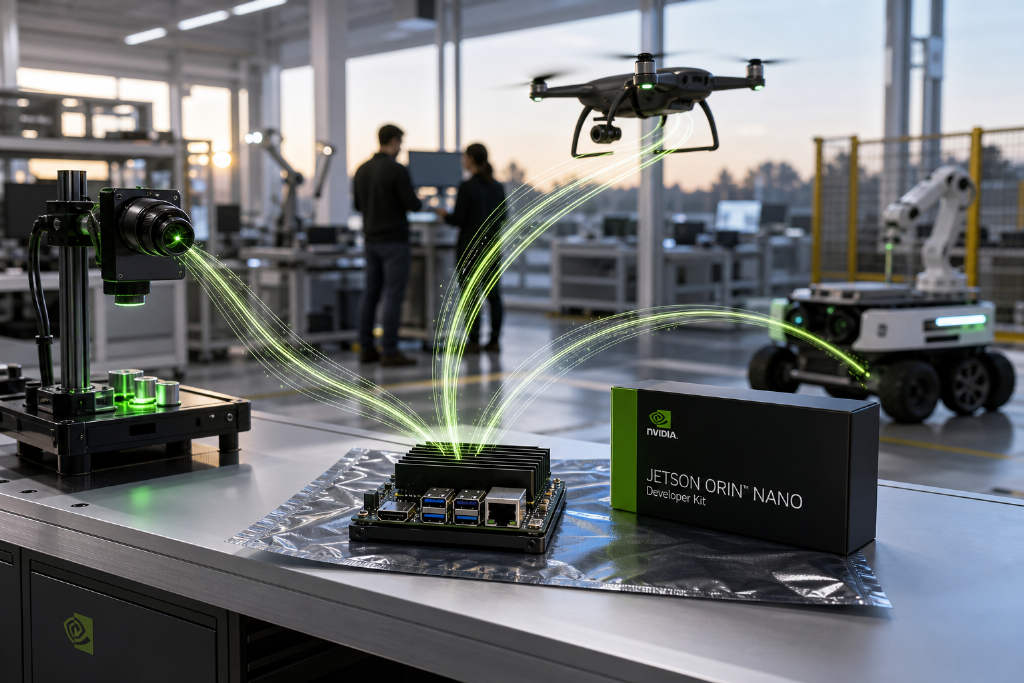
Nvidia has introduced the Jetson Orin Nano 2, an entry-level edge robotics computer aimed at bringing physical AI to drones, robots, and vision systems. The company says the device lets developers run generative AI models directly on-device instead of relying on data centers, a setup designed for real-time inference at the edge.
According to Nvidia, Jetson Orin Nano 2 delivers 78 trillion AI operations per second, along with 8GB of memory and an eight-core Arm CPU. Nvidia also said the new system offers double the inference performance of the current Jetson Orin Nano Super while cutting power consumption by 40% in 15-watt mode.
The hardware supports large language models and vision-language models, including Nvidia’s Cosmos and Nemotron, as well as Gemma 4 and Qwen 3. Nvidia robotics and edge AI vice president Deepu Talla said the product is intended to bring what he described as breakthrough performance to millions of developers.
Companies including Cognex, Doosan Bobcat, and Matic have already started adopting or exploring the platform. Wing, Alphabet’s drone delivery unit, plans to evaluate the system to improve real-time AI perception and inference for faster and safer deliveries, while Matic Robots plans to use it to add conversational AI, gesture detection, and semantic understanding to its home cleaning robots.
Nvidia has launched the Jetson Orin Nano 2, an edge robotics computer built to bring physical AI to drones, robots, and vision systems.
The company is positioning the product as an entry-level option, giving developers a way to run generative AI models directly on-device rather than depending on data centers. Deepu Talla, Nvidia’s vice president of robotics and edge AI, said the computer is meant to deliver what he called breakthrough performance to millions of developers, along with the performance and power efficiency needed for real-time inference at the edge.
Specs and performance claims
Jetson Orin Nano 2 provides 78 trillion AI operations per second, 8GB of memory, and an eight-core Arm CPU. Nvidia said its inference performance is double that of the current Jetson Orin Nano Super, while power use in 15-watt mode is 40% lower.
The hardware is designed to run large language models and vision-language models, including Nvidia’s Cosmos and Nemotron as well as Gemma 4 and Qwen 3.
Early adopters and evaluation plans
Companies including Cognex, Doosan Bobcat, and Matic have started adopting and exploring Jetson Orin Nano 2.
Wing, Alphabet’s drone delivery subsidiary, plans to evaluate the product to improve real-time AI perception and inference for faster and safer deliveries. Consumer robotics company Matic Robots plans to use the hardware to add conversational AI, gesture detection, and semantic understanding to its home cleaning robots.
This article was originally published by Bit.Fan. For more cryptocurrency news and market insights, visit www.bit.fan. Disclaimer:
The market information, project data, and third-party content displayed on this platform are for industry information sharing only and do not constitute any form of investment advice or return commitment.
Cryptocurrency trading carries high risks. Users should fully assess their risk tolerance and make independent decisions. All profits, losses, and legal responsibilities are borne by the users themselves.