HBM4 Bottleneck Lifted, Rubin Platform Poised for Volume Shipments
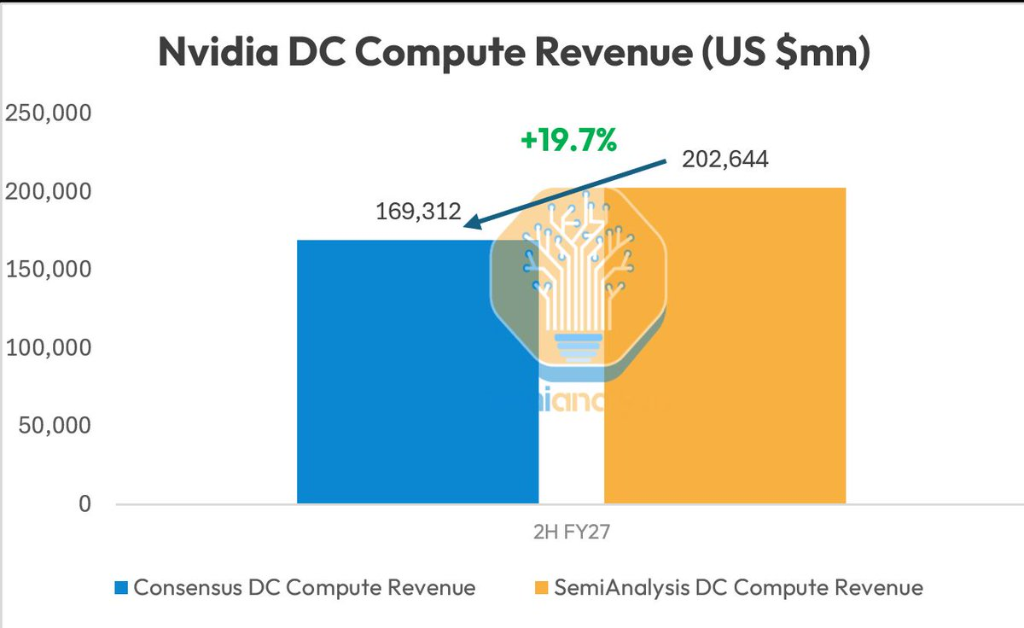
On June 30, semiconductor research firm SemiAnalysis released a bullish prediction on X, forecasting NVIDIA's data center computing revenue for the second half of fiscal 2027 to exceed Wall Street consensus by approximately 20%. The optimism hinges on resolved HBM4 memory supply constraints that had previously delayed Rubin platform mass production, along with front-end wafer capacity secured in advance. SemiAnalysis emphasizes that its Accelerator Model relies on first-hand supply chain intelligence, cross-verifying data from material suppliers, wafer fabs, key components, server OEMs, and hyperscaler procurement, contrasting with traditional sell-side analysts who tend to build conservative earnings forecasts to allow room for beats.
Flagship Rubin Ultra Downsized, CUDA Moat Under Threat
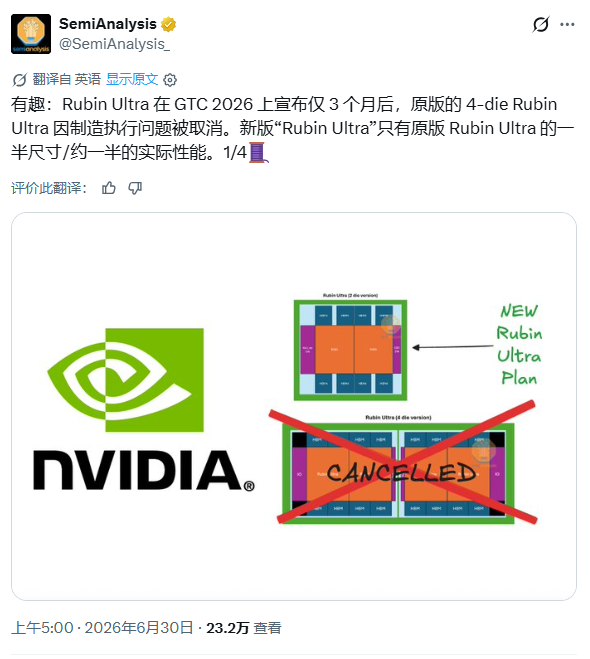
However, earlier the same day, SemiAnalysis revealed a bearish development: NVIDIA's original Rubin Ultra design featuring four compute chips was canceled roughly three months after its GTC 2026 unveiling due to advanced packaging difficulties. The new version shrinks to half the original size, effectively halving performance. More concerning is the gradual erosion of the CUDA moat. For instance, Anthropic now runs a multi-platform AI architecture combining Google TPUs, Amazon Trainium, and NVIDIA GPUs – the majority of Claude model training occurs on TPUs, while Claude Code inference increasingly relies on Trainium, with NVIDIA GPUs reserved for frontier research and general-purpose tasks. SemiAnalysis noted that the scale of TPU and Trainium deployments was unimaginable a year ago, signaling that CUDA's defensibility is slowly weakening.