
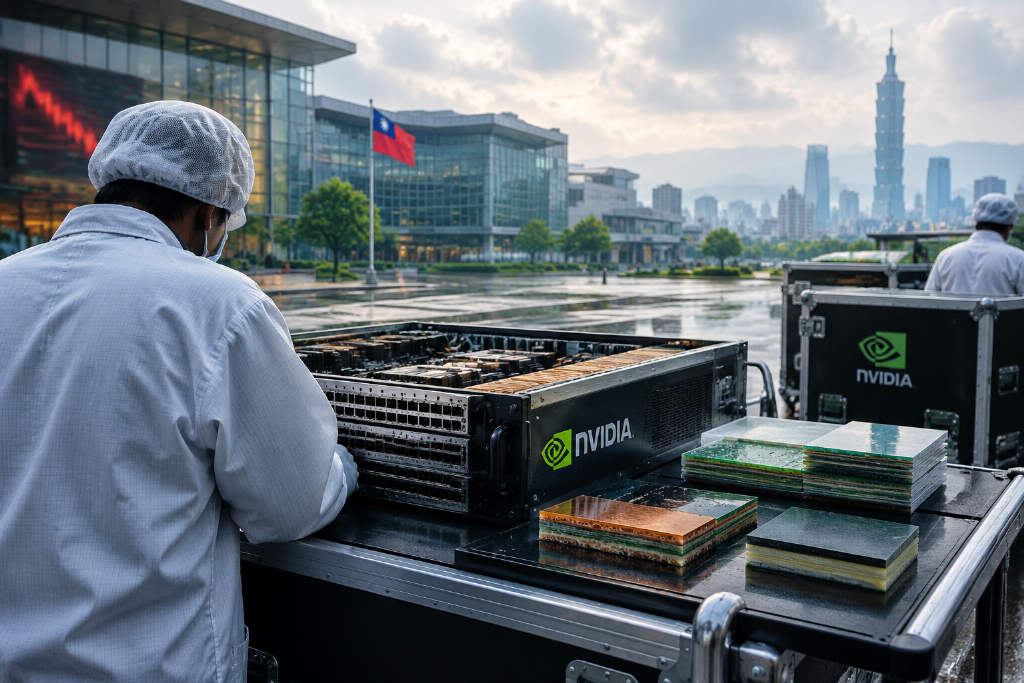
Nvidia is testing a hydrocarbon resin-based clothless copper clad laminate, or CCL, for its next-generation AI server hardware, a shift that put PTFE-linked names under pressure. In a supply-chain survey, TF International Securities analyst Ming-Chi Kuo said Nvidia has started evaluating clothless HC CCL as a replacement for the clothless PTFE CCL used in earlier tests. The work is tied to the Rubin Ultra NVL576 switch tray program, which is scheduled for mass production in the second half of 2027.
After the report emerged, Taiwan Union Technology (8039) fell 3.99%, while Asia Electronic Material (4939) dropped 4.71%. Kuo said the latest test result does not represent a final material decision and does not mean Nvidia has fully moved away from PTFE.
Nvidia swaps PTFE CCL for HC CCL in the latest test round
Kuo said the earlier NVL576 switch tray test setup used clothless PTFE CCL together with clothless HC prepreg, or PP. In the latest round, Nvidia replaced the PTFE CCL with clothless HC CCL while keeping the same PP part number. He said the likely reason was to improve PCB manufacturing yield and production efficiency.
The result showed that clothless HC CCL met the switch tray’s high-frequency electrical requirements. Its electrical performance was still below the original PTFE option, but it was better than the M9-grade solution and even exceeded the published M10 specification. Kuo stressed that this is still not the final material selection.
Shengyi Technology leads the current material evaluation
On the supplier side, China’s Shengyi Technology (600183.SS) is the leading participant in the current NVL576 switch tray material evaluation. The material references involved are SG5300N for clothless PTFE CCL, SG1030N for clothless HC CCL, and SIF09 for clothless HC PP.
Future testing may also assess whether HC PP reinforced with glass fiber cloth can replace the clothless version. The key question is whether the material can still meet signal integrity and loss requirements after glass fiber is added.
Kuo also noted that SG1030N and SIF09 still contain a small amount of PTFE, even though HC is the main resin. That means the latest test has not fully removed PTFE from the material stack. Instead, it adjusts the main resin system and material combination in an attempt to balance electrical performance and yield.
Why the industry is pushing clothless designs
The move toward clothless materials is tied to signal integrity demands at higher speeds. Traditional glass fiber introduces a weave effect and uneven dielectric constants. Removing the glass cloth can help reduce signal attenuation.
Taiwan-based senior PCB industry analyst kokycpcb said Nvidia’s testing appears to follow a dual-track approach:
- Preferred option: PTFE CCL with clothless PTFE PP or HC PP, offering the best electrical performance but with more difficult processing.
- Transition option: HC CCL with HC PP, both clothless, with a process window that is easier to control.
He added that Shengyi Technology is currently the only supplier on the HC route, while Taiwan CCL makers have not yet mass-produced clothless HC CCL for shipment.
Debate remains over whether HC can really improve yield
Views in the market are split on whether HC can solve yield issues. Zephyr, a researcher at Citrini, said hydrocarbon resin has very low polarity, and its dielectric constant and dissipation factor are indeed much lower than those of glass fiber. But he also said hydrocarbon-based CCL is relatively soft, making it harder for the PCB to stay rigid. Its coefficient of thermal expansion, or CTE, is high, which raises warpage risk, and its low polarity also makes copper foil adhesion more difficult.
Zephyr said the technology is still immature and that yield may end up worse than PTFE. He also questioned how the industry could solve those issues in the short term.
PTFE-linked stocks fall while major traditional CCL names stay flat
After Shengyi Technology, Taiwan Union Technology is the world’s second-largest PTFE CCL supplier and the only company that fully replaces glass fiber cloth with pure PTFE filler. Asia Electronic Material uses an M10-grade PTFE hybrid material together with existing M9 prepreg, rather than a fully clothless structure. Because both companies are positioned around PTFE, they became the main stocks under pressure after the report.
Following the news, Taiwan Union Technology fell 3.99% and Asia Electronic Material dropped 4.71%. The three major traditional CCL names — ITEQ (6213), EMC (2383), and TUC (6274) — were broadly flat.
Final material choice and production progress remain the main variables
Looking ahead, Kuo said PTFE remains a long-term trend in advanced PCB materials. Even so, shipment growth over the next two years is still uncertain. The variables include the final material choice for the NVL576 switch tray, the adoption rate of NVL576, and the progress of Kyber-class rack designs that use orthogonal backplanes.
Nvidia’s final selection and the yield performance of HC remain the key factors for PTFE-linked stocks.