
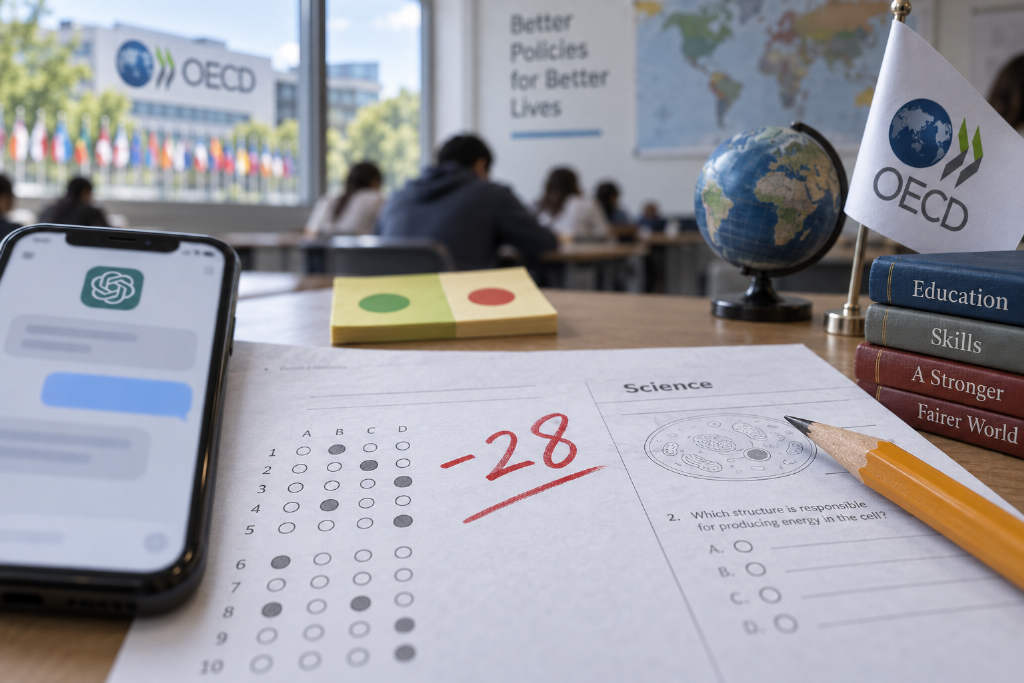
The Organisation for Economic Co-operation and Development (OECD) said in its PISA 2025 results released on Sept. 8 that students who use AI for homework every day or almost every day scored noticeably lower than peers who rarely or never use it in that setting. Students who used AI about once a week for learning, however, performed the best.
PISA 2025 was the largest assessment in the program’s history
The test was the first PISA round conducted after generative AI became widely available. It covered more than 760,000 15-year-old students across 91 countries and economies, and measured performance in science, mathematics and reading. OECD described it as the biggest PISA assessment on record.
Daily AI homework use was tied to a 28-point science gap
In tasks such as drafting essays, students who never or almost never used AI scored 509 points in science, while those who used AI every day or almost every day scored 481 points. After adjusting for socioeconomic status, the gap was 28 points. The report said that difference was equal to about one and a half years of schooling.
When all use cases were averaged together, the science-score gap between AI users and non-users was about 20 points, or roughly one year of learning.
Taiwan ranked among the top group as broader performance trends weakened
Taiwan was listed in the top-performing group alongside Singapore, multiple provinces and municipalities in China, Estonia, Japan, South Korea, Macao and the United Kingdom. At the same time, OECD warned that broader academic performance has continued to deteriorate. From 2015 to 2025, PISA reading scores fell by 28 points and mathematics scores fell by 22 points, while the share of low-performing students rose from 16% to 20%. OECD said that downward trend did not stop after AI became widespread.
OECD said the issue is not AI itself, but cognitive offloading
OECD education and skills chief Andreas Schleicher offered a direct explanation. Watching sports does not make someone healthy, he said; people need to get onto the field themselves. Learning works the same way. It does not happen at the moment content is consumed, but during the struggle between the mind and new material.
The report described that process as cognitive offloading. In practice, that means students hand difficult tasks to AI and stop trying to work through them on their own. The few minutes spent getting stuck while drafting an essay, or the moment a student has to summarize a paragraph independently, are exactly where learning happens.
Schleicher argued that AI should serve as scaffolding rather than a crutch. If technology pushes students into that cognitive struggle or strengthens it, students can improve. If it skips that stage, the cost shows up in the score gap.
Once-a-week use showed the best results, and training added 13 points
The data did not point in only one direction. For the use case described as “using AI to help me learn,” students who used AI once a week performed the best, at about 500 points. That was higher than both students who never used it and those who used it daily, forming an inverted U-shaped curve.
Another result stood out. Among students who used AI every day, those who regularly received classroom training on how to evaluate AI-generated information recovered 13 points in science scores. The report said that gain was worth more than half a year of schooling.
OECD said 46% of students in OECD countries now use an AI chatbot at least once a week, while the global share of daily users remains below 20%. Usage also varies sharply by country: in Japan, about 40% of students never or almost never use AI, compared with about 4% in Vietnam.
According to the report, countries are now trying two paths at the same time: direct bans, or spending time teaching students how to use AI.