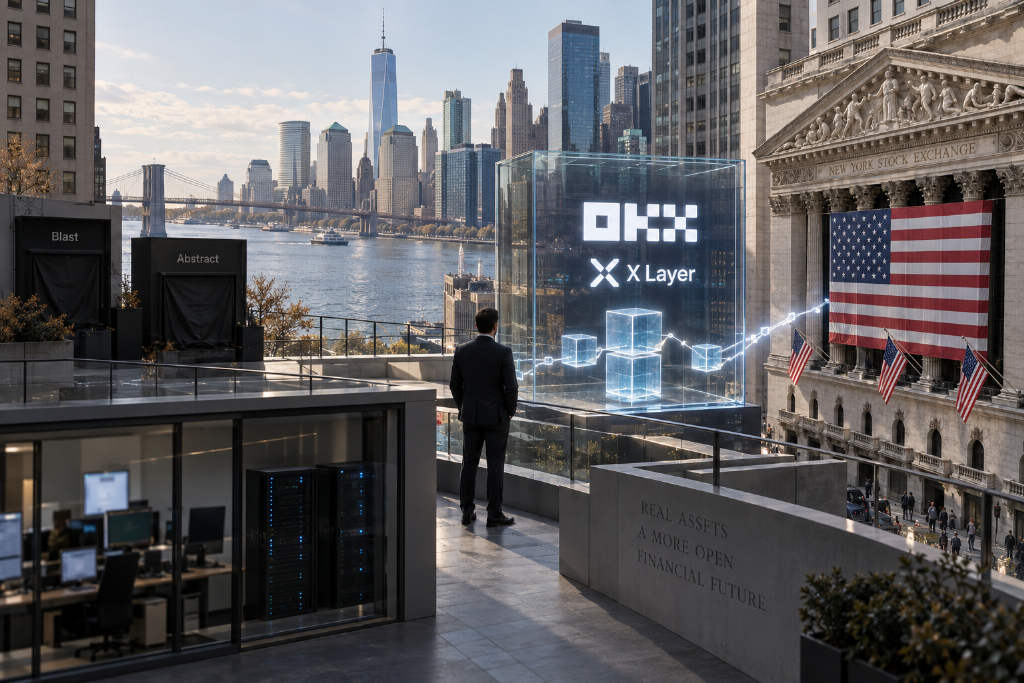
A joint venture backed by OKX and the parent company of the New York Stock Exchange has filed with the U.S. Securities and Exchange Commission to launch a tokenized U.S. stock trading platform on X Layer, OKX’s layer-2 network. The filing comes as two layer-2 projects that once drew heavy attention in the NFT market, Blast and Abstract, have announced they are shutting down.
Blast and Abstract lose momentum after high-profile starts
According to Foresight, Blast was an Ethereum layer-2 network launched by the team behind Blur, the NFT marketplace that rose quickly through a transaction mining model and overtook OpenSea in trading volume. After that surge, the team rolled out Blast and used token expectations and mining incentives to pull users and applications into the network.
Abstract also came with a notable pedigree. Its team was behind the revival of Pudgy Penguins, turning what had been a purely on-chain NFT project into one with both on-chain and offline business models. Building on that momentum, the team used a token airdrop to bring fresh attention to NFT activity on-chain and then launched the Abstract layer-2 ecosystem.
The article says both networks entered the market with strong visibility. While Blast did not have a roadmap as clear or direct as Abstract, which was positioned around a gaming ecosystem, neither lacked early attention compared with many other layer-2 projects that were already operating at the time.
Even so, both projects ended up closing. Foresight’s central argument is that neither built applications or a business model capable of producing sustainable profit.
Infrastructure alone does not solve the L2 business problem
The article says layer-2 networks can provide the technical conditions and base infrastructure needed to pursue ambitious goals, especially as Ethereum mainnet continues to improve performance and security. But technology on its own does not create steady cash flow, and it does not give a project lasting vitality.
In that reading, the shutdowns of Blast and Abstract are not isolated cases. The same issue stands in front of every L2 project.
X Layer turns to tokenized equities
As those once-prominent layer-2 networks fade, X Layer appears to be taking a different route. Foresight says the joint venture formed by OKX and the NYSE parent has already filed with the SEC for a tokenized stock trading platform, with the aim of entering the on-chain equities market.
The article lays out two points. First, if on-chain stock trading can fully replace, or even replace a large share of, today’s centralized stock trading market, the sector could have major room to grow on the strength of that use case alone. Second, the space is likely to attract many entrants, and major firms are unlikely to stay out.
It argues that the move by OKX and the NYSE parent already supports the second point.
Robinhood Chain remains a key test case
Whether the first point will hold is still unclear, the article says, and Robinhood Chain is one of the networks worth watching closely.
Citing DefiLlama data, it says Robinhood Chain drew users through meme coin and stock-token trading pairs and reached a peak trading volume of $3.5 billion on Sept. 4. A month later, daily volume was only about $1 billion, less than one-third of that peak.
The article estimates that one important reason for the drop may be fading sentiment in meme coin trading. If that estimate is correct, it would at least suggest that sentiment is still the main force behind activity in tokenized stock trading at this stage.
That is not the same as durable demand. Foresight says the next major test for Robinhood Chain, X Layer and every team that has entered or plans to enter this market is whether tokenized stock trading can find a real use case that supports a lasting business model.
The article ends with a risk warning, saying the market carries risk and the piece does not constitute investment advice. Readers should consider whether any opinions, views or conclusions in the article fit their own circumstances and bear responsibility for their own investment decisions.