
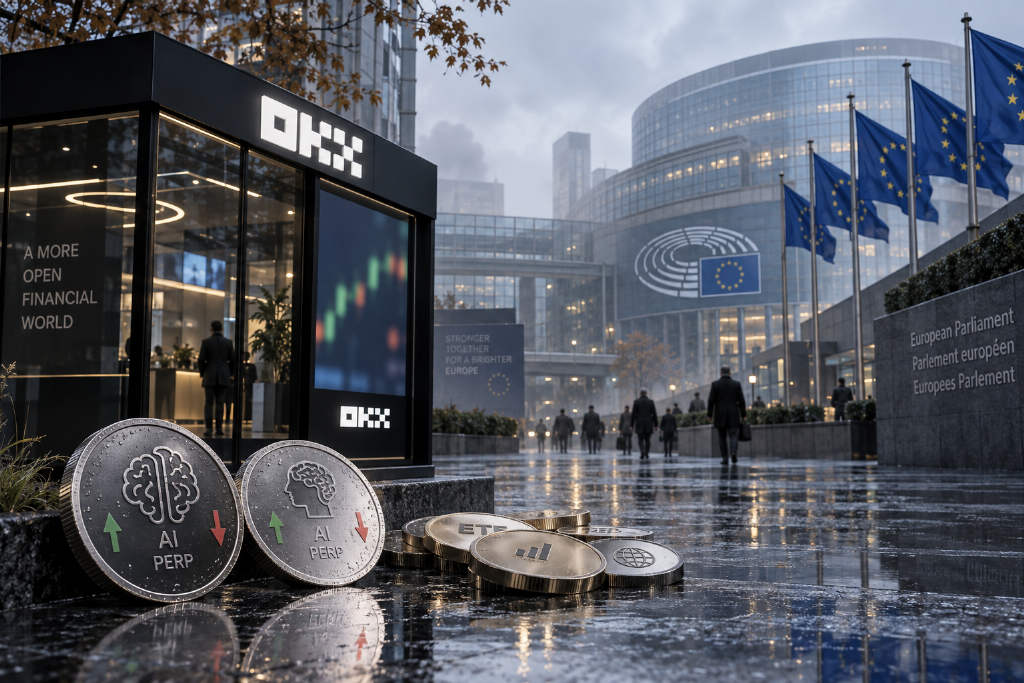
OKX said on Sept. 10 that it has launched pre-IPO perpetual contracts linked to OpenAI and Anthropic in Europe, allowing traders to go long or short on changes in the valuations of the two AI companies with up to 10x leverage. The contracts do not require users to own any equity in either company.
The product is not unique to OKX. Hyperliquid had already listed related contracts for OpenAI and Anthropic through its HIP-3 framework, and Binance also offers pre-IPO perpetuals tied to the two companies. OKX’s entry suggests the segment is moving beyond early experimentation and into direct competition among larger exchanges.
These contracts track valuation moves, not ownership
The basic structure is straightforward. A pre-IPO perpetual contract follows the latest valuation of a private company, typically based on pricing from its most recent funding round. What traders are taking a position on is the rise or fall in that valuation, not the company’s shares themselves.
For retail traders, that creates one of the few available ways to gain direct exposure to valuation swings in private companies such as OpenAI and Anthropic. Under the traditional route, access to private-company equity usually comes through fundraising rounds or secondary-market transactions, both of which carry high entry barriers and often require accredited-investor status and sizable minimum checks.
Still, these instruments are not stocks and do not represent equity. Holders do not receive voting rights, and a future IPO would not automatically convert the contracts into shares. The product is a derivative built purely around valuation changes.
OKX says Europe derivatives volume rose 4x after MiCA transition ended
Erald Ghoos, CEO of OKX Europe, said in the announcement that trading volume for the platform’s X-Perps derivatives business in Europe has increased fourfold since the transition period under the European Union’s Markets in Crypto-Assets Regulation, or MiCA, ended in July.
His remarks point to a compliance-driven expansion story: a clearer regulatory framework, as described in the source material, has given both retail and institutional participants more confidence to trade crypto derivatives on regulated venues.
100 tokenized stocks and ETFs launched at the same time
Alongside the pre-IPO contracts, OKX also introduced 100 tokenized stocks and ETFs. The lineup includes Nvidia, Alphabet, Palantir, as well as index-tracking products such as SPY and QQQ.
These tokens mirror the price action of the underlying assets but do not grant actual ownership or voting rights. The source material says some of them can be withdrawn from OKX to self-custody wallets.
Tokenized equities competition in Europe is widening
Tokenized equities remain one of the most active branches of the real-world asset, or RWA, market, and the competitive map is becoming clearer.
- Kraken: working with Nasdaq through the xStocks initiative to connect on-chain and off-chain markets, while already allowing tokenized stocks and ETFs to be used as collateral so users can open leveraged positions without selling their holdings.
- Binance: its bStocks product reached about $118.5 million in size within two months, making it the second-largest issuer and accounting for about 90% of on-chain stock DEX trading volume.
- OKX: using the post-MiCA compliance environment to list 100 tokenized instruments at once and compete directly with the other two in Europe.
The report also notes that traditional entertainment companies including AMC have strongly opposed tokenized stocks, arguing that such instruments sidestep the U.S. Securities and Exchange Commission framework. Even so, exchanges including Kraken, Bullish, and OKX are continuing to push into the area. The rationale cited in the source is clear: 24/7 trading, on-chain composability, and lower barriers to entry than traditional brokerages can offer.
Key risks: opaque valuations, uncertain liquidity, and leverage
The source highlights several risks tied to pre-IPO contracts. One is valuation opacity. Private-company valuations are derived from fundraising rounds, are updated irregularly, and may be heavily influenced by a single large financing event.
Liquidity is another issue. Unlike publicly traded stocks, liquidity in pre-IPO perpetuals depends on the exchange’s market-making depth. If trading activity is thin, slippage can widen sharply.
Then there is leverage. At 10x, a 10% drop in valuation can be enough to trigger liquidation. The source says OpenAI and Anthropic can see large valuation swings, with AI-sector news, competitive developments, and regulation all cited as possible factors. That leaves little room for error in highly leveraged trades.
With the simultaneous push into pre-IPO derivatives and tokenized equities, OKX is adding more assets that are hard to access through traditional channels into an on-chain trading framework.