


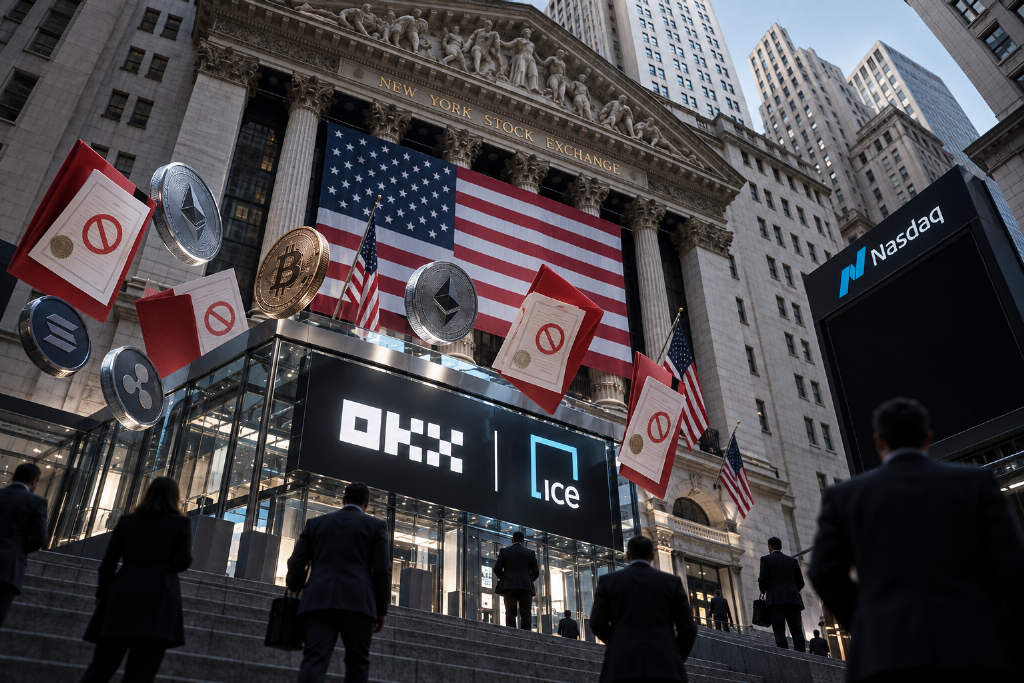
Nine U.S.-listed companies have formally objected to having their shares traded as tokenized stocks on OKXICE, less than two weeks after the platform notified the U.S. Securities and Exchange Commission of its plan on Oct. 4.
OKXICE is a joint venture owned equally by OKX and Intercontinental Exchange, or ICE, the parent company of the New York Stock Exchange. The companies opposing the plan are Cerebras Systems, Broadcom, CoreWeave, Verizon, UnitedHealth Group, AppLovin, Applied Digital, Rocket Lab and Applied Optoelectronics.
The objections put fresh pressure on the idea of 24/7 trading for tokenized U.S. equities, with listed companies themselves now questioning how such markets would work.
Companies raise concerns over uncertainty
The official notice did not spell out the reasons behind the objections. Applied Optoelectronics, however, gave the clearest explanation in comments to The Wall Street Journal.
The fiber-optics manufacturer said it could not determine how tokenized trading might affect its share price, liquidity and volatility. It also said investors could be misled into believing the tokens were issued or endorsed by the company.
The company said it saw no argument showing a clear benefit to AOI or its shareholders that would justify that uncertainty.
OKXICE says the rollout will continue
Eight of the nine companies were included in OKXICE’s first list of 63 target stocks announced on Oct. 4. Cerebras was not on that list but still chose to object, suggesting the pushback was not limited to companies that had already been named.
In its response to The Wall Street Journal, OKXICE said it still plans to launch dozens of tokenized U.S. stocks, including Nvidia, Apple, Microsoft, Amazon, Alphabet, Tesla, JPMorgan Chase and Walmart. The objections did not stop the broader project, but the disputed names will be removed from the lineup for now.
Andrew Cuomo, co-chair of OKXICE and former governor of New York, said in a recent Wall Street Journal interview that he expected some companies to be skeptical of tokenized stocks. He described the area as 「the first step for tokenized securities」.
Nasdaq declines to participate
Nasdaq’s position drew even more attention. In an FAQ posted on its website, the exchange said it would not allow Nasdaq, or NDAQ, shares to be traded as tokenized stocks under the SEC’s innovation exemption framework.
Nasdaq said it does not want its stock trading in a venue that does not display the best price in real time and does not report trades to the consolidated tape.
At the same time, Nasdaq said that stance should not be read as opposition to tokenization itself. According to the report, the SEC approved Nasdaq’s pilot for tokenized stock trading earlier this year.
That position echoes concerns Citadel Securities raised in a letter to the SEC last year, warning that a 「shadow U.S. stock market」 operating outside national market system pricing and transparency rules could create price divergence and regulatory gaps.
The SEC’s 30-day objection process
The current wave of objections is tied to the SEC’s innovation exemption, released on Sept. 17. The order is valid for five years and allows venues for tokenized securities to trade tokenized U.S. stocks without registering as exchanges.
Under the framework, when a third party rather than the listed company itself wants to tokenize a stock, the venue must notify the company at least 30 days before trading begins. The company then has 30 days to file an objection.
If the objection succeeds, that venue cannot trade the tokenized version of the stock. The objection applies only to the venue that sent the notice, however. A different venue would start a new 30-day clock.
That means silence functions as consent. Companies do not need to actively approve a listing for the process to move ahead.
Brett Redfearn, president of Securitize, told The Wall Street Journal that a company can object to one venue without rejecting tokenization across the board. Rodrigo Seira, a partner at Cooley, said the SEC is using the exemption to gather information that could support permanent rules in the future. In that sense, the current objections are themselves part of the data the agency is watching.
Market size keeps growing
Data from The Block showed the total market capitalization of tokenized stocks was about $3.5 billion on Oct. 15, up more than fivefold from $680 million at the start of the year. The report said most of that growth came from offshore markets and from stock-token products offered by platforms such as Robinhood. Those products are offshore debt securities in structure, not direct tokenized U.S. equities.
Morgan Stanley also said recently that it expects to begin supporting tokenized stock trading in the first quarter of 2027, a sign that large traditional finance firms have not stepped back from the sector despite the latest objections.