A New Heavyweight Enters the Stablecoin Arena
On June 30, Open Standard, an newly formed company, unveiled its plan to launch a new dollar-pegged stablecoin, Open USD, slated for release later this year. The accompanying partnership list includes 140 enterprises spanning payments (Visa, Mastercard, Stripe, Adyen), finance (BlackRock, BNY, DBS, Standard Chartered, Mizuho), tech (Google, Shopify, IBM), and crypto (Coinbase, OKX, Bybit, Ripple, Fireblocks, MetaMask). This coalition covers multiple sectors, positioning Open USD with an unprecedented starting advantage.
Disruptive Economics: Zero Fees + Revenue Sharing
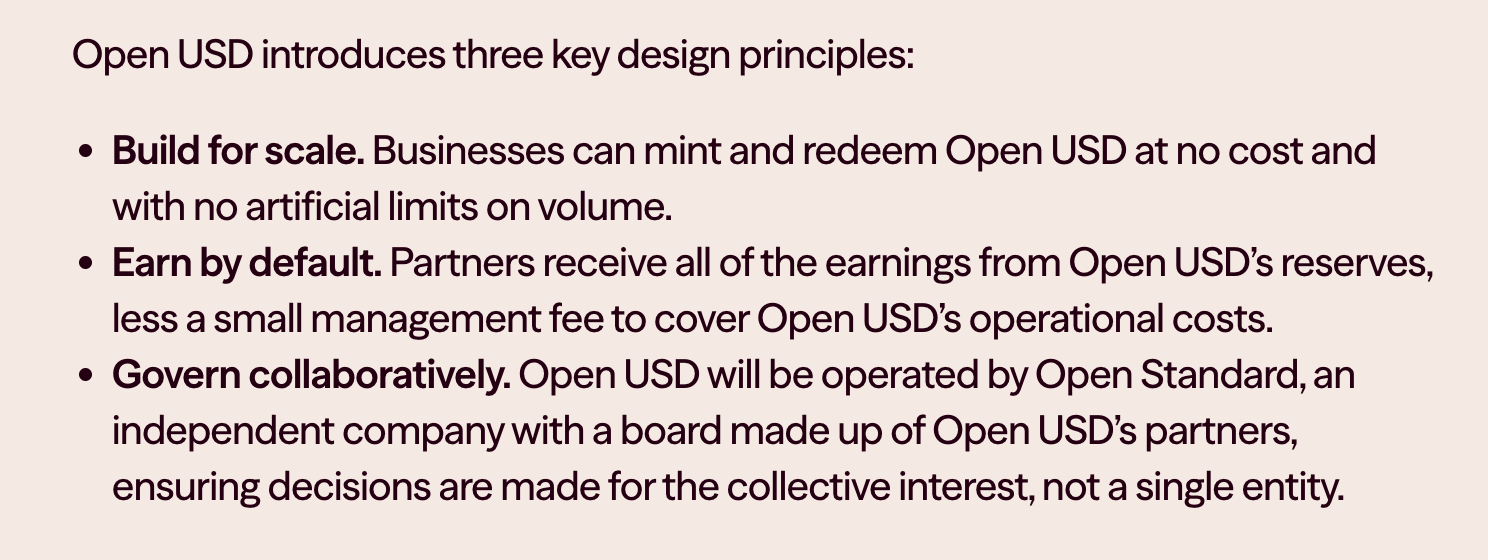
Open USD differentiates itself from incumbent stablecoins like USDC and USDT with two key innovations. First, enterprise users can mint and redeem unlimited amounts at zero cost, significantly reducing friction for large-scale capital flows. Second, and most critically, the yield generated from reserve assets (e.g., U.S. Treasuries) will be passed back to partners, with Open Standard charging only a small management fee. This starkly contrasts with Circle's model, which retains the majority of reserve income—one of its primary profit engines. The design incentivizes partners to adopt and promote Open USD, creating a virtuous cycle.

Neutral Governance: Industry Infrastructure, Not a Proprietary Product
Open USD will be managed by Open Standard, but a board comprising partners will oversee major decisions, a model dubbed "Neutral Governance." The goal is to position Open USD as open industry infrastructure rather than a product owned by any single company. This approach aims to address trust and centralization concerns in the stablecoin space by granting participants shared governance and economic benefits.

Circle Hit by Double Whammy: Competition Escalation and Index Exclusion
Following the announcement, Circle's stock (CRCL) tumbled 17.55% in a single day, its steepest decline in recent memory. Beyond Open USD's competitive threat, FTSE Russell removed Circle from five major Russell growth index benchmarks in its annual reconstitution, directly impacting institutional holdings. Market concerns center on whether USDC's moat—built on first-mover advantage, regulatory compliance, and network liquidity—remains defensible when a consortium of heavyweight players joins Open Standard. If enterprises can obtain comparable compliance and network access while also sharing reserve yield, why continue to fuel Circle's network? While Open USD won't immediately erode USDC's market share (launch is later this year), capital markets have begun to price in this possibility. The CRCL plunge reflects investor reassessment of Circle's business sustainability.