
Open USD Launches with 140 Corporate Partners: A New Chapter for Stablecoins
On the evening of June 30 (Beijing time), a new company called Open Standard announced the upcoming launch of Open USD, a dollar-pegged stablecoin scheduled to go live later this year. What sets this announcement apart is the simultaneous reveal of an impressive partner roster comprising 140 enterprises across payments (Visa, Mastercard, Stripe, Adyen), finance (BlackRock, BNY, DBS, Standard Chartered, Mizuho), technology (Google, Shopify, IBM), and crypto (Coinbase, OKX, Bybit, Ripple, Fireblocks, MetaMask). The broad coverage across payments, banking, internet, and digital assets signals that Open USD enters the market with unprecedented institutional support from day one.
Open Standard positions Open USD as a 'global money movement' stablecoin, offering enterprises a lower-cost, more open on-chain dollar infrastructure. The market reaction was swift: shares of Circle (CRCL) — the issuer of USDC — plummeted 17.55% in a single day, marking one of the steepest declines in recent memory. The market now views Open USD as a formidable competitor that could disrupt the stablecoin duopoly of USDC and USDT.
Differentiated Design: Zero-Cost Mint/Redeem & Shared Reserve Yield
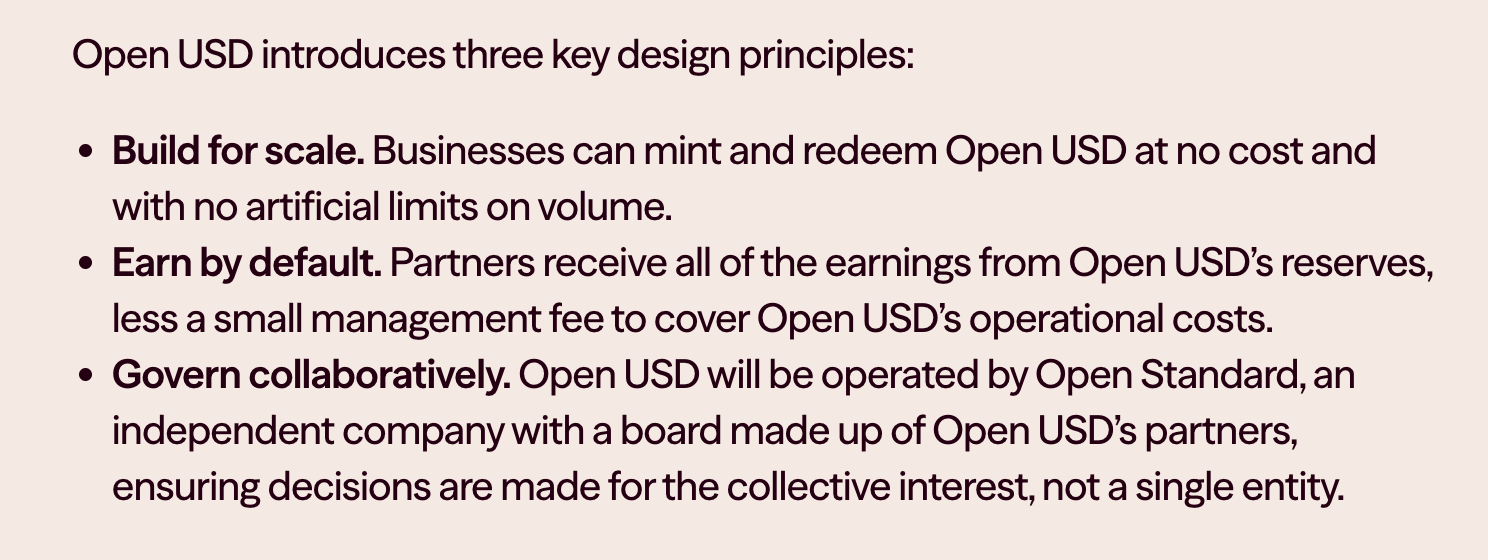
While Open USD is another fiat-collateralized stablecoin pegged to the U.S. dollar, its issuance and operational mechanisms differ fundamentally from USDC and USDT. First, Open USD offers zero-cost minting and redemption: enterprise users can issue and redeem stablecoins without limits and with zero fees, eliminating scale requirements. For payment processors and financial institutions handling large volumes, this dramatically lowers capital costs and the barrier to adopting stablecoins as payment infrastructure.

The most critical differentiator lies in the distribution of reserve asset income. Currently, most stablecoins (including USDC) invest user deposits into low-risk assets like U.S. Treasuries, with the interest income accruing primarily to the issuer — this is Circle's most important profit source. Open USD, by contrast, automatically returns reserve yield to its partners, with Open Standard charging only a small management fee to cover operational costs. In other words, the income that was previously captured by the issuer is now redistributed to the entire ecosystem of partners.
Furthermore, Open USD is not controlled by a single entity. Open Standard manages the protocol, while partners form a board of directors to oversee future direction and major decisions. The company calls this model 'Neutral Governance,' aiming to build Open USD as an open infrastructure for the industry rather than a proprietary product.
Circle's Moat Under Real Threat: Market Rerating Begins
Previous attempts to challenge USDC have largely failed because stablecoins are not won on technology alone — trust, regulatory compliance, and adoption are the true moats. Circle has long embraced regulation, becoming one of the most compliant stablecoin issuers in the U.S., while USDC enjoys deep integration with Coinbase, Visa, Stripe, Robinhood, and countless exchanges and wallets. However, Open USD arrives in a unique position: it already counts many of USDC's key ecosystem participants (Coinbase, Visa, Stripe) among its partners. These enterprises themselves are the most important potential users and promoters of stablecoins.

USDC's greatest advantage was being the default institutional choice for on-chain dollars. But when a critical mass of heavyweights collectively decide to build a new standard, the market must reassess: if an enterprise can obtain similar compliance, similar network coverage, and also share in stablecoin reserve income, why continue to help Circle grow USDC's network?

Notably, CRCL's plunge was amplified by an additional negative factor: FTSE Russell removed Circle from five major Russell growth indices during its annual rebalancing, a direct blow to institutional holdings. The dual headwinds pushed the stock down over 17% in one day.

While Open USD will not launch until later this year — so the short-term impact on USDC market share is limited — the market is now questioning whether USDC's moat (built on first-mover advantage, regulatory compliance, and liquidity network) remains secure. If enterprises can collectively issue a stablecoin and share reserve income, can Circle continue to capture the full upside of stablecoin growth? There are no clear answers yet, but CRCL's sell-off indicates the market is re-pricing this risk.