Open USD Emerges with a Stellar Partner List
The stablecoin sector welcomes a heavyweight new entrant. On June 30, Open Standard announced the upcoming launch of Open USD, a new dollar-pegged stablecoin expected to go live later this year. The announcement came with a partner list of 140 companies spanning payments (Visa, Mastercard, Stripe, Adyen), finance (BlackRock, BNY Mellon, DBS, Standard Chartered, Mizuho), technology (Google, Shopify, IBM), and crypto (Coinbase, OKX, Bybit, Ripple, Fireblocks, MetaMask).
Zero-Cost Minting and Reserve Yield Redistribution
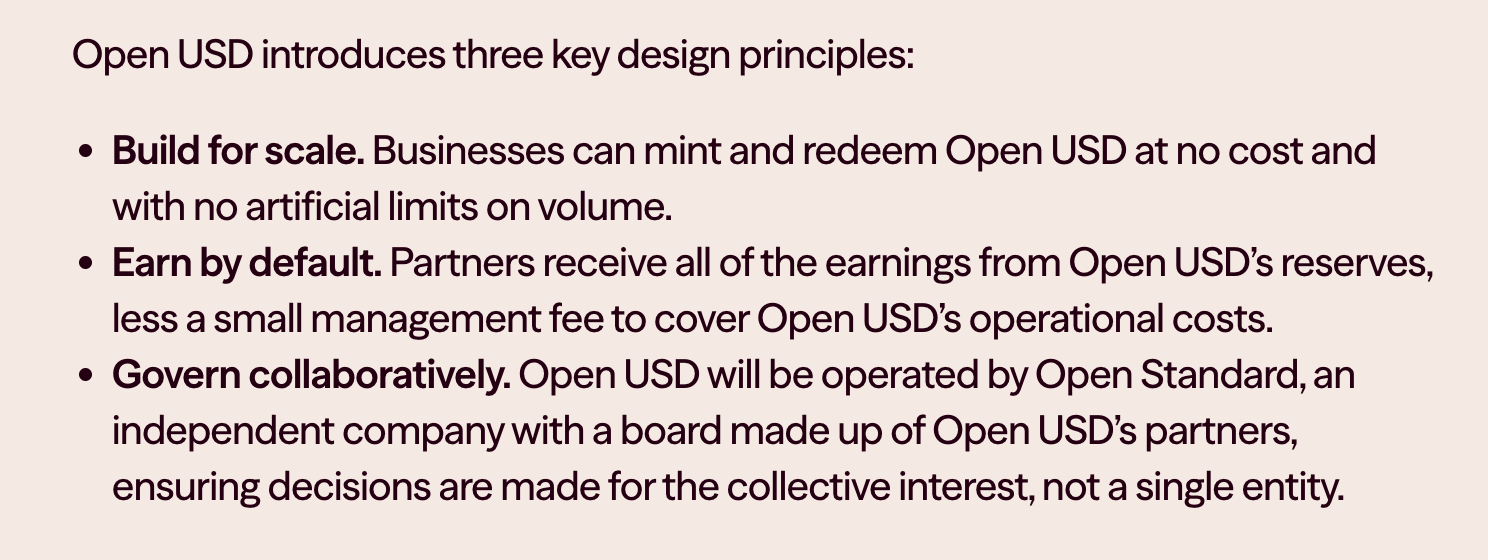
Open USD's design directly challenges Circle's dominance. First, enterprise users can mint and redeem unlimited amounts with zero fees, significantly reducing capital costs for large-scale fund flows. Second, and more critically, the yield from reserve assets (such as U.S. Treasuries) will be returned to partners by default, with Open Standard charging only a small management fee. This stands in stark contrast to the traditional model where issuers like Circle (USDC) and Tether (USDT) keep most of the reserve income, which constitutes a major revenue stream for Circle.

Neutral Governance vs. Circle's Moat
Open Standard describes its model as "Neutral Governance" – a board composed of partner companies that collectively decide future direction and major decisions, positioning Open USD as an open infrastructure rather than a proprietary product. Previous attempts to challenge USDC failed primarily due to lack of trust, regulatory compliance, and adoption. However, Open USD starts with a built-in network of partners that are already key players in the USDC ecosystem. The market is now questioning: if enterprises can achieve similar compliance and network coverage while also sharing reserve yields, why would they continue to help Circle build USDC's network?

CRCL Drops 17% as Russell Index Removal Adds Pressure
Circle's stock (CRCL) tumbled 17.55% on the news, its steepest single-day drop in recent history. Adding to the pressure, FTSE Russell removed CRCL from five major Russell growth indices during its annual rebalancing, directly impacting institutional holdings.

Market Reprices the Risk to USDC's Moat
Although Open USD will not launch until later this year and poses no immediate threat to USDC's market share, the market has already begun reassessing Circle's business model. USDC's moat – built on first-mover advantage, regulatory compliance, and liquidity network – may no longer be insurmountable. If enterprises can co-issue a stablecoin and share in reserve yields, Circle's ability to exclusively capture the benefits of stablecoin growth is in doubt. The sharp decline in CRCL indicates that capital markets are pricing in this new reality.