Open USD Launch: 140 Giants Line Up
On June 30, new entity Open Standard announced the upcoming launch of Open USD, a dollar-pegged stablecoin set for release later this year. Alongside the announcement came a partnership list of 140 companies spanning payments (Visa, Mastercard, Stripe, Adyen), asset management (BlackRock, BNY, DBS, Standard Chartered, Mizuho), tech (Google, Shopify, IBM), and crypto (Coinbase, OKX, Bybit, Ripple, Fireblocks, MetaMask). This lineup is unprecedented in stablecoin history.
Business Model Disruption: Zero Fees, Shared Revenue
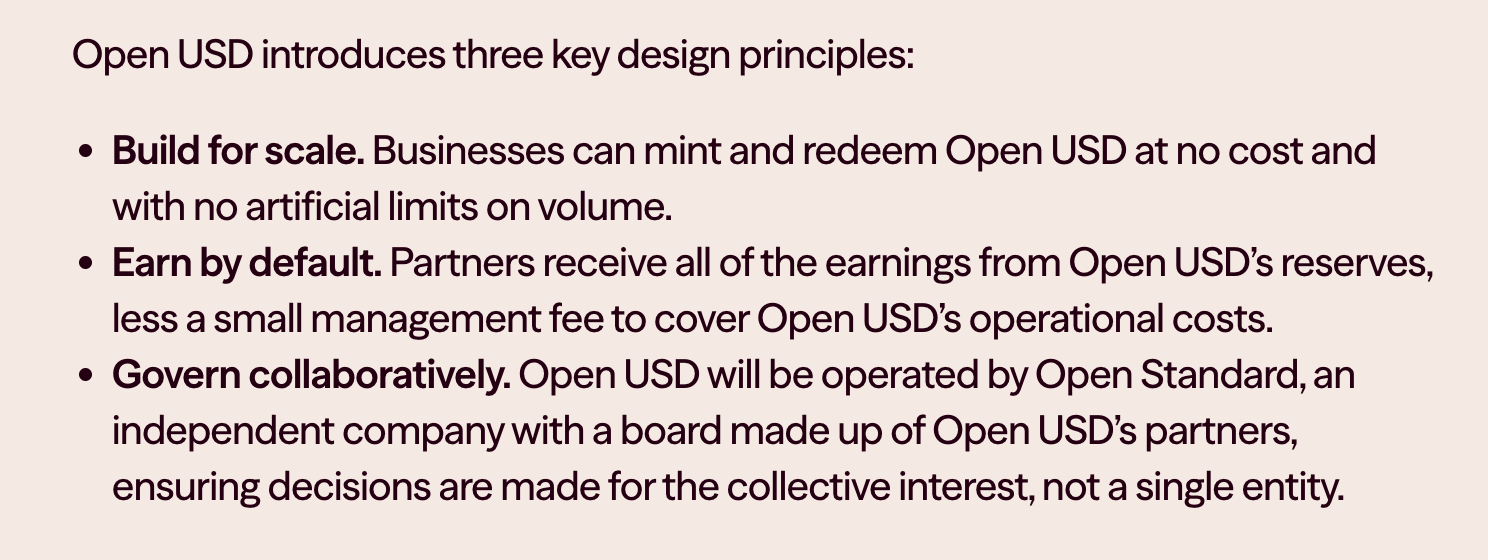
Open USD is an over-collateralized stablecoin but introduces two key differentiators. First, enterprise users can mint and redeem unlimited amounts with zero fees, significantly reducing capital costs for high-volume payments. Second, the yield generated from reserve assets (e.g., U.S. Treasuries) is returned to partners, with Open Standard charging only a small management fee. This directly challenges Circle's primary profit driver, which typically keeps all reserve income. Additionally, Open USD adopts "Neutral Governance"—a board composed of partner firms that oversees direction and decisions, positioning the stablecoin as open infrastructure rather than a proprietary product.

Market Reaction: CRCL Plunges 17%, Index Removal Adds Pain
Circle's stock CRCL dropped 17.55% on July 1, its largest single-day decline in recent history. The selloff was exacerbated by FTSE Russell's annual index rebalancing, which removed CRCL from five major Russell growth indexes, directly impacting institutional holdings. Although Open USD has not yet launched, the market is already repricing Circle's franchise. When enterprises can both earn shared reserve yields and participate in governance, does USDC's first-mover advantage, regulatory compliance, and adoption network still constitute an unbreachable moat?

For Circle, the existential threat is that former allies—Coinbase, Stripe, Visa, etc.—are now building a rival platform. These firms were key to USDC's ecosystem. If an enterprise can achieve similar compliance and coverage while sharing profits, why continue to fuel USDC's network effects? The market's answer, reflected in CRCL's drop, is increasingly skeptical.