Unprecedented Partnership Roster: The Strongest Debut in Stablecoin History
On the evening of June 30 (Beijing time), a new company called Open Standard announced the upcoming launch of Open USD, a new dollar-pegged stablecoin scheduled to go live later this year. What sets Open USD apart is its simultaneous release of a partnership list covering 140 enterprises: payment giants Visa, Mastercard, Stripe, Adyen; financial institutions BlackRock, BNY, DBS, Standard Chartered, Mizuho; tech leaders Google, Shopify, IBM; and crypto industry heavyweights Coinbase, OKX, Bybit, Ripple, Fireblocks, MetaMask. This all-star lineup spanning payments, banking, internet, and digital assets gives Open USD an adoption channel that few stablecoins have ever achieved from day one.
Differentiated Design: Zero-Cost Minting/Redeeming and Revenue Sharing
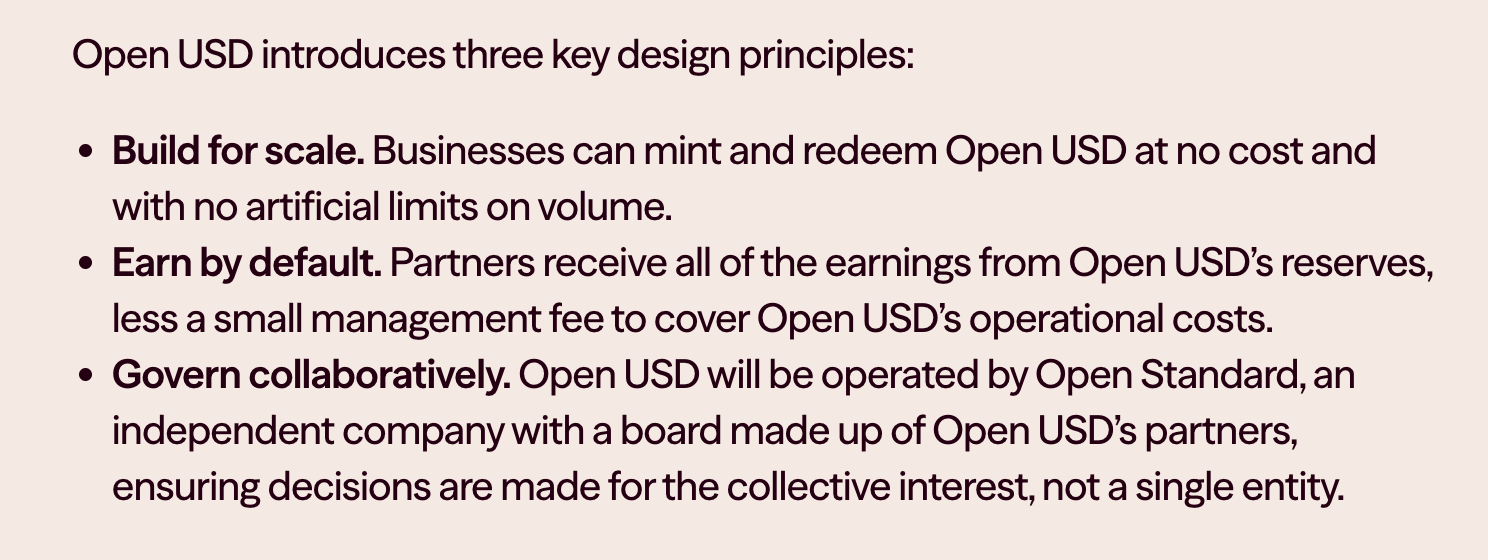
Open USD introduces fundamentally different design in issuance and operation. First, enterprises can mint and redeem unlimited amounts of the stablecoin with zero fees and no additional scale restrictions. For payment institutions and financial institutions handling large fund flows, this significantly reduces capital costs and access barriers. Second, and most critically, the yield generated from reserve assets is fully returned to partners. Mainstream stablecoins like USDC allocate deposited dollars into low-risk assets such as U.S. Treasuries, with interest income primarily accruing to the issuer—Circle's most important profit source. Open USD only charges a small management fee to cover operating costs, redistributing reserve yields to the ecosystem participants. This directly targets the heart of Circle's business model.

Neutral Governance: An Open Platform for Stablecoin Infrastructure
Open Standard calls its governance model "Neutral Governance." Open USD is not operated independently by a single company; instead, it is managed by Open Standard with a board of directors composed of partners who participate in future direction and major decisions. This model aims to position Open USD as an open industry infrastructure rather than a product owned by any single firm. Previous attempts to challenge USDC have largely failed to shake Circle's position because the moat lies in trust, compliance, and adoption—not technology. However, Open USD's luxury partnership list gives it a significantly higher starting point in compliance, distribution, and adoption from the outset—especially since many partners were already key participants in the USDC ecosystem, such as Coinbase, Stripe, and Visa.

Market Reaction: CRCL Plunges 17%, Moat Under Reassessment
Following the announcement, Circle's stock (CRCL) tumbled 17.55% in a single day, its largest decline in recent memory. The market widely believes that Open USD represents a truly competitive challenger to the stablecoin industry. Additionally, FTSE Russell removed CRCL from five major Russell growth indices in its latest annual index rebalancing, further hitting institutional holdings. Although Open USD has not yet launched, the capital market has already started re-pricing Circle's business model: if enterprises can co-issue stablecoins and share reserve yields, can USDC's moat—built on first-mover advantage, compliance framework, and liquidity network—remain solid? These questions remain unanswered, but the CRCL crash clearly shows that investors are reassessing this possibility.