

OpenAI on July 29 launched “ChatGPT for Academic Researchers,” a program that will provide one year of free access to its advanced models and research workspace to academic users. The company’s target is 100,000 researchers by 2027, with 10,000 slots available this summer.
The first participating institutions include the École Normale Supérieure (ENS) in Paris and the Institute for Advanced Study (IAS) in Princeton. Eligible researchers will be able to use GPT-5.6 Sol Pro, described in the source article as OpenAI’s flagship model.
Research workflow brought into one workspace
According to the report, OpenAI is not just adding another chat interface. It is packaging a broader research workflow into a single workspace that covers tools researchers typically split across editors, literature software, terminals, and chat windows.
In the setup described by the article, ChatGPT can be used for reading papers, questioning ideas, and generating hypotheses. Codex can be used for coding, running data, and formal verification. ChatGPT Work is positioned for grant applications, proposal writing, and drafting manuscripts.
Approved users will receive access to ChatGPT, ChatGPT Work, Codex, an expanded version of Deep Research, higher rate limits, and larger context windows.
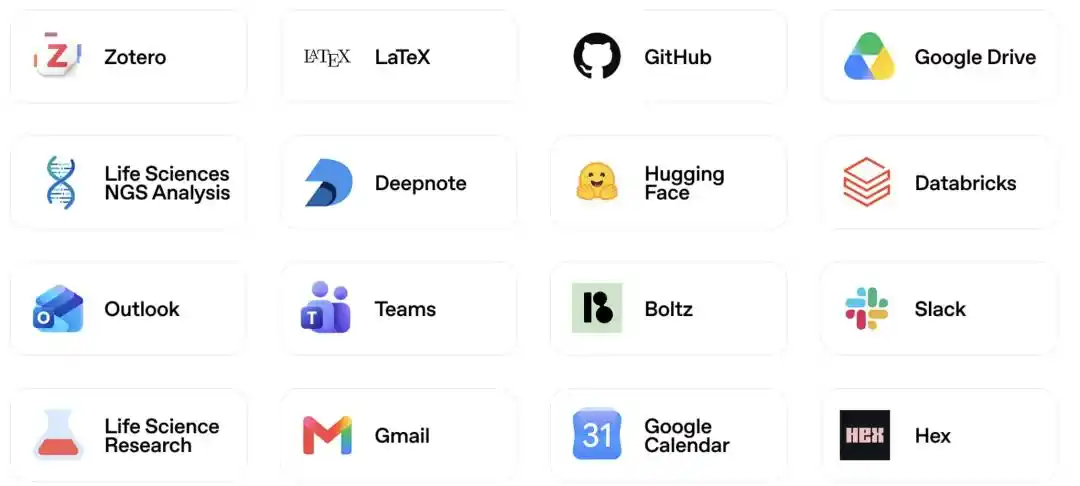
The package also includes more than 75 life science skills, covering genetics, genomics, single-cell analysis, protein modeling, and drug discovery. On the connector side, it can link to literature libraries, public genomic and clinical databases, satellite imagery, and tools such as Zotero and GitHub. The article also mentions tools including Boltz and NGS analysis being brought into the same workspace.
Models inside the system are assigned different roles. GPT-5.6 Terra handles day-to-day work, Luna is used for lighter tasks, and Sol is aimed at harder scientific and mathematical problems.
Usage data cited by OpenAI
OpenAI said roughly 1.3 million people each week are already using ChatGPT for advanced science and math work, generating about 8.4 million messages.
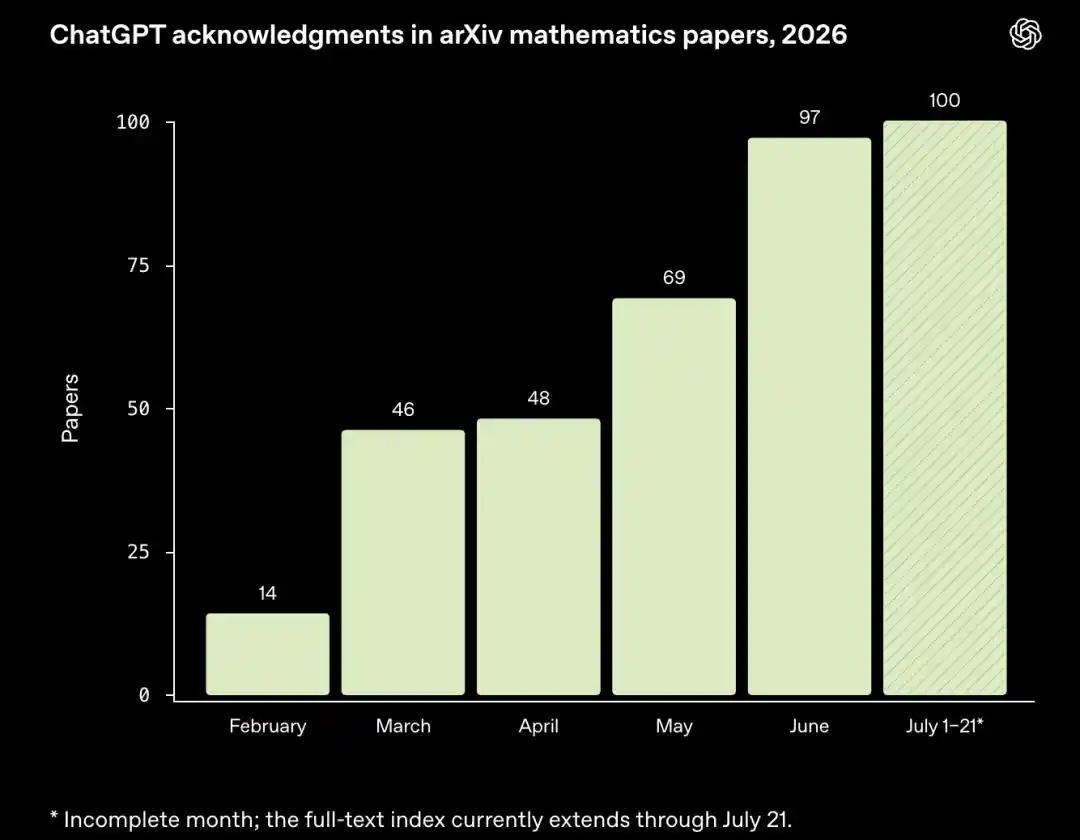
The article points to a signal from mathematics research on arXiv. Papers in mathematics acknowledging ChatGPT numbered 14 in February, rose to 97 by June, and reached 100 in the first three weeks of July as of July 21.
It also cites a gap between heavier and lighter AI users in science. Among scientists in the top 20% by AI usage, the share willing to hand over tasks expected to take more than four hours to AI was close to 7%. For other peers, the figure was 3.5%.
Research benchmarks and privacy settings
The source article says Sol scored 83% on FrontierMath Tier 4, a benchmark for research-level mathematical reasoning, compared with 72.5% for the previous GPT-5.5 generation. On GeneBench Pro, a benchmark for complex biological data analysis, Sol Pro solved 31.5% of the problems.
On privacy, the article says the workspace does not use user content for model training by default and includes enterprise-grade privacy protections.
The report argues that OpenAI is trying to move literature search, analysis, and writing into the ChatGPT and Codex environment and make that workflow a daily habit for researchers.
Three limits on the free offer
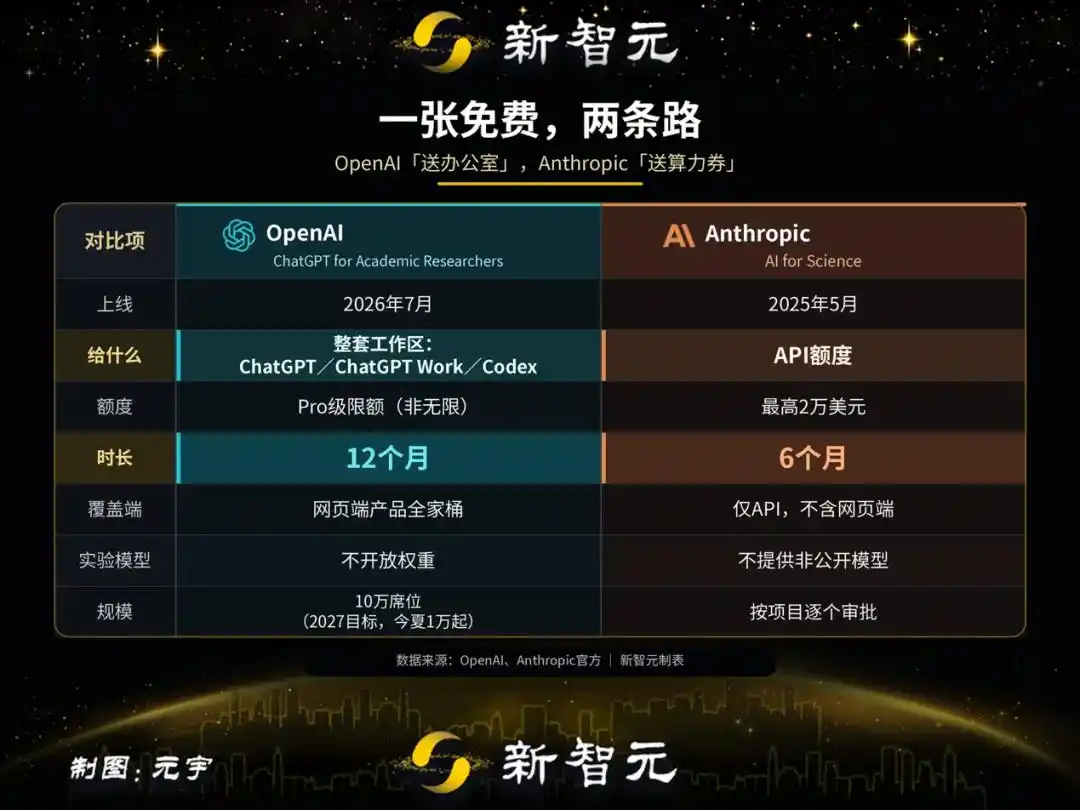
The program does not provide unlimited usage. The article says OpenAI made clear that limits are roughly in line with ChatGPT Pro, and users who go beyond them would need to pay for additional capacity themselves.
The second limit is that the plan does not include OpenAI API credits. The self-serve version of the program explicitly excludes API access credits, according to the report.
The third and most important limit is that model weights are not being released. Researchers are getting 12 months of product access, which lets them use the models but not view or modify the weights.
Eligibility requirements are also strict. Applicants must be university research faculty or postdocs, pass institutional verification through SheerID, be located in a supported country, and submit a paper from the past three years published on arXiv, bioRxiv, or ChemRxiv with their name on it.
Comparison with Anthropic
The article notes that Anthropic launched its AI for Science program in May 2025. That program offers up to $20,000 in API credits for researchers at universities and nonprofit organizations, valid for six months, with a focus on biology and life sciences.
The two offerings are structured differently. Anthropic provides API credits, meaning researchers use the service through interfaces and do not get access to the Claude web app or non-public experimental models. OpenAI, by contrast, is offering a full workspace, Pro-level limits, and five team seats.
There is one clear overlap between the two approaches: neither company is opening model weights. The article says researchers studying AI systems themselves are looking for weights and training data so they can independently evaluate model behavior, test reproducibility, and run safety audits. OpenAI and Anthropic both argue that restricting access to weights helps prevent misuse.
The source material cites OpenAI’s post on X and the company’s official “ChatGPT for Academic Researchers” page. The original Chinese article was published by the WeChat account Xinzhiyuan and credited to ASI Qishilu.