
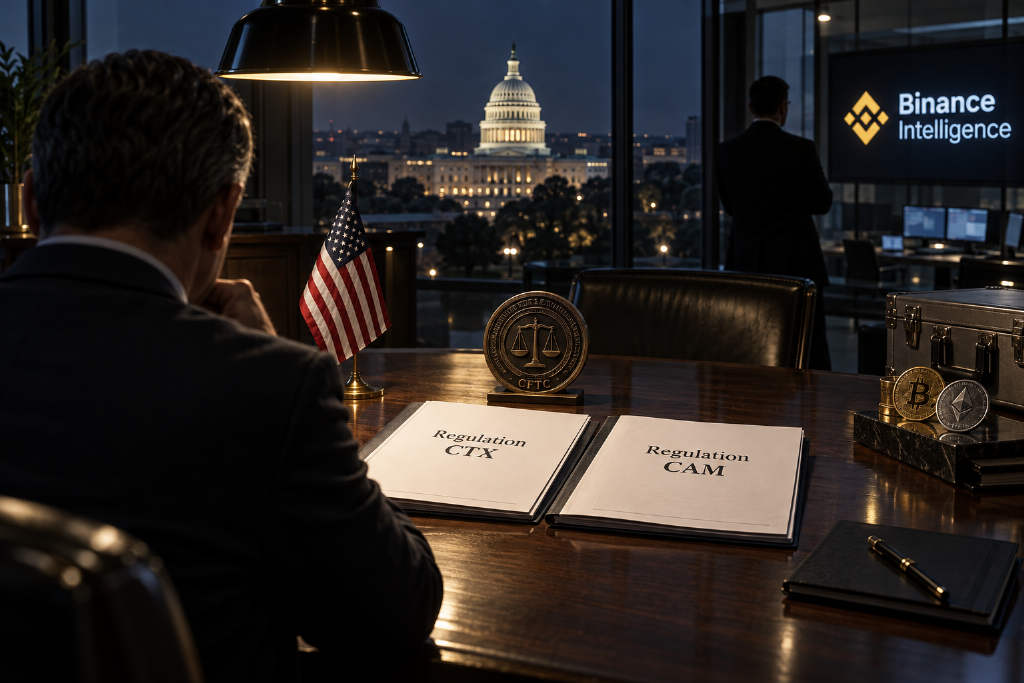
Crypto markets on the day were driven by regulation, platform product updates, treasury disclosures, and a fresh round of Bitcoin market analysis.
Regulation and macro
CFTC proposes its first crypto market rules
Michael S. Selig, chair of the U.S. Commodity Futures Trading Commission, wrote in a Wall Street Journal opinion piece that after Congress failed to pass the Clarity Act, the CFTC is now proposing its first set of crypto market rules, including Regulation CTX and Regulation CAM. The proposals are designed to give CFTC-registered exchanges a federal framework tailored to crypto assets.
Unlike the Clarity Act, the new rules would not require crypto assets to trade on CFTC-registered venues. Exchanges that choose the framework, however, would be allowed to offer retail customers trading on margin, leverage, or financing terms.
Ray Dalio warns of a U.S. debt crisis within three years
Bridgewater founder Ray Dalio said U.S. debt-service costs are crowding out other spending and that a U.S. debt crisis could break out within three years.
Hong Kong plans to submit a virtual-asset licensing amendment this year
Hong Kong Secretary for Financial Services and the Treasury Christopher Hui said at a Legislative Council policy briefing that the government will submit draft legislative amendments within the year to establish licensing regimes for virtual-asset trading, custody, advisory, and management services.
He also said Hong Kong’s central gold clearing and settlement system will formally launch in the first quarter of next year, and Hong Kong Exchanges and Clearing will release details this year on a new RMB-denominated, physically delivered gold futures contract.
U.S. Treasury withdraws proposed crypto surveillance rule
According to market reports, the U.S. Treasury has withdrawn a proposed crypto surveillance rule aimed at unhosted wallets and CVC crypto mixing.
Project and platform updates
Binance launches Binance Intelligence
Binance said it has launched Binance Intelligence, an AI product stack that includes three offerings: the free Binance AI for all users, Binance AI Pro for turning natural-language prompts into executable strategies, and Binance Agent OS for developers building AI applications.
Binance AI combines charts, news, social platforms, on-chain data, and research tools, and uses a generative UI to adjust the interface dynamically. The rollout began on Oct. 5.
Each Binance AI Pro strategy runs in an isolated sub-account, and users must review and approve trades before execution. The product will launch in the second half of October under a freemium model, with a Premium plan priced at 19.99 USDC per month.
Binance Agent OS has logged more than 280,000 daily calls since its launch in August 2026.
Bithumb to list BR and POD in the KRW market
South Korean crypto exchange Bithumb said it will list BR and POD in the won market, with trading expected to open at 19:00 local time.
Solana Foundation introduces DvP settlement framework
According to TheStreet, the Solana Foundation has launched Solana DvP, an open-source delivery-versus-payment settlement program for institutions. The system is meant to help financial firms settle assets and cash simultaneously on Solana. JPMorgan provided input on institutional settlement needs during development.
Solana DvP follows traditional delivery-versus-payment principles to reduce counterparty risk and can settle in seconds through a single atomic transaction, compared with the one to two business days often seen in traditional markets. The framework uses the MIT open-source license, allowing institutions to use and build on it without authorization fees.
Binance to distribute MRVL and ORCL dividends through bStocks
Binance said users holding MRVLB and ORCLB balances will receive dividends for Marvell Technology and Oracle Corporation through bStocks.
After applicable withholding tax, fees, costs, and other charges, the net cash dividend will be reinvested into additional units or fractional shares of the same underlying security. Eligible users will receive the distribution in the form of MRVLB and ORCLB stock tokens. Users holding MRVLB and ORCLB on-chain will receive bStocks dividends through a multiplier adjustment.
Ethereum team pushes emergency fix before Glamsterdam testing
CoinDesk reported that Ethereum developers completed an emergency software update ahead of Glamsterdam upgrade testing on the Sepolia testnet, fixing an issue that could have caused some validators to produce low-capacity blocks.
The test will raise Sepolia’s gas limit from about 60 million to 200 million as part of work to validate future increases in Ethereum network throughput. Prysm, an Ethereum validator client, released version 7.2.1 to make sure validator nodes participate in the Glamsterdam test as intended. Glamsterdam is Ethereum’s next major upgrade, and Sepolia is the first test network to deploy the related changes.
OKX says it is moving beyond the exchange model
OKX founder and CEO Star said at the OKX NOW conference in Singapore that the exchange business is the company’s starting point, not its endpoint. He said OKX plans to build a global fintech platform around four areas: holding funds, payments, investing, and wealth management.
Star said crypto finance and traditional finance are converging faster, and that OKX will keep investing in global compliance infrastructure while improving transparency through regular proof-of-reserves reports. Deloitte has become OKX’s global audit firm.
On AI, he said about 95% of engineering code merge requests have already had their main development work completed through AI workflows. He added that AI will be used widely in customer service, anti-fraud, user protection, compliance, and wealth management.
GLM-5.3 added to Amazon Bedrock
According to the STAR Market Daily, Amazon Web Services has added Zhipu’s GLM-5.3 to Amazon Bedrock, with AWS sharing revenue with Zhipu based on model usage.
Beyond AWS, Zhipu has recently put revenue-sharing arrangements in place with several overseas cloud providers. In China, it has signed similar agreements with major cloud platforms including Alibaba Cloud’s Bailian platform. Huawei Cloud has also listed GLM-5.3 and reached an intention for a similar partnership, creating a revenue-sharing system spanning domestic and overseas markets.
LayerZero buys back more ZRO
Arkham data shows LayerZero bought about $347,000 worth of ZRO roughly 40 minutes earlier, bringing cumulative buybacks to 2.538 million tokens worth about $5.4 million.
ZRO rose above $2.13 and moved closer to the $3 resistance area. LayerZero co-founder Bryan Pellegrino has previously expressed optimism about ZRO’s long-term development.
Strategy adds 334.3 BTC
According to market reports, Strategy, formerly MicroStrategy, disclosed that it bought 334.3 BTC last week, lifting total holdings to 848,000.3 BTC.
Strive buys 2,000 BTC for $169 million
Strive CEO Matt Cole said the firm bought 2,000 BTC last week for $169 million at an average cost of $84,422 per coin, bringing total holdings to 29,462 BTC.
He said 61.5% of the financing came from SATA, while warrants generated $56.7 million. A Form 8-K filed today also disclosed key metrics and KPIs through the third quarter of 2026.
Bitmine adds 15,112 ETH in a week
Ethereum treasury company Bitmine said that as of Oct. 4, 2026, its combined holdings of crypto assets, cash, marketable securities, and “Moonshots” totaled $17.4 billion.
The company held 6,016,414 ETH at a price of $2,726, equal to 4.9% of Ethereum’s 122.1 million total supply. It also held 214 BTC, a $180 million stake in Beast Industries, a $117 million stake in Eightco Holdings, and $643 million in cash and marketable securities. Over the past week, Bitmine added 15,112 ETH.
Bitmine said it has staked 5,067,309 ETH worth $13.8 billion, with expected annualized staking income of $363 million. Chairman Thomas “Tom” Lee said the company is 99% of the way toward its “Alchemy of 5%” target and has bought ETH every week since launching its ETH reserve strategy on June 30, 2025.
Lee also said ETH fell 10% in the first nine months of 2026 while BMNR fell only 3%, outperforming by 731 basis points. In the third quarter, ETH outperformed the S&P 500 by 6,832 basis points.
Metaplanet reports net purchase of 1,000 BTC in Q3
Metaplanet said it made a net purchase of 1,000 BTC in the third quarter, bringing total holdings to 44,000 BTC.
Funding and deal activity
OpenAI in talks with UAE funds and BlackRock for latest round
Bloomberg reported that people familiar with the matter said several UAE investment funds, including MGX, are in talks with OpenAI about joining its latest $30 billion financing round. The funds would participate as a consortium, with discussions covering as much as $10 billion in combined investment. BlackRock is also in talks to join the round.
The financing is still underway and terms may change. OpenAI is seeking at least $30 billion at a pre-money valuation that could reach about $1.4 trillion. The company has delayed IPO plans until at least next year, citing its focus on AI safety. Its last financing came in March, when it raised $122 billion at a post-money valuation of $852 billion.
DayOne data center targets up to $5 billion in U.S. IPO proceeds
Reuters reported that people familiar with the matter said SoftBank-backed DayOne data center plans to raise up to $5 billion in a U.S. IPO and could list American depositary shares on Nasdaq by year-end. The company filed its prospectus with the SEC on Monday.
According to the filing, Singapore-headquartered DayOne posted revenue of $512 million in the first half, up more than threefold from a year earlier. Net loss widened from $13.5 million to $81.9 million over the same period.
Hadrian raises $40 million
Businesswire reported that AI security company Hadrian has completed a $40 million financing round co-led by Forgepoint Capital International and SmartFin, with participation from existing investors including HV Capital, Motive Partners, Picus Capital, and Oetker Ventures.
The company combines continuous exposure management with AI-agent penetration testing to simulate an attacker’s perspective for enterprises, helping them identify external attack surfaces, validate real risk, and optimize remediation priorities. After the round, Hadrian’s cumulative funding reached $65 million. The proceeds will be used to expand in Europe and the U.S. and to grow its engineering and research teams.
DeepSeek round could reach $12 billion
Bloomberg reported that AI company DeepSeek is close to completing a new financing round expected to total at least RMB 80 billion, or about $12 billion, well above its earlier target of roughly RMB 50 billion.
People familiar with the matter said Tencent Holdings and CATL have committed sizable amounts, and the deal is expected to close soon. With demand and investor interest rising sharply after the release of its latest AI model, the final amount could even approach RMB 100 billion. DeepSeek plans an IPO in early 2027, and the new round is expected to fund growth ahead of that listing.
Bloomberg: Goldman Sachs earns advisory and incentive fees from SpaceX listing
Bloomberg reported that Goldman Sachs earned hundreds of millions of dollars in incentive fees after helping clients invest early in SpaceX, which went public in June at a $1.77 trillion valuation.
People familiar with the matter said Goldman helped some high-net-worth clients invest in SpaceX more than five years ago, when the company was valued at only tens of billions of dollars. After the listing, those clients sold shares at large gains, generating hundreds of millions of dollars in incentive fees for Goldman. The bank also earned about $100 million in advisory fees as one of the lead listing advisers and plans to use part of the incentive-fee gains for early charitable giving to improve tax efficiency.
Moonshot AI said to complete pre-IPO financing
People familiar with the matter said Moonshot AI has completed its final private financing round at a valuation of about $50 billion and is moving toward a Hong Kong IPO in the first quarter of next year.
The sources said the company has started preparing to gauge investor interest and could begin preliminary talks with investors as early as this month. Discussions are still ongoing, and the IPO timing could change.
Views and market analysis
Bitcoin holds above the $80,400 capital cost basis
Crypto analyst Darkfost said Bitcoin’s market trend has changed noticeably since late August, and that the shift can be seen through the Capital Cost Basis indicator. The metric weights realized price by transaction value in dollars, giving more weight to BTC bought at higher prices and offering a closer read on the market’s actual capital cost.
He said BTC was still struggling around that key level in late August, but has now closed for several consecutive weeks above the roughly $80,400 capital cost basis. That suggests most capital in the market is now sitting on small profits, with market stability improving day by day, which he described as a positive sign for the current consolidation phase.
Bitcoin rejected again near $87,000
CoinDesk reported that Bitcoin ran into selling pressure in the $87,000 area, marking the third rejection near that level since Sept. 23. Total crypto market capitalization slipped to about $2.93 trillion. U.S. equities remained firm, with the Nasdaq 100 closing at a record high and the S&P 500 less than 0.5% from its all-time high. The 10-year U.S. Treasury yield rose to 5.32%, near its highest level since 2002.
FxPro analyst Alex Kuptsikevich said BTC has been forming a pattern of rising local lows, but bulls still lack enough momentum. Price is nearing the end of a triangle formed by horizontal resistance and an ascending support line. Market watchers said Bitcoin needs enough buying to absorb supply at that level before a sustained move higher can develop.
Cathie Wood says collapsing AI costs could trigger a productivity revolution
ARK Invest founder Cathie Wood wrote on X that AI inference costs are now falling 99.99% per year while performance remains unchanged. At the same time, OpenAI’s annualized revenue run rate has risen from $20 billion to $70 billion, which she said shows lower costs are driving demand sharply higher.
Wood said cost declines from AI and other innovation platforms should spread through the broader economy, lifting productivity and corporate profitability while pushing inflation below what many investors expect, a dynamic she described as “benign deflation.” ARK Invest expects real GDP growth could reach the high single digits. In a stronger real-growth environment, she said, interest rates could rise rather than fall.
Long-term holders have been selling for seven straight weeks
Crypto analyst Axel Adler said data shows Bitcoin long-term holders have been taking profits as BTC rises, while new demand is still absorbing the supply coming to market. Holdings have now declined for seven consecutive weeks, though the selling has not stopped Bitcoin from moving higher.
Compared with the roughly 1.07 million BTC reduction seen in November 2025, the current scale remains limited. The indicator turned negative on Aug. 17 and has stayed in decline for seven weeks. As of Sept. 28, holdings were down 73,400 BTC, wider than the 1,100 BTC decline recorded a week earlier.
Cathie Wood says investors should watch where AI agents spend money
Cathie Wood also said investors looking for the next technology trend should shift from tracking where developers spend time to tracking the spending behavior of AI agents, watching which services autonomous software pays for.
As AI agents move from answering questions to carrying out tasks on their own, the payments they generate may reveal real adoption more clearly than product launches do, she said. She added that OpenAI, Anthropic, and Nvidia are likely to remain central to AI infrastructure competition in 2027, while compute supply, energy, capital spending, and model reliability remain the main constraints on expansion.
Bitcoin down about 32% one year after its all-time high
CoinDesk reported that one year after Bitcoin set an all-time high above $126,000 on Oct. 6, 2025, the asset is now trading around $85,453, down about 32%. In prior cycles, the drawdown one year after the top was roughly 70% to 82%.
The low of the current bear phase came around June 30, 2026, when BTC fell to about $59,000, more than 53% below its peak. The report said this cycle has been driven more by spot ETFs, asset managers, family offices, and corporate capital. ETF flows rebalance toward target allocations, and passive buying on declines can reduce selling pressure. The market may now be moving in steps rather than in a parabolic pattern. Bitcoin’s annualized volatility is about 40%, below the historical level above 80%. If 30-year Treasury yields keep rising, that could create fresh pressure.
Tom Lee says crypto is already in a bull cycle
Tom Lee, chairman of Bitmine, said the crypto market has entered what he sees as a bull cycle. In the first nine months of 2026, ETH fell 10% while BMNR fell only 3%, an outperformance of about 731 basis points.
He said BMNR’s stock performance reflects the company’s continued effort to improve shareholder returns, including what he described as the largest corporate treasury stock buyback program in the crypto industry, with 21 million shares repurchased in 2026 alone. He also said ETH has outperformed the S&P 500 by 6,832 basis points so far in the third quarter despite macro pressure.
Bitcoin fails twice to break the late-September high
CoinDesk also reported that Bitcoin climbed to nearly $87,000 last week, coming within about $500 of the late-September swing high near $87,400 before pulling back under selling pressure. It was the second failed attempt within a week to break that late-September high. In the earlier move, softer-than-expected U.S. inflation data pushed BTC near $85,500 before it gave back gains within hours.
Weaker U.S. employment data reduced pressure on the Federal Reserve to keep raising rates, offering support to risk assets. A daily close above $87,000 could become an important signal that buyers are finally breaking through the late-September ceiling.
Citadel Securities says AI investment is intensifying competition for capital
Citadel Securities said the recent sell-off in U.S. Treasuries is not mainly about worsening inflation expectations. Instead, it reflects stronger U.S. growth and rising demand for capital driven by fiscal spending and AI investment.
Nohshad Shah, the firm’s EMEA head of fixed income sales, warned that if yields keep rising, markets may need to reassess the growth outlook, the policy path, or the term premium. He said nearly all of the rise in the U.S. 10-year Treasury yield in September came from real yields, while inflation expectations stayed relatively stable. Higher real yields reflect an economy supported by fiscal easing, loose financial conditions, and large-scale AI investment, with investors demanding higher after-tax returns.
Power-law model points to $157,800 as a reference level
Darkfost said Bitcoin’s swings around its power-law trend line have narrowed over the past decade. The oscillator peak has fallen from +169 in 2018 to +102 in 2025, while the standard deviation of daily changes has dropped from 4.81 to 2.47, a decline of about 49%. As of Oct. 3, the model oscillator stood at +34.5 and Bitcoin traded around $84,700.
Using the model parameters for that day, an oscillator reading of +100 would correspond to a Bitcoin price of about $157,800, roughly 86% above the current level. He said that figure is not a fixed target, but a reference level based on current regression parameters. If the power-law trend line keeps rising, the reference price would rise as well.
A technical futures switch could amplify the next Treasury sell-off
Financial Post reported that with the U.S. 30-year Treasury yield approaching 6%, a technical rule in Treasury futures contracts could become a new amplifier for long-end yields.
Futures prices usually track the cheapest-to-deliver bond in a basket of deliverable Treasuries. When yields rise quickly, the cheapest-to-deliver bond can shift to a longer-duration Treasury, triggering a CTD switch and forcing investors to rebalance futures positions. BNP Paribas strategists said a shift toward longer-duration CTDs could intensify the rise in long-end yields in the cash market. Once long-bond yields reach certain levels, forced selling in Treasury futures can feed back into even higher yields.
Bull Score Index stays in bullish territory, but spot demand lags
Darkfost said Bitcoin’s Bull Score Index remains firmly in bullish territory at 80 out of 100, with multiple indicators still supporting upside momentum.
He said the main lagging component is spot demand. Spot trading volume remains low, and there is still no clear sign of strong spot buying. In his view, spot demand is the missing piece in the current BTC setup, and it is often the last part of the cycle to appear.
CZ says the “every dip is an opportunity” call was coincidence
A community user said CZ posted a daily message on Sept. 16, 2026 saying “every dip is an opportunity,” when Bitcoin was trading around $75,800, and linked that comment to the recent BTC move. CZ replied that it was purely a coincidence, adding: “I’m only right slightly more than 50% of the time, because I’m always bullish.”
Michael Saylor lays out a Bitcoin investment matrix
Strategy founder Michael Saylor wrote on X that Bitcoin can serve different types of investors: BTC offers direct ownership, MSTR offers amplified Bitcoin exposure, and STRC offers yield, with 30-day price volatility lower than all of the Magnificent Seven stocks.
He added that digital capital is the foundation of digital equity and digital credit.
Key data points
Fed seen holding rates steady in October with 77.3% probability
CME FedWatch data shows a 77.3% probability that the Federal Reserve will leave rates unchanged by October, versus a 22.7% probability of a cumulative 25-basis-point hike.
By December, the probability of no change stands at 13.4%, while the probability of a cumulative 25-basis-point hike is 67.8% and the probability of a cumulative 50-basis-point hike is 18.8%.
Elon Musk’s net worth tops $1 trillion again
Elon Musk’s net worth has climbed back above $1 trillion for the first time in three months. According to the Bloomberg Billionaires Index, his wealth rose by $65 billion on Monday to $1.04 trillion as the value of his SpaceX and Tesla holdings recovered.
Since the start of October, SpaceX shares have gained 13% and Tesla shares have risen 6.7%. A post-IPO surge in SpaceX shares in June had previously made Musk the world’s first trillionaire, but he quickly lost the title after the stock pulled back. The latest rebound reflects renewed optimism around SpaceX and Tesla, whose shares have recovered 58% from their August lows. Musk’s holdings in the two companies account for more than 98% of his net worth.
New wallet withdraws 7,166 ZEC from Coinbase
Lookonchain said a newly created wallet address, t1Sj6J, withdrew 7,166 ZEC worth about $9.67 million from Coinbase over the past 12 hours. It is not yet clear whether the address belongs to an individual investor, an institution, or another entity.