Pew Research Center says about 10% of English-language webpages now show significant signs of AI authorship, a figure that rises to 35% for pages published since ChatGPT launched in November 2022. The study analyzed roughly 490,000 pages from Common Crawl, running the text through Open Pangram, an AI detection model built by Pangram Labs. The gap is stark by domain: .com pages show AI traces at about 10 times the rate of .edu and .gov sites, both near 1%, while .org sits around 4.6%. Pew says detection models can misclassify individual pages, and “significant signs of AI authorship” does not mean a page was written entirely by a machine. Still, the report says AI-style cues such as em dashes, Oxford commas, and words like “delve” and “testament” have become more common since 2023, and .com AI-authorship rates have climbed from about 1% in January 2021 to 9.35% in January 2026.
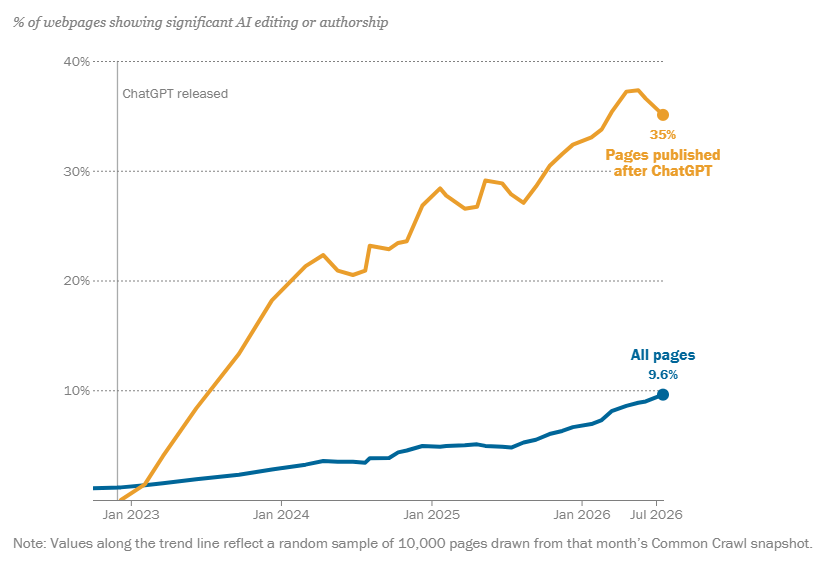
Pew Research Center says about 10% of English-language webpages now show significant signs of AI authorship. For pages published since ChatGPT launched in November 2022, that share rises to 35%.
The study analyzed roughly 490,000 pages pulled from the Common Crawl web archive, covering January 2021 through July 2026, and ran the text through Open Pangram, an AI detection model.
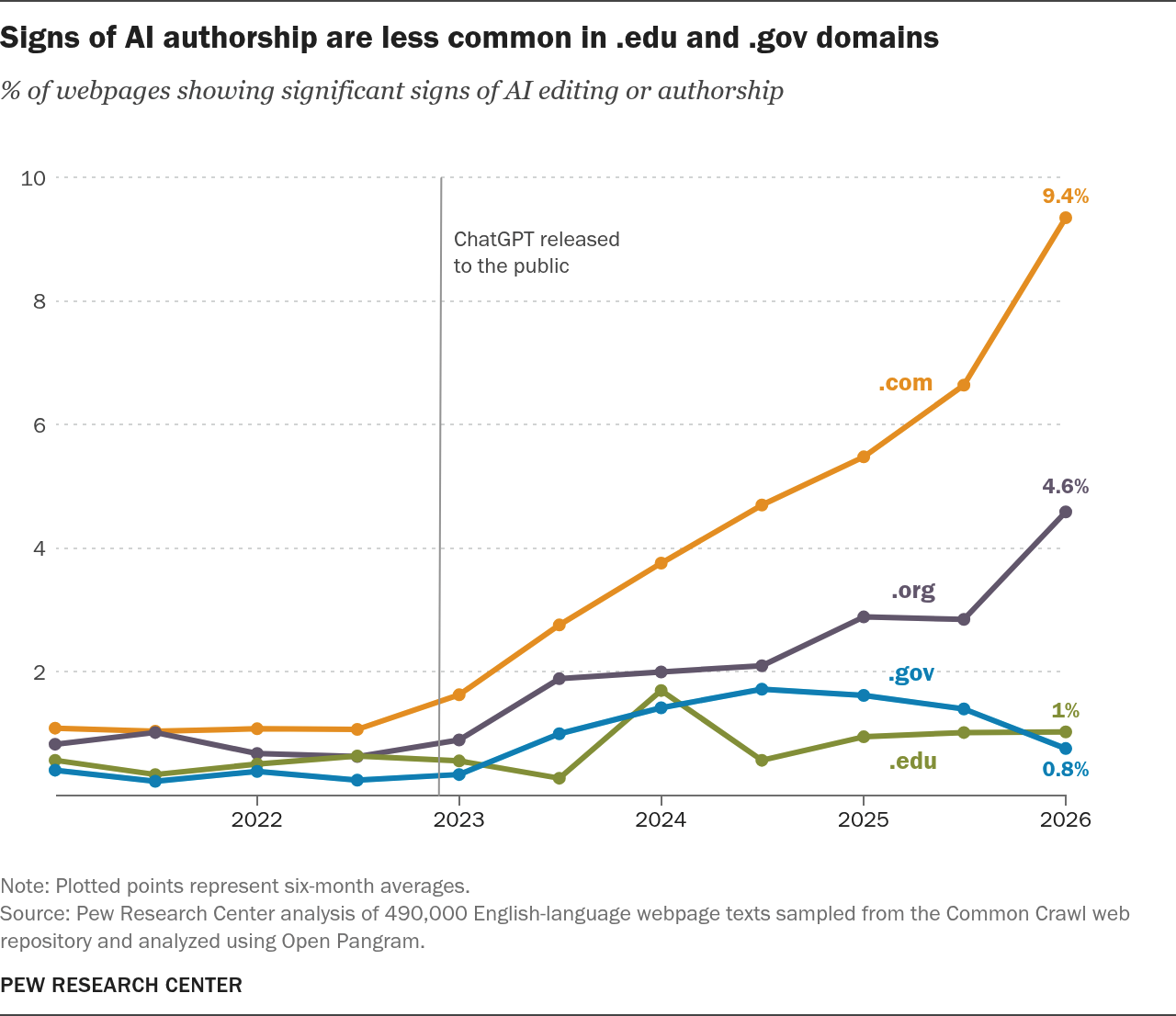
The pattern is uneven by domain. Pages on .com sites show signs of AI authorship at roughly 10 times the rate of .edu or .gov domains, both near 1%, and about twice the 4.6% rate on .org sites. In 2021, those four domain types looked nearly identical.
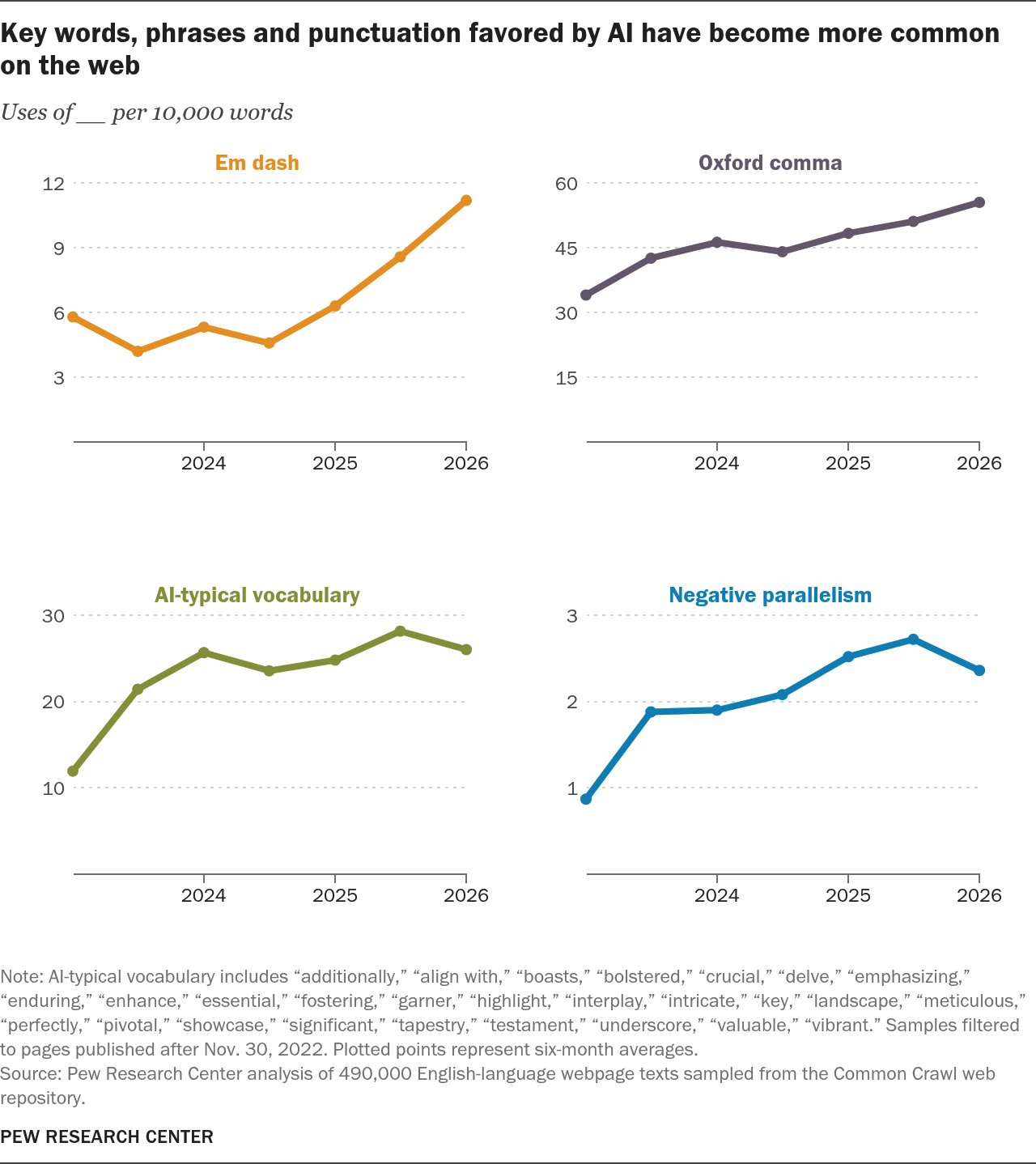
Pew says the detector does not look for a single word or phrase. It weighs statistical patterns across large batches of text. Even so, some writing cues have become more common since 2023. Em dashes now appear about twice as often, Oxford commas are up 63%, and AI-favored words such as “delve,” “interplay,” and “testament” have more than doubled in frequency.
“Negative parallelism” — constructions like “it’s not just X, it’s Y” — has nearly tripled since 2023, though Pew says it remains rare overall.
Pew also stresses the limits of the method. Detection models can misclassify individual pages in either direction, and “significant signs of AI authorship” does not mean a page was written entirely by a machine. Much of the text may have been AI-assisted rather than fully AI-generated.
Open Pangram comes from Pangram Labs. Its detector has also been used in separate research that found AI-generated text in roughly 9% of U.S. newspaper articles this year, including opinion pages at outlets such as The New York Times.
The report says the growing gap by domain likely reflects who is publishing and how. Academic and government sites usually go through editorial review, institutional approval, and slower publishing cycles. .com domains include everything from newsrooms to affiliate-marketing content farms producing pages at a pace no human editor could sustain.
At scale, the trend is steep. Pew says the .com AI-authorship rate rose from roughly 1% in January 2021 to 9.35% in January 2026 alone.
Pew also notes that AI detection may get easier over time, not because of surface-level patterns, but because of the underlying technology. Anthropic and other major AI companies are already working on model-level text fingerprints that could make AI text easier to identify while reducing errors.

This article was originally published by Bit.Fan. For more cryptocurrency news and market insights, visit www.bit.fan. Disclaimer:
The market information, project data, and third-party content displayed on this platform are for industry information sharing only and do not constitute any form of investment advice or return commitment.
Cryptocurrency trading carries high risks. Users should fully assess their risk tolerance and make independent decisions. All profits, losses, and legal responsibilities are borne by the users themselves.