
Phison Electronics CEO K.S. Pua publicly accused Chinese memory module maker Longsys of copying technology during the company’s Aug. 13 second-quarter earnings call, while also using the event to argue that investors should no longer see Phison as just a consumer module company.
Pua directed his criticism at Longsys’ recent Edge Device general DRAM offload solution shown with UNISOC, as well as HLC+ SPU technology developed with AMD. He said that earlier this year, at China’s FMS event, he had already confronted Longsys executives in person and said: 「You are a big company and also an innovative company, so why do you only know how to copy?」
The exchange came after investors asked how Longsys’ recent work with UNISOC and AMD differed from Phison’s own aiDAPTIV technology.
Pua also rejected the idea that 「AMD chose Longsys,」 saying the cooperation only involved AMD’s China team. He told investors to 「ask AMD Austin what is happening now,」 and added that Phison’s work with Intel and MediaTek still sits behind extensive NDA restrictions, telling the market to wait.
Phison is trying to move past the “module maker” label
Beyond naming a rival directly, Pua used the earnings call to reshape how the capital market sees Phison.
Starting in the first quarter of this year, Phison reclassified its business lines and added a new category called AI Ecosystem Solutions. The segment includes Enterprise Main Drive, Boot Drive, aiDAPTIV, and AI-related storage applications. By the second quarter, that business accounted for about 38% of total revenue, up about 68% from the previous quarter.
That shift stands against continued weak demand in traditional consumer markets such as smartphones and PC OEM. According to Pua, AI and enterprise storage have quickly become the company’s new growth engines.
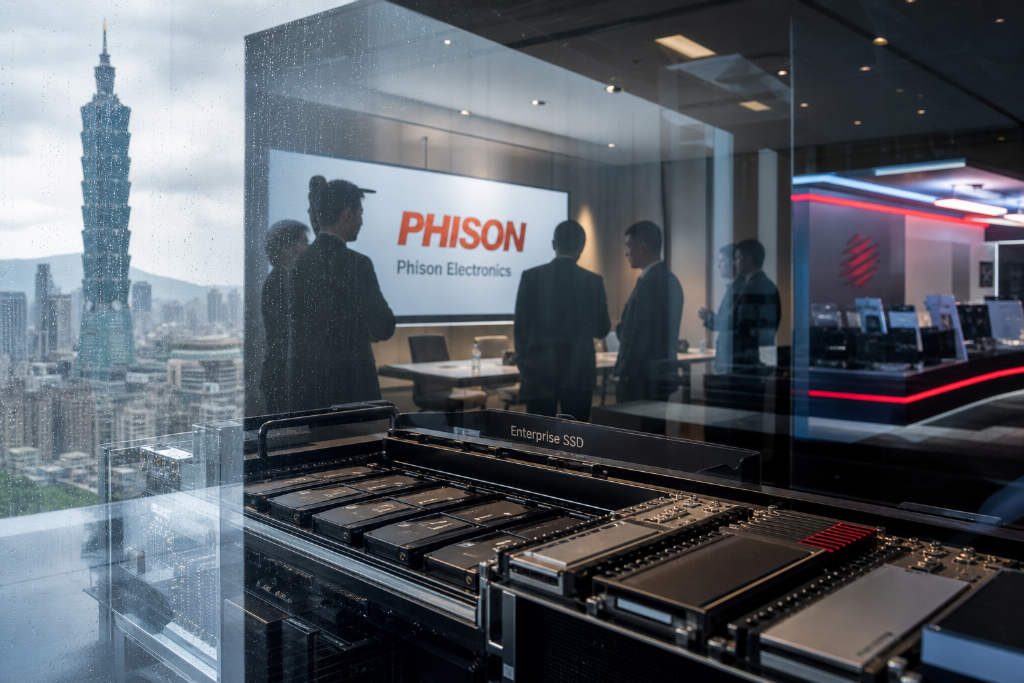
He repeatedly told investors during the call not to treat Phison only as a consumer company. In his description, the company now reaches into AI infrastructure, spanning Enterprise SSD, Main Drive, Boot Drive, and extending to an AI Data Platform.
Pua said Main Drive makes up about 30% of total company revenue and is currently the biggest contributor within the AI-related business mix. Boot Drive, he said, has already won a large number of AI system and networking design wins. aiDAPTIV remains small in revenue terms for now, but Phison has expanded it into a full AI Data Platform and hopes to see a clearer revenue contribution starting from the fourth quarter and over the next few quarters next year.
Phison sees storage as the next AI server bottleneck
Pua gave a strong view on AI storage demand. He said generative AI is moving from text to images and video, and then toward agentic AI, which would push data generation from KB, MB, and GB up to TB scale. Because of that, he said he does not agree with expectations that memory demand will come under control by 2027 or 2028.
For Phison, that means future AI servers will need more than GPUs and DRAM. They will also require large amounts of enterprise SSDs and storage controllers, which is where the company wants to establish its position.
Phison’s Enterprise PCIe Gen5 SSD is already in mass production, and the company is also advancing PCIe Gen6 Enterprise SSD products. Pua said some new products are already fully booked. The issue now, he said, is not whether customers have demand, but whether Phison can secure enough NAND supply to complete shipments.
On the Enterprise Boot Drive side, Phison has recently continued to secure new design wins in AI networking, OEM, CSP, Near Cloud, and AI infrastructure. Pua said AI networking alone added six new projects recently, and he stressed that Phison now covers both Main Drive and Boot Drive within the AI ecosystem.
Pua says the NAND shortage will last for “many years”
Pua’s comments on the NAND market were just as forceful. He said the biggest problem in NAND is no longer only pricing. 「No matter how much you are willing to pay, supply itself is a big problem,」 he said.
Phison’s current strategy is to keep enough inventory on hand so that once it wins a customer design win, it can keep supplying that customer for years. Even so, as new CSP and Cloud OEM projects roll in from the end of this year into early next year, the NAND allocation Phison has secured still cannot fully meet demand.
When analysts asked whether the shortage could continue into 2027, Pua answered not with 「next year」 but with 「many years, not next year, many, many years.」 He said a new NAND fab can take about four years from investment to real output, which means supply cannot quickly catch up with demand.
On pricing, he said NAND still has room to rise, though the pace of increases may gradually narrow. He also said a memory maker gross margin of 85% is already high enough, and pushing for 90% could hurt the broader industry and end demand.
Phison says it spent more than $450 million on NAND wafers in June and July
Pua also disclosed that Phison has been using weakness in China’s consumer market to secure large amounts of NAND.
He said some module makers in Shenzhen have more than 90% of their business tied to the consumer market. When end demand is weak and those companies need cash, they may choose to sell the NAND wafers they hold.
According to Pua, Phison spent more than $450 million in June and July alone to buy NAND wafers from Shenzhen module makers. He said the pricing was 「of course far below normal NAND prices, otherwise why would I buy?」
He said Phison was willing to take on that inventory because the company already has enterprise, AI, and customized products that can absorb the NAND, rather than simply buying and reselling it.
Pua used that point to draw a line between Phison and traditional module makers. In his telling, the traditional module business often centers on 「buy goods, mark them up, sell them.」 Phison, by contrast, builds on its own R&D capabilities across controllers, firmware, and module design, then combines NAND into different products. Even if it sells modules, he said, the company sees the underlying technology as the real source of value.