
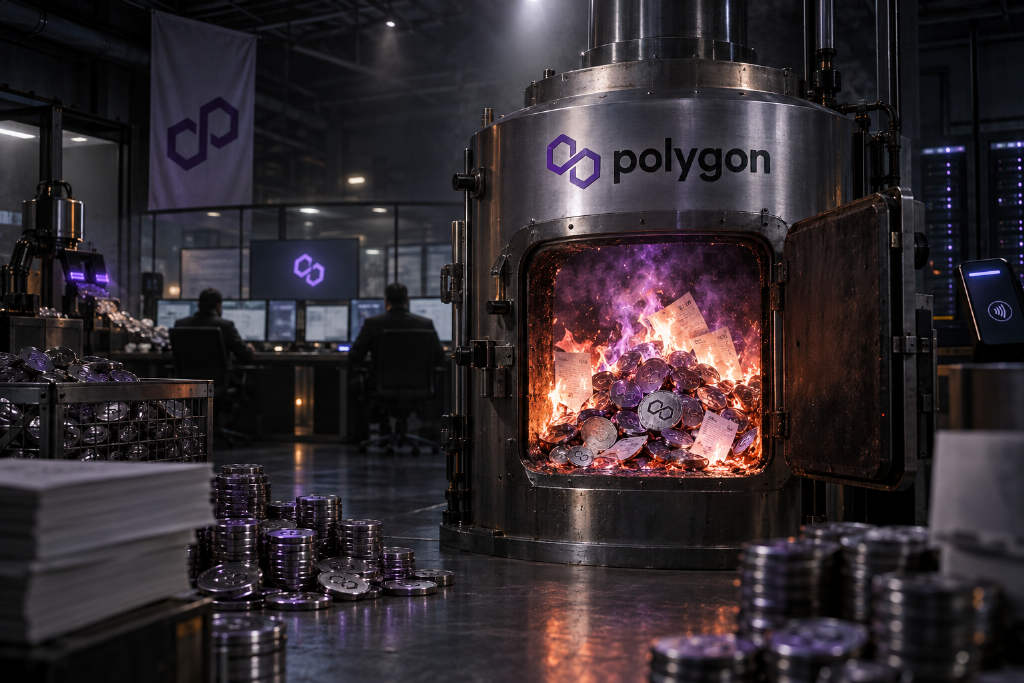
Polygon Foundation CEO Sandeep Nailwal said on Sept. 23 that the POL burn contract was ready and could be triggered by anyone in the community. A little more than three hours later, he posted a Polygonscan transaction hash showing that 100 million POL had been permanently burned.

At about $0.10 on the day, the 100 million POL was worth roughly $10 million. The tokens did not come from the foundation treasury. They came from a network base-fee collection contract that had accumulated transaction fees over time. Nailwal had previously said the collection address held about 121 million POL. The first burn removed 100 million of that amount, or about 83%, while the remainder stayed in the collection address for future quarterly burns that can also be triggered by the community.
Even so, POL did not get the kind of price reaction often tied to token-burn narratives. The article says the token was still hovering around $0.10, with the market not turning the word “deflation” into fresh buying.
Where the 100 million POL came from
Polygon PoS has used a fee structure similar to Ethereum’s EIP-1559 since January 2022, with the base fee routed toward burning. But for the past few years, those fees were not destroyed instantly at the contract level on a per-transaction basis. They were collected in a network base-fee accrual contract instead.

According to Nailwal, POL has been in net deflation since January 2026. One comparison widely cited earlier this year showed that about 105.2 million POL had been minted in 2026, while about 107.7 million POL in base fees had been collected over the same period.
On Sept. 18, Nailwal first previewed the plan to burn 100 million POL and said the contract was still on testnet and needed a final signature before going live on mainnet. Five days later, the mainnet deployment was complete, the community triggered it through a permissionless call, and the burn was done. Polygon said the community will be able to burn newly accumulated POL from the collection address every quarter going forward.
POL began with a 10 billion supply through the 1:1 migration from MATIC. Total on-chain supply before the burn was around 10.7 billion, so the 100 million burn was about 1% of the original supply and roughly 0.93% of current supply. Polygon documentation says effective annual issuance has been about 2% since June 2025. On that basis, the one-off burn still does not cover even half a year of gross issuance.
That is the core point in the article: the burn is real, but its scale fits a model of periodic fee recovery rather than a rewrite of the issuance system. For holders, the question is not only how many tokens disappeared today, but whether supply will climb back by this time next year.

Revenue and payment activity are still growing
Nailwal said this month that Polygon had generated $24.5 million in revenue so far in 2026. He compared that with Arbitrum’s $8.41 million and NEAR’s $5.60 million, concluding that “POL revenue is three times ARB and five times NEAR.”
Latest data from DefiLlama shows that while Polygon’s total value locked has fallen sharply from 2021 levels, its protocol fee revenue has been rising since the start of 2026.
The payment side shows larger scale in direct usage. In May 2026, Polygon processed about $79.25 billion in stablecoin transfer volume and around 198 million stablecoin transactions for the month, placing it among the leading chains. Cumulative stablecoin transfer volume has exceeded $2.4 trillion. Stablecoin market capitalization on Polygon remains around $3 billion.
Visa has also included Polygon in its stablecoin settlement pilot. Those figures suggest the chain is still being used. But the people using Polygon and the people buying POL increasingly do not appear to be the same group.

Executive exits, layoffs, and a narrower business focus
Alongside those operating metrics, Polygon has gone through a visible internal reshaping. Of the project’s original four co-founders, Jaynti Kanani and Anurag Arjun stepped away from day-to-day work around 2023. Mihailo Bjelic resigned from the foundation board in May 2025 and ended his daily role at Labs. That left Sandeep as the only founder still in place. He became Foundation CEO in June that year and said he wanted to regain direction and execution. Polygon Labs continues to be led by CEO Marc Boiron.
The management chart at Labs has also changed. In July 2023, Boiron moved up from chief legal officer to CEO, while then-president Ryan Wyatt left. In mid-2025, zero-knowledge research lead Jordi Baylina left with his team to build ZisK.
The product lineup has narrowed as well. In June 2025, Polygon said it would discontinue Polygon zkEVM. On July 1, 2026, the sequencer was shut down, with the official page listing July 3 as the sunset completion date. That chain came from Polygon’s 2021 acquisition of Hermez in a deal worth about $250 million, and it had once been positioned as the company’s flagship ZK effort.
Layoffs have run on a parallel track. In January 2026, the company cut about 60 jobs, saying there was overlap after the acquisitions of Coinme and Sequence. On July 16, 2026, Boiron announced a second round of layoffs for the year without disclosing the number of affected staff. The stated goal was to turn the company into a profitable “blockchain payments company” by 2027.

The acquisitions themselves are part of that shift. Early in 2026, Polygon Labs announced the purchases of Coinme, a U.S.-licensed cash-to-crypto company, and wallet infrastructure provider Sequence. Outside reports put the combined value of the deals at more than $250 million. What came in were payments, licenses, compliance capabilities, and wallet teams. What moved out were non-profitable infrastructure efforts tied to the base public-chain ecosystem and zero-knowledge proof development. The organizational logic shifted from building an ecosystem to building a transfer business that can make money.
The market is looking past a single burn
For the secondary market, that broader transition is harder to price than one burn event. The project’s narrative has changed, the product set is narrower, and the older growth story around scaling and ZK is no longer what it was.
Polygon has already moved from MATIC to POL, from a scaling narrative to a payments narrative, and from four founders to a foundation led in practice by one remaining founder. In that context, the next thing the market is watching is not simply who posts the next burn screenshot. It is whether the roughly 2% annual issuance changes, whether quarterly burns can consistently exceed newly minted supply, and what share of cash flow POL can actually capture if the payments-company strategy works.