
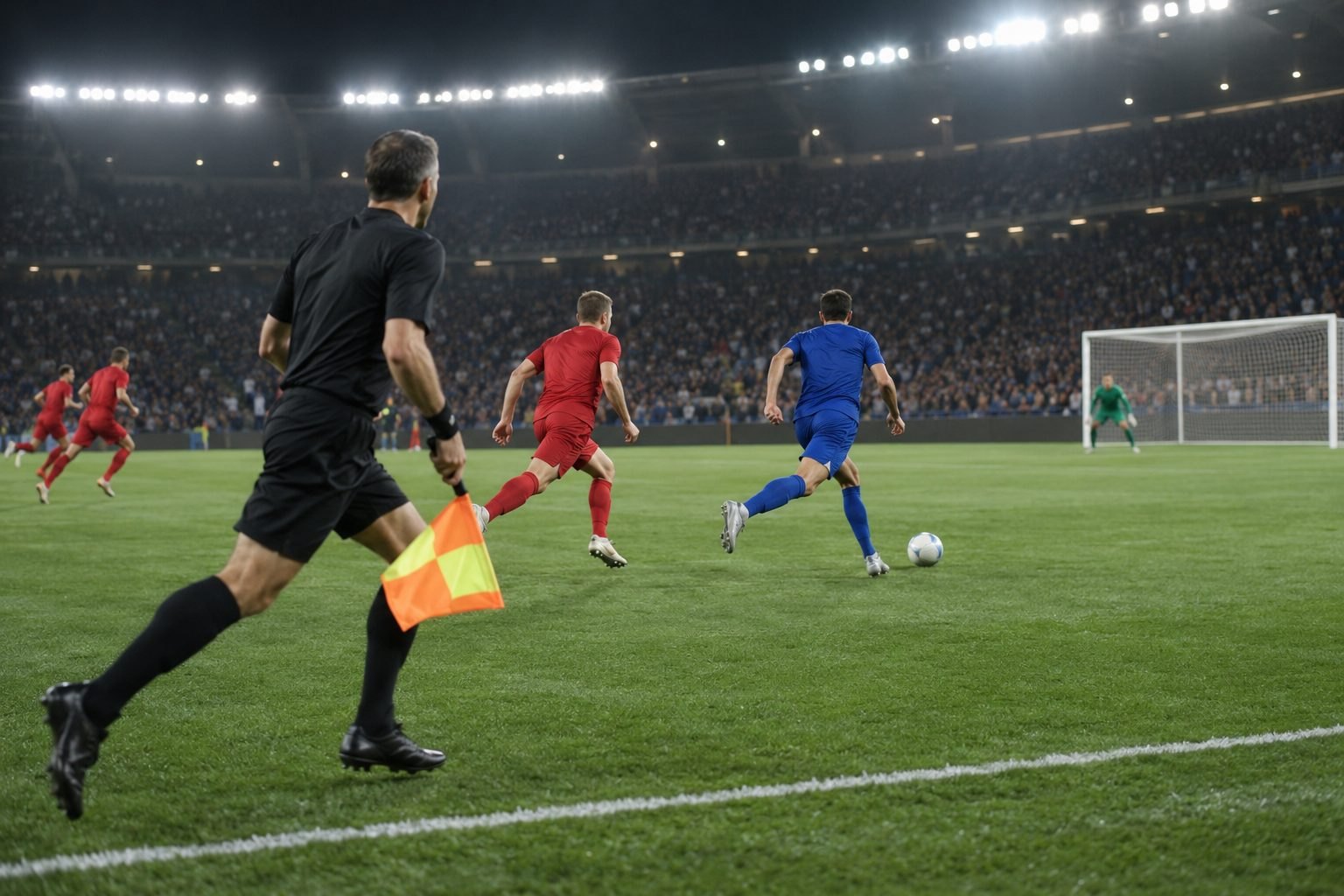
An assistant referee, often called a linesman, must be in line with the second-last defender, or with the ball if it is nearer the goal line, and must always face the field of play, even when running.
Basic positioning rule
That is the starting point for normal play and for many restarts. At a kick-off, for example, the assistant referees must be in line with the second-last defender.
At a goal kick, a penalty kick and a penalty shoot-out, the positions differ where additional assistant referees are used.
Where the assistant referee stands in each situation
Here are the standard positions for each situation.
| Situation | Position |
|---|---|
| Corner kick | Behind the corner flag, in line with the goal line |
| Free kick | In line with the second-last defender, to check the offside line |
| Goal kick | Checks the ball is inside the goal area, then takes a position to check the offside line |
| Goalkeeper releasing the ball | In line with the edge of the penalty area, then a position to check the offside line |
| Kick-off | In line with the second-last defender |
| Penalty kick | At the intersection of the goal line and the penalty area; on the touchline in line with the penalty mark is recommended where technology can check the goal line |
| Penalties (penalty shoot-out) | One at the intersection of the goal line and the goal area, the other in the centre circle |
What changes in the main restart situations
Corner kick
At a corner kick, the assistant referee’s position is behind the corner flag, in line with the goal line. The assistant referee must not interfere with the player taking the kick and must check that the ball is properly placed in the corner area.
Free kick and short-range assistance
For a free kick, the assistant referee must stay in line with the second-last defender to monitor the offside line. If there is a direct shot on goal, the assistant referee must also be ready to follow the ball by moving down the touchline towards the corner flag.
When a free kick is awarded very close to the assistant referee, the assistant referee may enter the field of play, usually at the referee’s request, to help ensure that players are 9.15 m from the ball. The referee must then wait until the assistant referee is back in position before play restarts.
Goal kick and goalkeeper release
At a goal kick, the assistant referee must first check whether the ball is inside the goal area. If it is not placed correctly, the assistant referee must stay where they are, make eye contact with the referee, and raise the flag; once the ball is correctly placed, the assistant referee must then move into a position to check the offside line.
When the goalkeeper is about to release the ball, the assistant referee must be in line with the edge of the penalty area and check that the goalkeeper does not handle the ball outside it. Once the ball has been released, the assistant referee must then move into a position to check the offside line.
Penalty kick and penalties
At a penalty kick, the assistant referee must be positioned at the intersection of the goal line and the penalty area. Where technology, such as goal-line technology or the VAR system, can check the goal line for goalkeeper encroachment and for goal or no goal, it is recommended that the assistant referee stand on the touchline in line with the penalty mark, which is also the offside line.
That recommendation is made because standing on the goal line creates a risk that the assistant referee may not be able to get back into position to judge offside if the kick rebounds. For penalties (the penalty shoot-out), one assistant referee must be positioned at the intersection of the goal line and the goal area, and the other must be in the centre circle to control the players.
Substitutions and the halfway line
Substitutions can also change where the assistant referee goes. If there is no fourth official, the assistant referee moves to the halfway line to help with the substitution procedure, and the referee must wait until the assistant referee is back in position before play restarts.
If there is a fourth official, the assistant referee does not need to move to the halfway line. An exception applies when there are several substitutions at the same time.
FAQ
Where does the linesman stand at a corner kick?
The assistant referee stands behind the corner flag and in line with the goal line. The position comes with two extra duties: not interfering with the kicker and checking that the ball is properly placed in the corner area.
Where do the linesmen stand in a penalty shoot-out?
One assistant referee stands at the intersection of the goal line and the goal area. The other stands in the centre circle to control the players.
Does the assistant referee stand near halfway for a kick-off?
The required position at a kick-off is in line with the second-last defender. The halfway line is not the reference point.
Does VAR change the assistant referee’s position at a penalty kick?
Where technology can check the goal line, standing on the touchline in line with the penalty mark is recommended. That recommendation exists because a rebound can leave too little time to recover from the goal line to the offside line.
Can the assistant referee come onto the field to help with a free kick?
Yes, when the free kick is very close to the assistant referee. That entry onto the field is usually at the referee’s request, to help ensure that players are 9.15 m from the ball, and the referee must wait until the assistant referee is back in position before restarting play.