
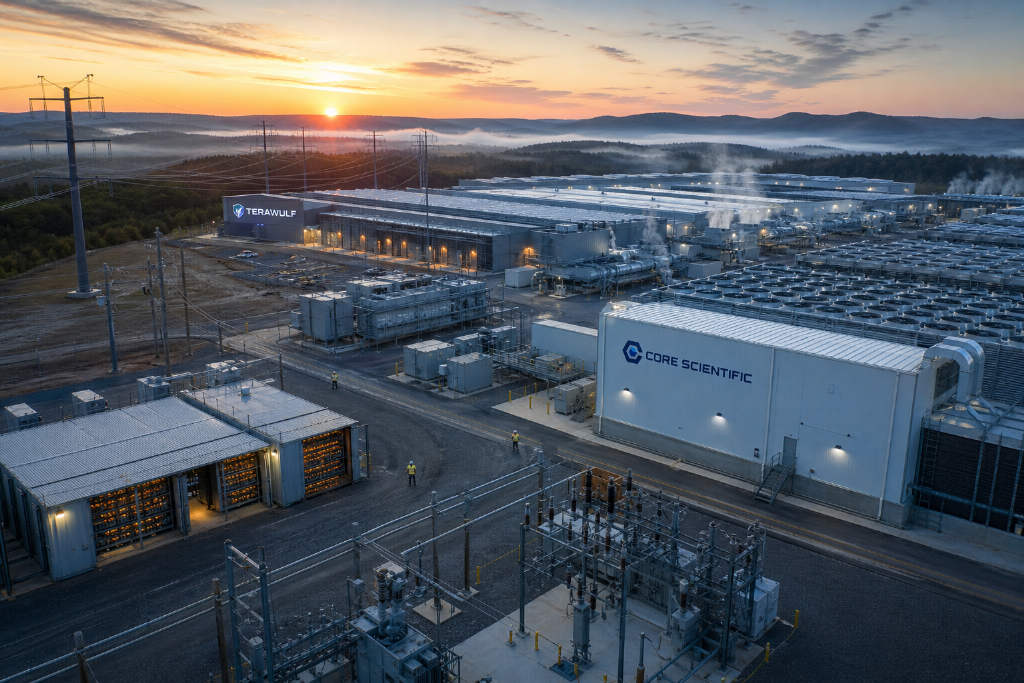
Publicly listed Bitcoin miners cut their operating hashrate by 13.4% between 2025 Q4 and 2026 Q2, a larger decline than the 10.6% drop seen across the Bitcoin network over the same stretch. BlocksBridge Consulting said in the latest edition of Miner Weekly that the retreat was not the result of a Bitcoin price collapse pushing miners out. Large operators have instead been moving power and facility capacity into AI data center and high-performance computing, or HPC, workloads.
Hashrate fell sharply, especially outside Bitdeer
A group of public Bitcoin miners posted 255 EH/s of actual hashrate in the second quarter of 2026. Compared with 324.6 EH/s six months earlier, that marks a 21.2% decline. The article notes that this set excludes Bitdeer.
Once Bitdeer is added back in, the overall hashrate of public miners still declined 13.4% over six months, which was steeper than the 10.6% drop for the Bitcoin network as a whole during the same period. BlocksBridge Consulting said the contraction was concentrated among several large public names.
Bitdeer moved in the opposite direction. Its hashrate grew 44% to 63 EH/s, making it one of the few public miners still expanding its Bitcoin mining footprint.
Core Scientific and TeraWulf now make more from AI than mining
Quarterly results show how quickly the business mix is changing. Core Scientific reported $136.7 million in AI hosting revenue in the second quarter, while mining revenue fell to $27.5 million. That puts AI at nearly five times the size of its mining segment.
TeraWulf showed a similar split. The company reported $31.9 million in HPC leasing revenue and only $12.8 million in mining revenue, with AI-related operations accounting for more than 70% of total revenue.
As presented in the article, the main source of cash flow at both companies is no longer Bitcoin mining. It is compute demand from AI customers.
Power contracts and mining sites are being redirected
Core Scientific announced in April that it would fully convert its 1.5 GW Texas Bitcoin mining site into an AI data center and spend $4 billion expanding facilities across four states. TeraWulf, for its part, signed a 20-year, $19 billion compute agreement with Anthropic in July, and its stock jumped 17% in a single day.
Not every public miner has made the same move. At Riot Platforms and Bitdeer, Bitcoin mining still accounts for the bulk of revenue in the most recent quarter. Their approaches differ. Bitdeer is still adding hashrate and is sticking with a long-term Bitcoin bet, while Riot Platforms is still evaluating the pace of any transition and has not shifted fully.
The article also points to a wider economic backdrop. After the 2024 Bitcoin halving, miner revenue was cut in half, while electricity demand from AI data centers has climbed quickly since 2022. For miners that already control data center capacity and power contracts, selling that capacity to AI companies can be more profitable than using it to mine Bitcoin.
Valuation models are changing with the business mix
Public miners have pulled nearly 50 EH/s of hashrate from the network. The article says that creates a real test for Bitcoin’s defensive strength. Smaller miners or facilities in other regions may eventually fill the gap, but the concentration of network hashrate could be redistributed in the short term.
Over a longer horizon, the valuation framework for Bitcoin miners is being rewritten. When a company draws part of its cash flow from AI contracts and part from mining, the market is no longer valuing it simply as a levered Bitcoin proxy. The article describes the new logic as a mix of power infrastructure and compute leasing.
That also helps explain why investment banks including JPMorgan have identified Bitcoin mining companies as potential acquisition targets for AI giants. According to the article, the appeal is not Bitcoin itself, but ready-built power infrastructure.
What the market will be watching next
The article highlights several open questions. One is how long Core Scientific and TeraWulf can sustain margins on their AI contracts, especially if more traditional data centers enter the market and put pressure on leasing prices. Another is Riot Platforms’ timetable for any transition, along with whether Bitdeer’s strategy of continuing to add Bitcoin exposure can remain profitable over the long run.
The final variable is the network itself: whether Bitcoin hashrate will keep falling as public miners step back, or whether smaller operators will move in and take over the capacity being left behind.