
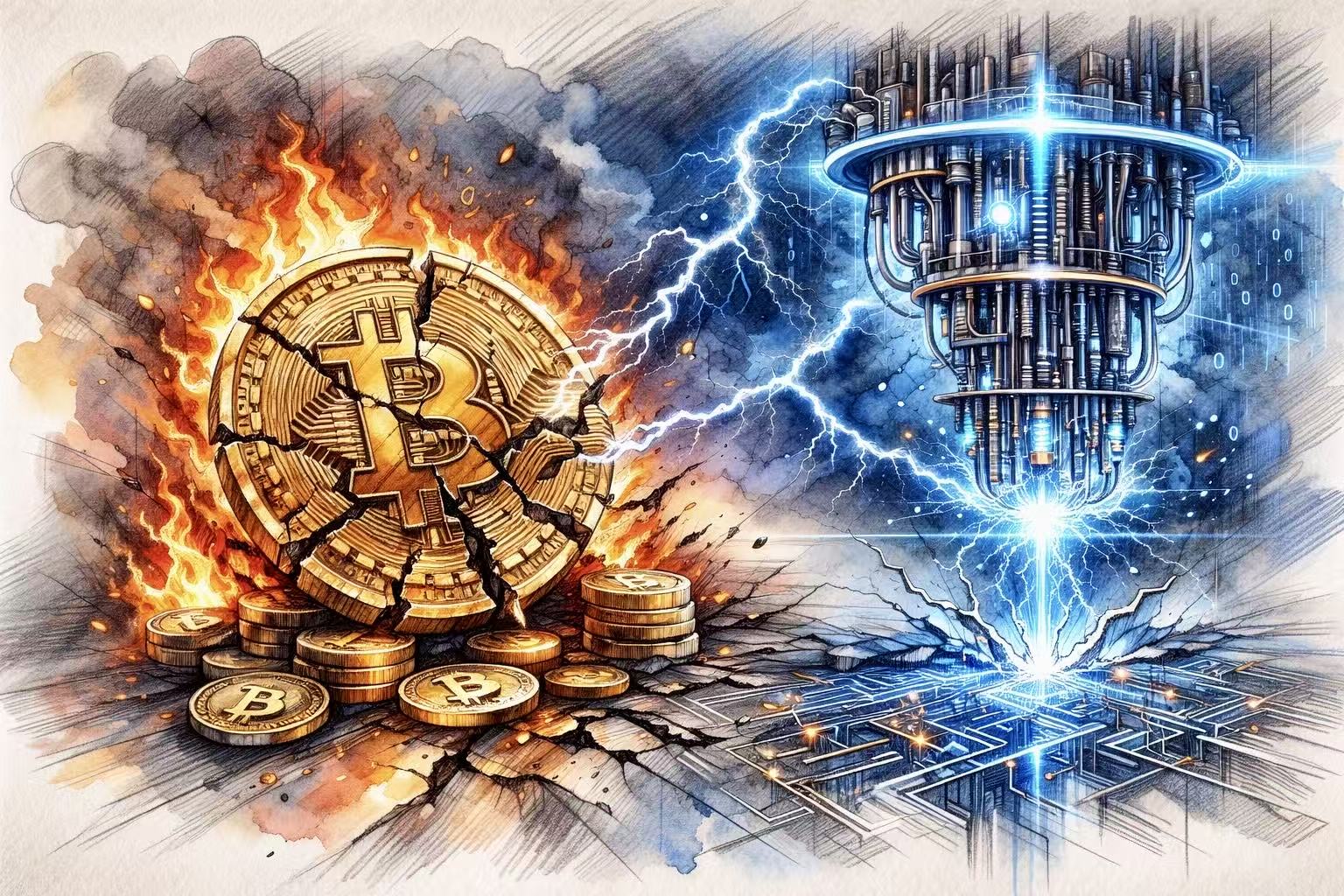
The mainstream debate about "quantum computing killing Web3" is looking in the wrong direction. Quantum is not a threat but an infrastructure migration. Strong cryptography, tamper-evident communication, physical randomness, and attestation are being pushed down from software layers to the substrate. Blockchains no longer need to "over-compensate" for untrusted networks by replicating trust primitives in software; they can focus on governance, incentives, and cross-domain coordination—the irreducible problems.
What Quantum Actually Changes (and What It Doesn't)
Quantum computers are not "faster GPUs"; they are specialized machines for factoring large numbers and solving discrete logarithms. They are not good at general computation, running large software systems, cloud infrastructure, or training AI models. The real threat: RSA and elliptic curve cryptography (ECC) are exactly the kinds of math quantum computers excel at. This affects not just blockchains but the entire trust base of the internet—logins, certificates, signatures, key exchanges, identity systems.
The timeline is uncertain but the direction is clear. Most credible estimates say a cryptographically relevant quantum computer is 10–20 years away, but no one can rule out an earlier breakthrough. The most immediate risk is "Harvest Now, Decrypt Later." Attackers already collect encrypted communications and data, waiting for future quantum power to decrypt them, threatening government communications, corporate secrets, and medical records.
The good news: post-quantum cryptography does not require quantum hardware. It is a software and protocol upgrade—TLS, VPNs, wallets, and signature schemes. The transition will be slow and uneven, like IPv6. For blockchains, quantum is not an existential crisis but a cryptographic upgrade path. The Ethereum Foundation has already made post-quantum security a core priority, launching research on quantum-resistant signatures, account models, and transaction mechanisms.
The Network Layer Shift: Invisible Listening No Longer Possible
While quantum computing attacks math, quantum communication attacks network trust. Quantum key distribution (QKD) uses quantum states to create tamper-evident channels—any silent interception is physically detectable. This is not a faster network, but a trust mechanism that cannot be quietly penetrated. Web3 today assumes the network is adversarial and invisible, forcing layers above to "over-compensate" with replication, verification, and economic security. If infrastructure embeds channel integrity, the cost of securing a channel drops dramatically. This is often missed in the "quantum doom" narrative.
The Trust Problem of Autonomous AI Agents
The real bottleneck is the rise of autonomous AI agents. They cannot rely on informal trust or institutional shortcuts. They require verifiable execution, coordination mechanisms, data provenance, and commitment mechanisms. Quantum networks do not solve coordination directly, but they commodify security at the substrate level. When security becomes infrastructure, more coordination can happen off-chain with stronger guarantees. Blockchains shift from pure broadcast systems to the coordination base for autonomous systems.
Frontier Quantum Primitives
Quantum processes can generate physically enforced randomness, unpredictable and unbiasable, supporting fairer validator selection and auctions. Quantum states cannot be copied—combined with hardware attestation, they enable non-cloneable device identities. Quantum-enhanced clock synchronization allows tighter time windows for cross-domain settlement. Most of these are still long-term possibilities, but they already shape how systems are designed.
Objections and Real-World Constraints
Quantum-secure communication is currently expensive, fragile, and limited in coverage. It will likely concentrate in high-value corridors—government networks, financial infrastructure, critical systems—creating a hybrid trust landscape. But even limited deployment reshapes design assumptions across the stack. Builders begin assuming "security by default," moving complexity to how systems interact, enforce permissions, and coordinate across boundaries.
Adaptation Timeline
Next 5 years: post-quantum cryptography rolls out across cloud providers and enterprises; quantum security becomes a default checklist item. 5–10 years: design assumptions shift; builders design for a world where security is baseline. 10+ years: quantum-secure channels become common in financial centers and government networks; infrastructure finally catches up with design patterns established years earlier.
Quantum will not kill Web3. It will force it to grow up. When security becomes infrastructure, what remains is the hard stuff—autonomy, commitment, and coordination.