
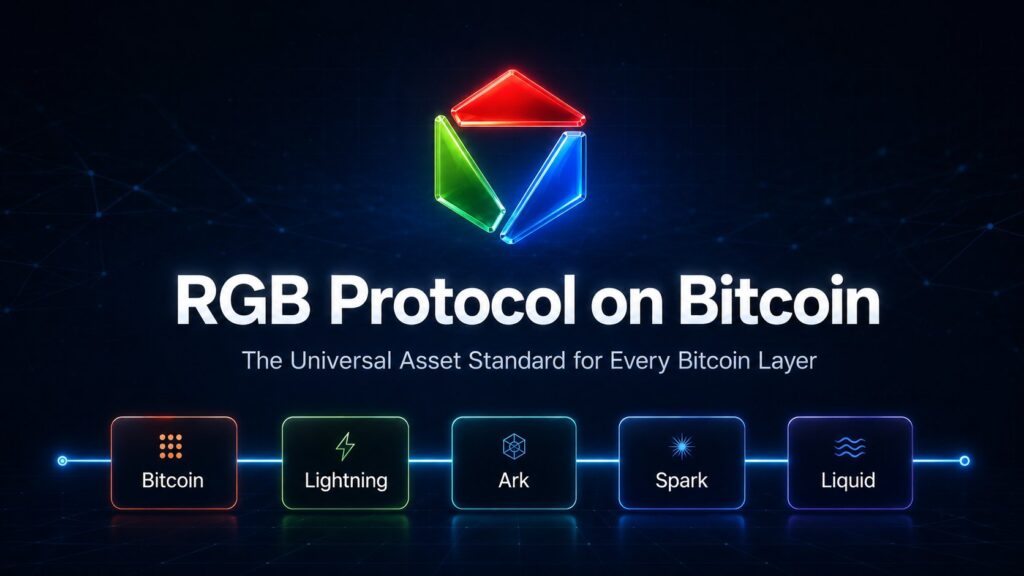
RGB has restated its ambition to serve as the common asset standard for Bitcoin’s multi-layer ecosystem, saying the current approach — where Lightning, Ark, Spark and other protocols build separate token standards — is fragmenting development across the stack.
The argument, laid out in an official RGB document updated on July 30, comes as Tether moves to bring USDT back to Bitcoin through RGB. Tether said on July 6 that it plans to issue USDT natively on Bitcoin using RGB, with UTEXO leading commercial rollout. The launch is expected within weeks. The source article notes that USDT’s previous issuance on Bitcoin dates back 12 years to the Omni Layer era.
RGB frames itself as a cross-layer standard
Bitcoin’s broader ecosystem now includes a range of second-layer or adjacent protocols, including Lightning, Ark, Spark, Liquid and Statechains. The issue, according to the July 30 document, is that each layer is developing its own asset rules. That means the same stablecoin use case can require a different rule set on each network, forcing developers to rewrite applications and wallet providers to integrate each stack separately.
RGB’s answer is to present itself as the unifying layer for asset issuance across Bitcoin-based systems.
Its design differs from Ethereum’s ERC-20 model. RGB uses client-side validation, so asset data and contract state are not written directly to the blockchain. Instead, transaction participants store and verify the relevant data themselves, while only commitments are left on-chain. Asset ownership is tied directly to Bitcoin UTXOs, meaning control of the UTXO determines control of the asset linked to it.
Asset transfers are designed to avoid bridge dependency
The source article says this structure gives RGB a distinctive feature: assets can be sent to future UTXOs that do not yet exist. Because ownership follows the UTXO, assets can move between Bitcoin’s base layer and Lightning channels without requiring a cross-chain bridge, while settlement remains anchored to the Bitcoin main chain.
That matters because bridges have been among the most heavily exploited products in crypto over the past several years. Fewer bridge dependencies mean fewer attack surfaces.
Technical groundwork has advanced, though support is uneven
The article argues that RGB’s bottleneck is no longer core technology alone, but actual use. RGB left testnet in July 2025, and version 0.11.1 gained full support on Bitcoin mainnet. Multiple teams have also built wallets, commercial tools and Lightning-related infrastructure, with RGB Lightning Node handling Lightning integration.
At the same time, support for Ark, Statechains and Liquid is still at the proof-of-concept stage, according to the official document referenced in the report.
On the consensus side, the LNP/BP Standards Association released version 0.12 on July 10, 2025 after an eight-month rebuild. The update removed Pedersen commitments and Bulletproofs in favor of zk-STARKs, cut consensus code size by about four times, reduced the zk-AluVM instruction set to 40 instructions, pushed consensus library test coverage above 75%, and added protection against block reorganizations. The article describes that work as part of preparing the protocol for production use.
Tether may become the first real adoption test
For all the work on specifications, RGB still faces the same question it has faced for years: whether anyone will use it at meaningful scale.
That is where Tether enters the picture. On July 6, Tether said it would issue USDT natively on Bitcoin through RGB, with UTEXO acting as the official issuance and distribution partner. The source says UTEXO has already prepared an API, SDK, interface tools and a minting bridge, while Tether Wallet and some exchanges are expected to add support within weeks.
UTEXO also completed a $7.5 million seed round in March this year, and Tether was identified in the article as the lead backer.
The scale of the opportunity is visible in USDT’s current distribution. About 92% of circulating USDT sits on Ethereum and Tron, according to the report. Tron has dominated stablecoin transfers for years on the back of lower fees, a period that coincided with delays in RGB’s development. USDT itself first launched on Bitcoin through Omni Layer in 2014. Now, under Tether’s latest plan, it is set to return to that base settlement network.
The next test is distribution, not theory
If USDT is paired with Lightning, the article says, it could support instant off-chain payments without requiring users to hold a separate token for fees. That would make the model different from most on-chain issuance setups.
What comes next depends less on architecture than on access points. Exchanges need to list it, wallets need to integrate it, and payment providers need to accept it. That is where standards are usually decided.
In the source article’s framing, Tether is the only major player currently positioned to bring immediate usage at scale. Whether RGB can turn that momentum into a unified Bitcoin asset standard may become clearer before the end of the year.