

Ripple completes MiCA licensing process for Europe
Ripple has obtained a full license under the European Union’s Markets in Crypto-Assets, or MiCA, framework, allowing it to provide regulated crypto services across the European Economic Area. The authorization was granted by Luxembourg’s financial regulator, completing the company’s licensing process in the region.

The approval follows Ripple’s preliminary authorization in June and adds to its existing Electronic Money Institution license. Ripple said it is now among a relatively small group of crypto firms that have secured full MiCA authorization and that it holds more than 75 regulatory licenses worldwide, including approval from the UK Financial Conduct Authority.
The timing is significant because the EU’s MiCA transition period ended on July 1. From that point onward, crypto firms were required to obtain authorization or stop offering regulated services. The European Securities and Markets Authority now lists 280 licensed crypto service providers, up from 243 a week earlier, highlighting a sharp increase in approvals and disclosures around the compliance deadline.
Not every company met that deadline. Binance withdrew its MiCA application in Greece ahead of July 1 and said it plans to seek authorization in another EU member state instead. Belgium has also started identifying crypto service providers operating without authorization. As MiCA moves from transition to active enforcement, licensing coverage and cross-border compliance capacity are becoming key differentiators for exchanges, payment companies and other crypto businesses operating in Europe.
Strategy sells Bitcoin to fund preferred stock payouts
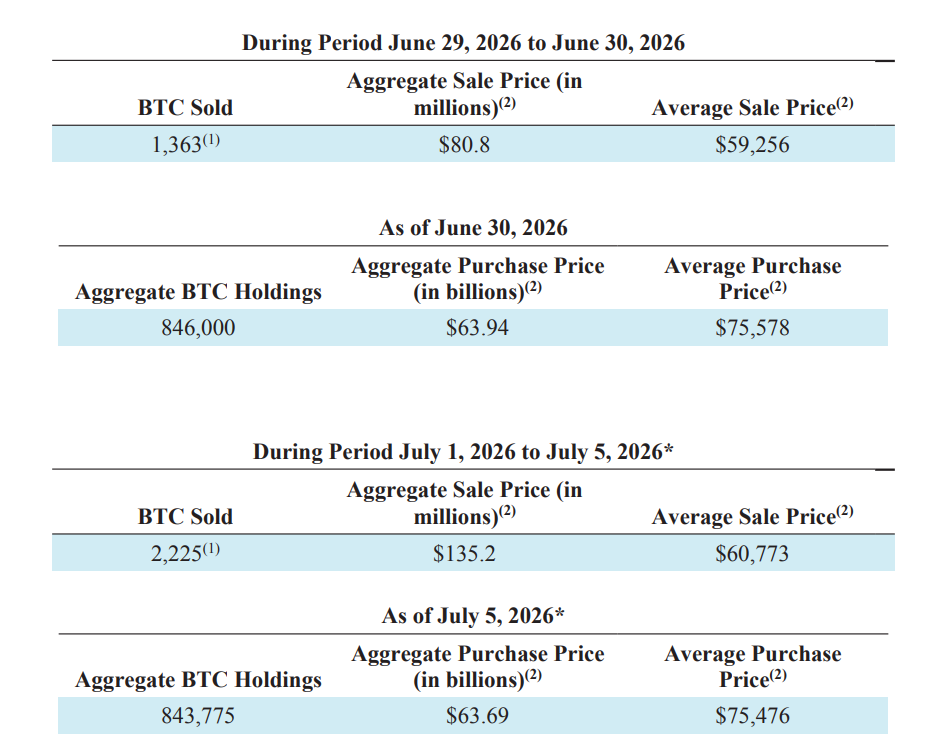
Strategy, the company closely associated with Michael Saylor’s Bitcoin treasury strategy, disclosed in a filing with the US Securities and Exchange Commission that it sold 3,588 BTC for about $216 million. The company said the proceeds were used to fund preferred stock dividend payments and replenish cash reserves. After the sale, Strategy’s total Bitcoin holdings stood at 843,775 BTC.
The filing broke the transactions into two windows. Strategy sold 1,363 BTC between last Monday and Tuesday at an average price of $59,256, then sold another 2,225 BTC between Wednesday and Sunday at an average price of $60,773. The disclosure follows the company’s reported sale of 32 BTC in early June, which had already drawn attention as its first publicly reported Bitcoin sale since a 2022 tax-loss transaction.

In a separate June 29 Form 8-K, Strategy outlined a capital framework that explicitly allows Bitcoin sales to support dividend payments. The company also raised the annual dividend rate on its STRC preferred stock to 12% and disclosed that its US dollar reserve had increased to $2.55 billion.
Monday’s filing showed that the $2.55 billion dollar reserve remained unchanged. That suggests the latest Bitcoin sale was tied to an already disclosed capital management plan rather than an emergency liquidity move. For a company that has built its identity around holding Bitcoin on its balance sheet, the transaction underscores an evolving approach: preserving a large long-term BTC position while also meeting obligations to preferred shareholders through flexible treasury management.

Coinspect flags “Ill Bloom” wallet vulnerability across multiple chains
Blockchain security research firm Coinspect said thousands of crypto wallets may be vulnerable to theft because of weaker-than-intended recovery phrases. The issue, which the firm has named “Ill Bloom”, is linked to weak randomness during the generation of wallet recovery phrases on certain software wallets.
According to Coinspect, the affected wallets span multiple networks, including Bitcoin, Ethereum, Polygon, Rootstock, Tron and Solana. The core problem is not in the blockchains themselves but in the use of an insecure pseudorandom number generator when seed phrases were created. In practice, that means some recovery phrases may be more predictable than users or wallet developers intended.
Coinspect warned that if funds have recently moved without permission, this vulnerability may be one possible cause. The firm said the issue appears more frequently in lesser-known mobile software wallets and may affect wallets generated as far back as 2018.

The firm estimates that at least $5 million has been drained from exposed wallets since May 27. It also cautioned that the true scope may be larger, because additional networks and addresses may have been exploited without being fully identified yet. As a result, the number of at-risk wallets could be significantly higher than the currently confirmed set.
The disclosure highlights a different category of wallet risk than phishing, malicious signing or direct private key leaks. “Ill Bloom” strikes at the recovery phrase generation stage itself. If entropy is flawed at creation, attackers may be able to reconstruct or narrow down seed phrases without ever compromising a user’s device directly. That makes older wallets, obscure mobile wallet apps and wallets with unexplained fund movements especially important to review in the aftermath of the disclosure.