

Bernstein said in a September 8 research report that Robinhood Chain is emerging as a new high-margin growth engine for Robinhood.
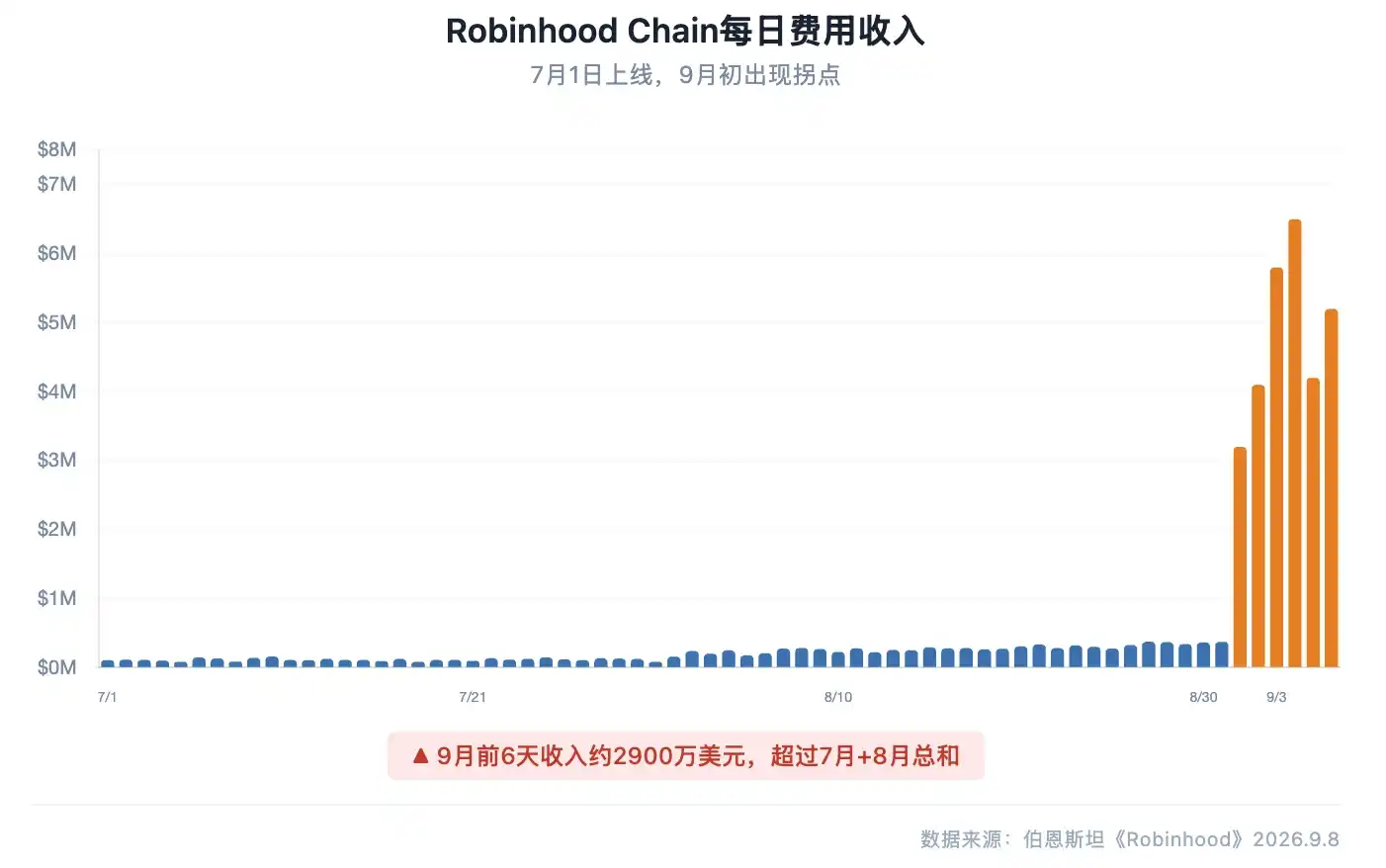
The chain launched on July 1. Over the past 15 days, it generated about $33 million in transaction fees, the highest among blockchains cited in the report, with Robinhood keeping roughly 90% of that revenue. Bernstein also said Robinhood Chain’s share of tokenized stock trading value rose from about 0.5% to 5%, while cumulative on-chain trading volume passed $50 billion.
24/7 network aimed at retail investors
Bernstein described Robinhood Chain as a 24/7 blockchain network where retail investors can trade tokenized stocks, crypto tokens, and lending assets, while also earning yield on stablecoins and other real-world assets.
The firm maintained an outperform rating on Robinhood and set a $160 price target, implying about 31% upside.
On-chain traction pushed the chain into the top group within two months
In a little over two months, Robinhood Chain reached about $1.5 billion in total value locked, more than $50 billion in cumulative DEX volume, roughly $7 billion in cumulative perpetual futures volume, over 550 million transactions, and about $39 million in cumulative on-chain fees.
During the past 15 days, the chain ranked first in fee revenue and second in spot DEX trading volume, according to the report.
Fee generation showed a sharp turn higher. Monthly fee revenue was about $3.6 million in July and about $6.7 million in August. In the first six days of September, the chain had already produced about $29 million. Over the latest 15-day period, Robinhood Chain brought in about $33 million in fees, far ahead of Solana at about $11 million, BSC at about $9 million, and Ethereum at about $6 million.
DEX activity is shifting toward tokenized stocks
The composition of DEX volume has changed over time.
In early August, meme coin pairs made up about 70% of trading, ETH-USD pairs accounted for about 25%, and tokenized stock pairs were about 6%. By early September, ETH-USD pairs and meme coin pairs each stood at about 36%, while Robinhood tokenized stock pairs rose to about 27%.
Bernstein said speculative demand in meme coins has helped pull in demand for tokenized stocks. The two are paired in Uniswap automated market maker pools, creating what the report described as a two-way positive feedback loop. The note added that the stock tokens maintain a 1:1 peg with the underlying shares and are backed by real stocks held in custody.
Tokenized stock share rose from 0.5% to 5%
Robinhood uses a third-party tokenization model for tokenized stocks, buying the underlying shares, holding them in custody, and issuing blockchain tokens against them.
Those tokens are structured as debt securities that track the economic performance of the underlying stock. They provide economic exposure, not ownership. Holders do not receive shareholder rights such as voting rights. The report said Robinhood automatically reinvests dividends into additional underlying shares, so each token can represent more than one share over time.
Market capitalization for tokenized stocks increased from about $10 million to about $140 million, and Robinhood Chain’s share of total tokenized stock value climbed from about 0.5% to about 5%.
Including ETFs, commodities, and U.S. Treasuries, the total value of tokenized assets on Robinhood Chain is about $150 million. Stocks account for about 76%, ETFs about 17%, and commodities about 6%.
The number of addresses holding tokenized stocks grew from about 35,000 at the end of August to about 107,000.
Weekly tokenized stock trading value has been running in a range of about $4 billion to $6 billion. Robinhood Chain accounts for about 32% of that activity, second only to BNB Chain at 53%. Bernstein said the gap between a 5% value share and a trading share of more than 30% suggests tokenized stocks on Robinhood Chain are being traded actively. The report linked that to their use in DEX meme coin pairs and as collateral.
Stablecoins and perpetual futures both expanded
Stablecoin supply on Robinhood Chain has reached about $1 billion, concentrated mainly in two assets. Global Dollar (USDG) makes up about 66%, while Ethena’s USDe accounts for about 33%.
Cumulative perpetual futures volume is about $7 billion. August alone contributed about $6.7 billion, compared with only about $300 million in July. Bernstein said decentralized exchange partner Lighter, which launched alongside the chain, was the main driver.
Financial impact centers on high-margin incremental revenue
Bernstein said Robinhood Chain is currently generating about $2 million to $4 million in daily transaction fees. The average over the past 15 days was about $2.2 million a day, equal to roughly $1.2 billion on an annualized basis.
Robinhood keeps about 90% of that revenue, shares 10% with Arbitrum as the technology provider, and pays less than 1% in data costs to Ethereum mainnet.
The firm said its current model includes about $160 million in on-chain fee revenue for 2028, but actual results are already running well above that assumption. In Bernstein’s view, blockchain revenue is fundamentally high-margin revenue that can flow directly into earnings per share.
Its forecasts call for a 32% compound annual growth rate in revenue from 2026 to 2028 and a 49% compound annual growth rate in earnings per share. Bernstein projects 2028 EPS at about $4.56, which underpins the $160 target price.
Valuation and risks
The report said Robinhood shares were trading at about $122, versus Bernstein’s $160 target, implying about 31% upside. The target is based on a 35x forward price-to-earnings multiple applied to 2028 EPS of $4.56.
Bernstein flagged regulatory risk as a key concern. The U.S. Securities and Exchange Commission has historically taken a strict stance on crypto trading businesses, and if certain tokens are treated as securities, Robinhood’s crypto trading business could be affected. The note also said digital assets remain an early-stage asset class with limited price history.
The original article stated that the piece was a summary and interpretation by Chaoxiang Research of a third-party brokerage report from Bernstein dated September 8, 2026, combined with public market information. It added that the ratings, target price, earnings forecasts, and related judgments cited in the article are the views of Bernstein analysts only, represent the position of their institution, do not represent the view of Chaoxiang Research, and do not constitute investment advice.
The article also said markets carry risk, decisions should be made independently, and the report should not be used as the basis for buying or selling any security.