


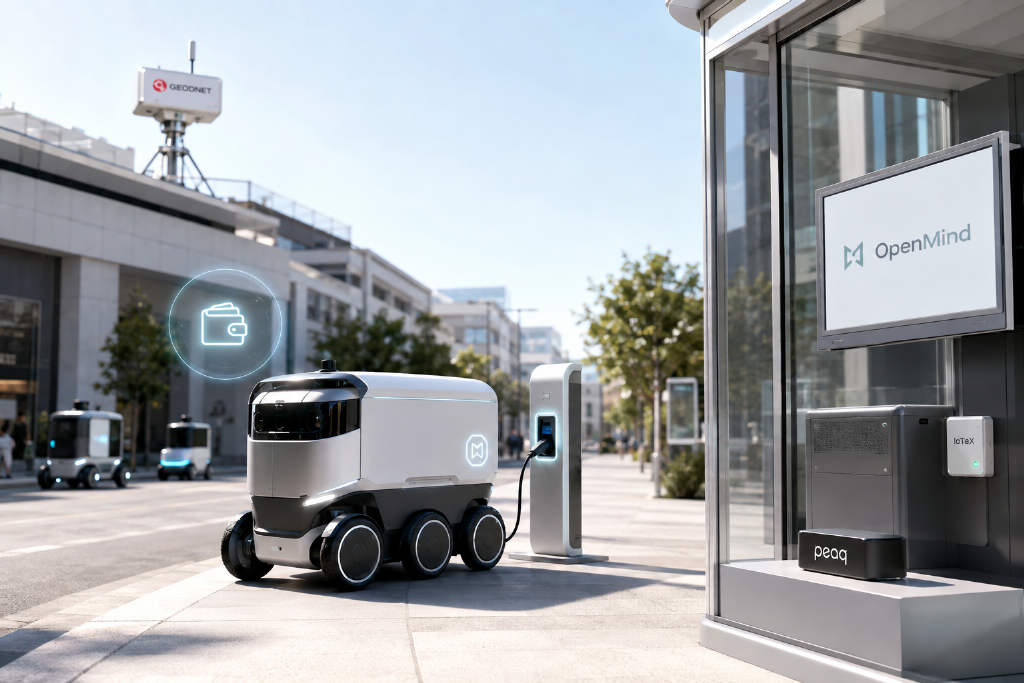
By Thejaswini M A. Translated by Chopper, Foresight News.
Do robots need money? Not AI agents calling APIs, but physical machines that move through the real world.
That question sits behind a small but active corner of crypto. More than a dozen companies are already building products around the idea that machines may need wallets, verifiable identities and a way to make tiny payments on their own. The pitch is not abstract. It is tied to a specific operational problem: when robots start buying electricity, positioning, compute or other low-cost services, the traditional payment stack is a poor fit.
Why the existing payment system breaks down
Starship Technologies operates about 3,000 six-wheeled delivery robots across eight countries, mainly in European city centers, and has completed more than 10 million commercial deliveries. Serve Robotics, which is listed on Nasdaq, has expanded into 44 cities including Los Angeles, Chicago, Atlanta, Miami and Dallas, handling delivery orders for Uber Eats and DoorDash.
These box-shaped robots on wheels typically carry about 20 kilograms and travel several miles on a trip. In those cities, spotting one on the street is no longer unusual.
Now take a smaller operator. Suppose you buy one delivery robot to run a neighborhood delivery business. It works 12 hours a day, and you fully own it once purchased. Based on Starship’s machine specifications cited in the piece, a full charge can keep it running for up to 18 hours. At some point it has to recharge.
For Starship, the answer is straightforward: its robots work outdoors and return to company-owned chargers. That model works because the company has scale and enough capital to build charging stations across all of its operating areas.
A single owner with one robot does not have that luxury. The machine would likely have to use a third-party charging point. An operator could deploy charging facilities much like EV charging stations. Street-side shops could offer charging services, or another delivery provider could open spare charging ports. The battery is roughly comparable to that of an electric bicycle, so the electricity consumed in one charge is small. The article puts the charging cost somewhere between a few cents and less than $1, using $0.40 as a working example.
That is where settlement becomes awkward.
The obvious option is to link a payment card to the robot and let it tap to pay. But card transactions usually include two components: a percentage of the payment amount plus a fixed fee of 10 to 30 cents. That fixed charge does not change whether the transaction is worth $0.40 or $400 because the processing cost itself is broadly constant. On a $0.40 payment, a $0.30 fixed fee consumes 75% of the transaction value.
The article then scales that math up. If machines eventually carry out $1 billion worth of small service transactions in a year, with an average payment of about $0.32, the annual transaction count would reach about 3 billion. At $0.30 in fixed fees per payment, that would imply roughly $900 million in fees on $1 billion of revenue.
Wire transfers are even less practical. A cross-border SWIFT transfer usually costs $15 to $50, with intermediary banks charging another $10 to $30 each, before adding foreign exchange costs. That setup is typically suitable only for transfers above $5,000.
The current monetary system was built for a small number of larger transactions. Machine-led commerce looks like the opposite: frequent, fragmented and low-value.
The harder problem is identity
Lowering fees still would not fully solve the issue. A charging station cannot really debit a robot’s account, because payment accounts belong to people or companies and sit inside systems designed around human account holders, disputes and liability. In practice, the owner still pays and the robot only triggers the action. According to the article, that is how robot payments are handled globally today.
When a charging point authorizes an unfamiliar device to draw power for a few seconds, it has to assess several things at once:
- whether the machine is a real physical device rather than a scripted request trying to get free electricity;
- whether the device has a credible operating history and is unlikely to leave halfway through charging;
- whether there is a basis for accountability if the machine malfunctions and causes damage.
Giving robots a standalone identity is meant to answer those checks without relying on a paper contract.
At the moment, many of those issues are still handled manually. A service provider can invoice you monthly, and if the robot damages something, the claim comes back to you. That can work in a small setup. It does not scale cleanly in a world where 2,000 operators and 40,000 machines may encounter one another in public space and make decisions in seconds.
That is the core logic behind the entire thesis.
Most robots will never need this
The article is explicit about the limits of the market. Most robots will never need autonomous payment or standalone asset accounts.
It says a robot would need such a system only if four conditions are met at the same time:
- the devices belong to different owners;
- the business consists of small, sporadic transactions;
- there is no centralized platform settling both sides;
- service authorization has to happen on the spot within seconds.
Amazon’s more than one million in-house robots across over 300 warehouses fail the first condition because they operate under a single owner and scheduling system. Platform businesses such as Uber Eats fail the third. Devices that already have pre-signed agreements with merchants usually fail the second and fourth.
That makes this a niche within a niche, not a universal requirement for the robotics industry.
The article points to several large players that largely sit outside this need. Tesla has deployed about 1,000 Optimus humanoid robots internally, but said in an earnings call that the machines remain in a learning and data-collection stage and are not yet open for external commercial services. FANUC, one of the largest industrial robot makers, sells hardware and offers the FIELD monitoring platform for fault warnings, but that setup does not involve fund flows.
Unitree Robotics, meanwhile, has pushed humanoid purchase costs down to a more affordable range. The article says the company completed a listing in Shanghai in August 2026 and raised about $619 million, after shipping more than 5,500 humanoid robots in the previous year. The company disclosed that buyers were using them in a wide range of scenarios. In May 2026, it also launched UniStore, an app store for humanoid robots.
The common thread is a closed-system model. Scheduling, collaboration and payment all remain inside proprietary platforms, with the economics captured by the platform itself.
Open protocols are more likely to survive in the gaps between those systems, such as cross-brand coordination between machines run by different operators or public charging services. By the article’s framing, the DePIN segment described by CoinGecko is much smaller than the robotics industry as a whole, and all of the analysis that follows should be read through that lens.
First requirement: machines need precise location
For a robot to pay for services in the field, it first needs to know where it is. Standard GPS has errors measured in meters. Starship’s CEO has publicly said that normal GPS accuracy does not meet the company’s requirements and that its robots need navigation precision at the inch level.
Getting from meter-level errors down to inches requires correction signals. A ground reference station obtains its own precise coordinates, measures the positioning deviation and sends correction data to nearby devices. That is real-time kinematic positioning, or RTK-GPS. The article says the effective coverage radius of a correction signal is about 30 kilometers, which means a large network of reference stations is needed.
GEODNET uses token incentives to persuade users to install positioning base stations on rooftops. According to the article, the network has deployed more than 21,000 devices across over 150 countries and generates about $11 million in annual recurring revenue. Multicoin Capital led an $8 million token acquisition deal.
The project earns money by supplying centimeter-level RTK positioning services to delivery robots, drones and agricultural machinery. On the consumption side, this business does not strictly require crypto tokens. A normal subscription model could also work. But at the infrastructure-building layer, the article argues that GEODNET shows how token incentives can accelerate the deployment of a global physical network. Building it through a traditional corporate approach, it says, could take decades and cost billions of dollars.
Second requirement: machines need a common software layer
Robots from different manufacturers currently run on separate software systems and often cannot communicate directly. A company buying hardware typically chooses a single brand. A mixed deployment of multiple brands would require a custom integration stack that largely does not exist today.
OpenMind, which raised $20 million in a funding round led by Pantera, is trying to change that. Its founder, Jan Liphardt, is a Stanford professor. The team is building an open-source general operating system called OM1 and a coordination layer called FABRIC.
The goal is to provide a shared base layer for robotics, much as Android allowed different handsets to run a common class of applications. Developers would write the business logic once, and the software could adapt to Unitree humanoids, quadrupeds and wheeled delivery machines at the same time.
Longer term, OpenMind wants that common interaction language to let machines from different brands recognize one another, collaborate and settle payments automatically.
The project uses the ERC-7777 standard to build a machine identity framework that defines behavioral boundaries. If a robot is designated for a support role, the software can reject tasks that violate that role definition. Robots can also cross-check each other’s sensor data to reduce safety risks caused by abnormal readings from a single machine.
On the payment side, OpenMind has partnered with Circle and uses the x402 standard to enable gas-free USDC micropayments, aiming at the same fixed-fee problem described earlier. In the team’s demonstration video, a robot successfully paid for electricity on its own.
That demonstration was run on a testnet, and the article notes that there is no real onchain transaction record yet. Even so, it showed that a physical machine can custody a wallet independently, identify a purchasable physical resource and complete the transaction flow end to end. Cooperation between machines, in that model, does not require preexisting trust.
Third requirement: verifiable identity
IoTeX has been building blockchain tools for physical devices since 2017 and focuses on identity through two main products.
The first is ioID, a hardware identity system that embeds a cryptographic fingerprint into a physical device so the device can sign and record its own actions. The second is W3bstream, described as proof of real-world work, which converts physical-world execution into digitally verifiable credentials onchain.
In simple terms, that solves the questions of who the device is and what it did.
The article argues, though, that IoTeX does not address the credit and financing layer, which is where peaq comes in.
Fourth requirement: peaq wants to build a machine trust and settlement stack
If robots are going to pay unfamiliar third parties, verify qualifications and leave auditable transaction trails, they need more than a wallet. They need an infrastructure comparable to company registration systems or cross-border clearing rails for the human economy. That is the role the article assigns to peaq.
peaq’s stack is split into four main modules. peaqID acts as a registration credential. Machine NFTs record ownership and can be fractionalized using ERC-3643, a token standard that allows transfers only between approved holders. In August 2026, peaq added support for P256 chip signatures, shifting verification into hardware security chips.
It also runs a machine credit scoring system. Based on robot revenue data, activity and delivery reliability, machines receive a score from 0 to 100 and a rating scale ranging from AAA to unrated, modeled after traditional credit rating systems.
If a robot is paying a $0.40 charging fee, the charging provider can choose Solana or Ethereum as the settlement network. The article’s view is that peaq’s main value lies in allowing a machine to connect to whichever settlement rail the provider prefers.
In a May 2026 demonstration of Serve delivery robots making autonomous payments, the funds settled on Solana rather than on peaq’s own chain.
Throughout 2026, peaq acted more as an ecosystem integrator. From January through the end of August, it completed 49 development milestones and delivered 20 ecosystem integrations. Those included GEODNET for positioning, NAVER Maps for navigation, World ID for separating human and machine identities, and compute resources from Akash, Acurast and Arcium. It also added Unitree humanoids and LG CLOi commercial service robots as hardware endpoints.
Still, legal recognition remains a hurdle. Corporate registration systems are backed by regulators. Courts can verify them. Banks use SWIFT because the industry agreed on common transaction formats. The article says that if peaq wants machine credit scores to be accepted by financial institutions, it will have to engage regulators in Dubai and seek official licenses. Until that happens, those credit scores do not carry legal force.
From machine financing to tokenized revenue
peaq has also partnered with CoinList on Initial Machine Offerings, a structure under which users can buy shares of machine-generated revenue. The asset design is handled through DualMintRWA.
The article’s example is a tokenized vertical farm in Hong Kong where 80% of operations are automated. It later added 20 tokenized claw machines. So far, the farm has distributed about $3,600 in returns to token holders.
The point is that even if a robot has positioning, software, identity and credit, the hardware still has to be financed. Splitting up machine income and securitizing it is being tested as one way to do that.
Another possible buyer and employer: AI agents
The article also points to another model now being explored: the buyer may not be a person at all, but an AI agent.
Virtuals has connected about 17,000 onchain AI agents to Solana’s BitRobot network. Those agents can pay physical robots to carry out offline work. Funds are held in smart contracts and released automatically after task completion is confirmed.
In the article’s assessment, the model in which software agents pay robots is more commercially sustainable than one in which robots mainly pay each other. AI agents have digital capital, objectives and compute, but they cannot act in the physical world. Physical robots have mobility and hardware capability, but do not naturally come with capital or demand. By contrast, when robots pay one another, they often belong to the same company, and internal accounting is usually simpler and cheaper than genuine onchain settlement.
This remains a small market
Even by crypto standards, this is still a narrow segment. Based on CoinGecko’s market definition for robot-related tokens, GEODNET is worth about $100 million and peaq about $55 million.
Set against the robotics industry as a whole, that is tiny. The International Federation of Robotics said in its World Robotics 2025 report that 542,000 industrial robots were newly installed worldwide in 2024, bringing the installed base to about 4.66 million. More than 2 million of those were deployed in China.
JPMorgan said in an external report published in July 2026 that global robot market sales would reach about $100 billion in 2025. In its base case, annual sales rise to $2.5 trillion by 2035, with a bear case of $500 billion and a bull case of $8 trillion. The same report estimates that the humanoid robot market grows from $2 billion in 2025 to $300 billion in 2035 under the base case.
That larger market is what the crypto sector wants exposure to, by providing the payment and identity rails for a narrower slice of it.
The machine economy idea is not new
Autonomous interaction between machines has been discussed for years. In 2015, IBM and Samsung demonstrated a washing machine that could buy detergent through Ethereum on its own under a project called ADEPT. A few months later, IBM committed $3 billion to the Internet of Things.
But IoT ultimately tilted toward monitoring rather than autonomous commerce. Billions of devices mainly ended up sending operating data back to manufacturer systems. The full technical stack was deployed and devices received the certificates needed to talk to vendor servers, yet machine-to-machine transactions never reached meaningful market scale and the traditional payment system did not change.
The article argues that robots differ from typical IoT devices in an important way. A temperature-control device may cost only $200 and performs a fixed function. Robots are much more expensive and can generate revenue. Once a machine can earn money, credit and insurance become necessary, and third parties need to evaluate its ability to perform and pay.
IOTA spent years trying to build a machine economy chain, but its real-world applications later shifted toward government record systems, including customs documents in Kenya, trade certificates in UK ports and organ donation registration in Argentina. Public institutions were willing to use blockchain-based identity tools for real records, but automated machine-to-machine payments still did not become a large market.
Where crypto may actually fit
The article’s conclusion is narrow rather than sweeping. Robotics as an industry does not depend on crypto to grow. The value of crypto, if it exists here, is in filling gaps that appear when different owners, operators and service providers need to work together: giving devices a public and credible identity, wallets they can control themselves and low-cost rails for small payments.
Imagine an open robot labor market where anyone can rent a machine they do not own in order to complete a task. That market would need verifiable device identity, cheap micropayments and performance records so users can avoid renting a robot with battery issues or poor execution reliability. It would also need add-on services such as precise positioning, cloud compute, remote human operation and access to spare charging stations. The article argues that DePIN could carry that entire stack.
Whether such a market ever forms is another question. If Tesla, Amazon and leading Chinese hardware makers continue to keep everything inside proprietary systems, the open market may never fully emerge.
Even if it does, a new set of issues follows: who finances robots that can earn income onchain, who insures them, how robot fleets can be used as collateral, and who runs the matching platforms that receive warehouse jobs and process bid offers from machines. Once identity is in place, securitization becomes the next problem. Tokenization only unlocks real value if the underlying assets can circulate freely.
By this framing, DePIN is a lightweight base layer for non-closed-loop use cases within robotics. Major industry players are under no obligation to send business into that ecosystem.