
RWA market cap and stablecoin activity both moved higher
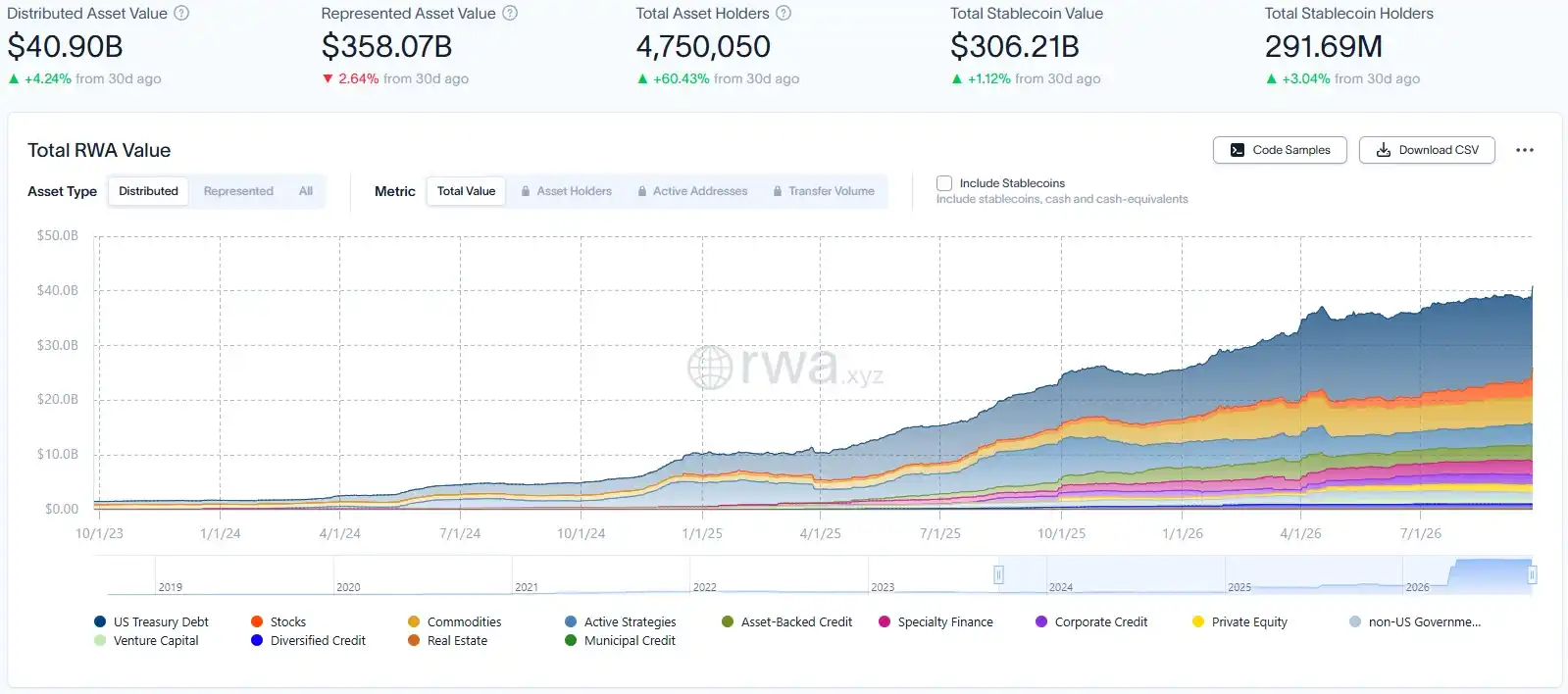
This edition covers the period from Sept. 18, 2026 to Sept. 25, 2026. Data cited from RWA.xyz showed that as of Sept. 25, on-chain RWA market capitalization had risen to $40.9 billion, up 4.24% from the same point a month earlier. The number of asset holders climbed to 4.75 million, a 60.43% increase over the same period.

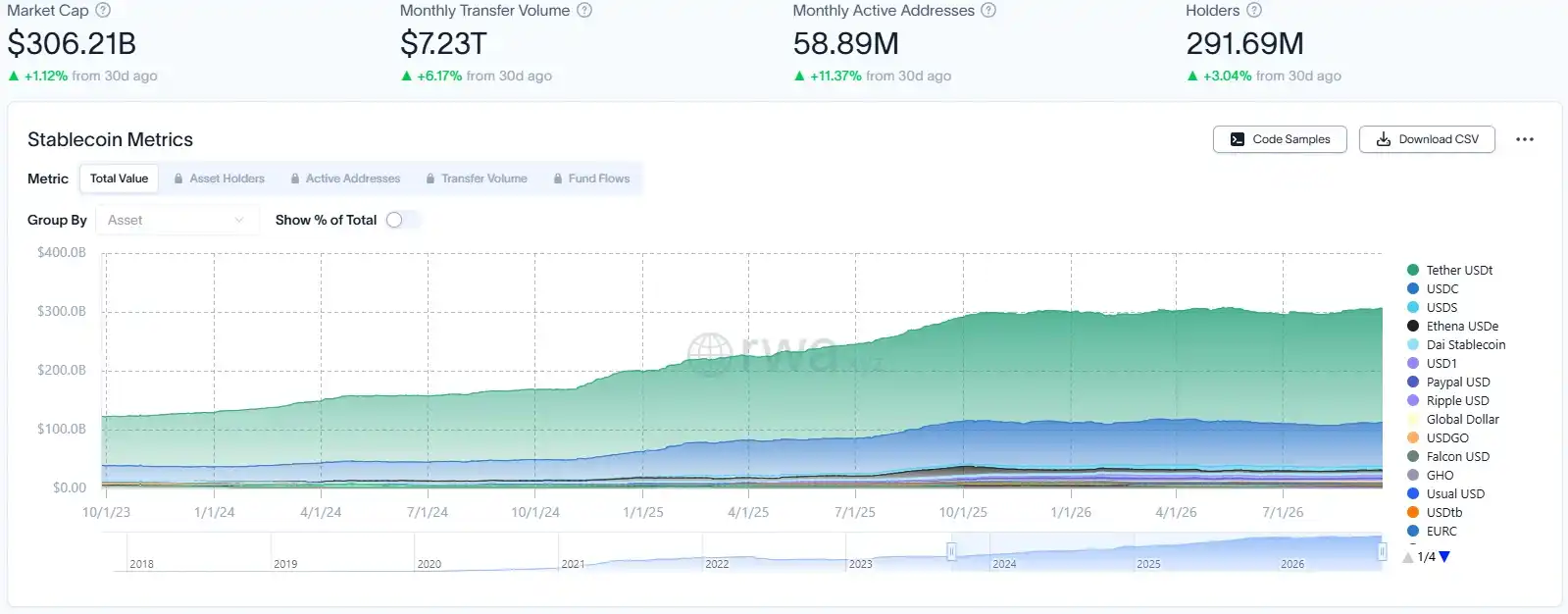
The stablecoin market also expanded. Total stablecoin market capitalization reached $306.21 billion, up 1.12% month over month. Monthly transfer volume came in at $7.23 trillion, up 6.17%. Monthly active addresses rose to 58.89 million, up 11.37%, while the number of holders increased to 292 million, up 3.04%. The three largest stablecoins remained USDT, USDC and USDS. USDT market capitalization edged up 0.42% from a month earlier, USDC rose 1.67%, and USDS increased 3.33%.
Policy and regulatory developments across the U.S., Europe, Hong Kong, Brazil and Saudi Arabia
Hong Kong targets RMB stock trading rollout and CBDC settlement support
According to Caixin, the Hong Kong Securities and Futures Commission said the inclusion of the RMB counter in Stock Connect will be implemented before July 1 next year, allowing mainland investors to buy and sell Hong Kong-listed stocks directly in renminbi.
Hong Kong Monetary Authority Chief Executive Eddie Yue also said CMU OmniClear, which is jointly owned by the HKMA and Hong Kong Exchanges and Clearing, is building a digital asset platform. The goal is for the platform to support settlement using central bank digital currency, or CBDC, before the end of the year, while also exploring interoperability with tokenized deposits and compliant stablecoins.
SEC innovation exemption could bring first operating plans next quarter
According to Crypto In America, Taylor Lindman, chief legal counsel of the U.S. Securities and Exchange Commission’s Crypto Task Force, said the first tokenized stock trading platforms using the newly introduced innovation exemption could begin announcing operating plans as early as next quarter. The SEC has already received inquiries from companies about using the exemption.
The exemption lasts for five years. It allows eligible platforms to trade tokenized U.S.-listed equities on public, permissionless blockchains through permissioned automated market makers and liquidity pools. The related tokens must preserve traditional shareholder rights, including dividends and voting rights.
Federal Reserve opens comment period on two stablecoin proposals
According to CoinDesk, the Federal Reserve Board on Thursday proposed two rules to carry out its supervisory responsibilities over stablecoin issuers under the GENIUS Act. The proposals are now subject to a 60-day public comment period.
The first proposal covers capital and reserve requirements. It is designed to make sure stablecoins are fully backed by highly liquid assets and that issuers maintain a solid footing during periods of stress. It also outlines the stablecoin-related activities that banks supervised by the Fed would be allowed to conduct, including provisions related to stablecoin rewards.
The second proposal sets out the process for supervised banks to issue their own stablecoins. Banks would need to submit a business plan, financial information, and related policies, procedures and other documents.
ESCB pushes for MiCA reserve changes and broader yield restrictions
Reuters reported that the European System of Central Banks, made up of the European Central Bank and national central banks across the European Union, said in a Sept. 22 opinion on MiCA that stablecoin issuers should not be forced to hold a minimum share of reserves as bank deposits. Under the current MiCA framework, major stablecoin issuers must keep 60% of reserves in bank deposits. The ESCB proposed instead that part of reserves be invested in assets maturing within one to five working days.

CoinDesk separately reported that in its response to the MiCA review consultation, the ESCB also recommended banning crypto-asset service providers from offering indirect returns to stablecoin holders through products such as lending and staking. That would extend the current ban on direct interest payments to indirect yield structures. The ESCB said e-money is meant for payments rather than savings, and that indirect return structures could blur the line between e-money tokens and bank deposits.
Brazil advances a tokenized securities simulation while Saudi Arabia exits mBridge
According to Ledger Insights, Brazil’s securities regulator CVM is moving ahead with a distributed ledger technology pilot for tokenized securities. The program covers simulated trading only and does not involve real securities or investors. Coordinated by CVM’s tokenization working group, the test will run for 60 days and may be extended by another 30 days. The draft still requires board approval. Its scope covers most of the securities lifecycle, from issuance to settlement, for stocks, bonds, receivables certificates and fund units.
The Financial Times reported that the Saudi Central Bank, or SAMA, has exited the mBridge cross-border CBDC platform. SAMA said it joined as an observer in 2023, took part in minimum viable product development in 2024, and ceased to be a member after completing proof of concept on May 13, 2025. It denied that the move was linked to pressure from the United States. mBridge was launched in 2021 by the Hong Kong Centre of the BIS Innovation Hub with the central banks of Thailand and the UAE, the Digital Currency Research Institute of the People’s Bank of China, and the HKMA as founding partners. The BIS transferred the project to the central bank partners in October 2024. The Monetary Authority of Macao joined this year and went live in June.
Project activity ranged from digital bonds to tokenized equities and deposits
Hana Bank issues a $100 million digital bond using Euroclear blockchain infrastructure
Cointelegraph reported that South Korea’s Hana Bank issued a five-year digital bond worth $100 million using blockchain technology from Euroclear. It was described as the first digital bond in South Korea issued directly on Euroclear’s blockchain infrastructure. Issuance, registration and settlement all took place on a distributed ledger network, cutting the bond allocation and payment settlement process from three to five business days to same-day completion.
NYSE, IBM, ARK, Ondo and Optimism all expanded tokenization efforts
Reuters reported that the New York Stock Exchange and Blockchain.com are exploring crypto versions of U.S.-listed stocks, effectively tokenized equity trading delivered through blockchain rails.
The Block reported that IBM said clients of IBM Digital Asset Haven, its digital asset management and security platform, can now connect to permissioned blockchain networks including Swift’s blockchain-based shared ledger. A new beta ISO 20022 messaging adapter allows institutions to initiate tokenized deposit transactions on the ledger using standard payment messages. IBM said financial institutions participating in the Swift project have already used Digital Asset Haven to complete tokenized deposit tests on the ledger. The ledger supports bank-issued tokenized deposits and is intended to help participating IBM clients move digital assets around the clock, while final settlement still takes place through existing systems.
CoinDesk reported that Cathie Wood’s ARK Invest has partnered with Securitize to tokenize the ARK Venture Fund, or ARKVX. The fund holds stakes in private technology companies including OpenAI, Anthropic, Stripe and Databricks. Securitize will provide on-chain issuance and investor services. ARKVX will launch first on Ethereum and may later expand to other blockchains. The report said the move does not mean the underlying shares of portfolio companies are themselves being put on-chain or opened to free trading. Investors receive a blockchain-based representation of fund interests. Securitize also plans to provide daily net asset value and support trading of fund interests in blockchain markets.
According to an Ondo Finance announcement, approved institutions can now use Alpaca’s Instant Tokenization Network to mint Ondo Stocks directly from shares they already hold, and redeem the tokens back into the corresponding equities. The mechanism is live on Ethereum and BNB Chain.
Optimism said KB Securities of South Korea has signed a memorandum of understanding with Securitize and Optimism to launch tokenized financial products for institutional investors in South Korea on OP Mainnet. The first products will include a tokenized money market fund and a fund based on a flagship strategy from KB Asset Management. The three parties also plan to explore tokenized stocks and ADRs, corporate bonds and South Korean government bonds. Optimism said this is KB Securities’ first public move into tokenization.
Canada, the euro area, the UK and LSEG-linked infrastructure also moved forward
CoinDesk reported that Canada’s six largest banks — Bank of Montreal, Canadian Imperial Bank of Commerce, National Bank of Canada, Royal Bank of Canada, Scotiabank and TD Bank — will jointly explore a Canadian dollar tokenized deposit solution. The first phase is aimed at enabling efficient movement of tokenized deposits among Canadian financial institutions. The longer-term goal is interoperability with other emerging digital asset projects. Testing is already under way.
According to an official European Central Bank announcement, the Eurosystem’s tokenized asset settlement infrastructure Pontes has gone live. It allows wholesale tokenized asset transactions to settle in central bank money and uses distributed ledger technology to integrate issuance, trading, settlement and custody while supporting smart contract automation. The first participants include 13 banks such as Deutsche Bank, Santander, Societe Generale and the European Investment Bank, along with four DLT operators including Clearstream. Full buildout is targeted for 2028.
Cointelegraph reported that UK banks including Lloyds, NatWest, Barclays and HSBC have completed what was described as the first interbank transactions using tokenized deposits.
Ledger Insights reported that cross-border payments network Partior has connected to the London Stock Exchange Group’s digital settlement platform DiSH. The setup will allow settlement banks to aggregate and settle bilateral interbank balances with one another around the clock. Partior’s current settlement banks include DBS, Deutsche Bank, JPMorgan and Standard Chartered, and it supports the U.S. dollar, euro and Singapore dollar. The solution is in industry testing and is expected to go live in the first quarter of 2027.
Binance buys $100 million of Circle stock and extends USDC partnership
A Form 8-K filed by Circle with the SEC showed that Binance spent $100 million to subscribe for 1.237 million shares of Circle Class A common stock at $80.84 per share, below the market price at the time. The shares are subject to a lock-up of up to two years. During that period, Binance retains voting rights but cannot sell, transfer or hedge the shares.
The two companies also expanded their existing commercial relationship into a new five-year agreement. Binance will promote USDC on its platform, while Circle will pay monthly incentive fees based on the amount of USDC held. The transaction closed on Sept. 17.
MSX adds five tokenized U.S. stock spot listings
MSX, a tokenized U.S. equities trading platform, has listed spot trading for FTNT, VRNS, SAIL, SHOP and EXPE.
Funding activity centered on RWA credit, broker-dealer licenses and stablecoin infrastructure
RockawayX commits $150 million to RWA credit through Catapult
CoinDesk reported that digital asset investment firm RockawayX will deploy $150 million through its Catapult program to support projects bringing real-world yield-bearing assets into decentralized finance. The support package includes venture capital, product structuring, liquidity, market making and distribution. RockawayX manages about $2 billion in assets and has already deployed roughly $300 million on-chain. The program will focus on trade and supply chain finance, specialty asset-backed securities, CLOs and real estate-related credit.
MoonPay plans North Capital acquisition worth more than $60 million
Fortune reported that MoonPay is acquiring Utah-based broker services firm North Capital Investment Technology, which provides custody, secondary trading and tokenization services for debt, equity and other assets. MoonPay did not disclose the purchase price, but people familiar with the matter said the all-stock deal is worth more than $60 million. North Capital holds multiple SEC-related licenses, including broker-dealer, alternative trading system, transfer agent and investment adviser registrations. MoonPay plans to use the acquisition to expand into tokenized stocks and related businesses.
HIFI and Atum both raised fresh capital
The Block reported that stablecoin infrastructure company HIFI raised $37 million in a Series A led by Left Lane Capital. Valuation details were not disclosed. HIFI Chief Executive Zach Walsh said it was the company’s first priced round and that the platform is currently handling about $7 billion in annualized direct transaction volume. The proceeds will be used to expand stablecoin payment products and tokenized capital markets infrastructure. HIFI supports fiat on- and off-ramps between U.S. dollars and stablecoins, payments through the U.S. banking system and cards, and U.S. dollar cash settlement for tokenized repo and U.S. Treasury transactions. It has also participated in tokenized securities production testing run by the Depository Trust & Clearing Corporation.
According to an official announcement, stablecoin payments network Atum raised $13.5 million in seed funding led by Variant, with participation from PayPal Ventures, Abstract Ventures, Road Capital, Mirana Ventures, First Commit and Credibly Neutral. Atum does not issue stablecoins, operate a blockchain or custody funds. It positions itself as a coordination layer for global money movement across stablecoins and across chains, handling authorization, routing and confirmation, and supporting AI agent payments through protocols including x402 and MPP. Founder and Chief Executive Pete Cooling previously led Visa’s crypto product team.
Research and commentary focused on tokenized stocks, stablecoin distribution and RWA perpetuals
PANews summary of an interview with investor Zheng Di
PANews summarized comments from investor Zheng Di, who said in an interview that the SEC’s five-year innovation exemption gives stock tokenization at least two years of regulatory stability and could open a compliance-led bull market driven by RWA. He said Coinbase, Robinhood and Circle each hold advantages at the exchange, user and stablecoin layers, while Uniswap is the protocol most recognized by traditional finance. He also said Arbitrum and Base each come with trade-offs.
According to the PANews summary, Zheng said putting U.S. equities on-chain is meant to address the shortage of on-chain assets, absorb offshore capital serving U.S. IPOs, and provide infrastructure for an AI-agent machine economy. He also said Bitcoin moving above its 200-day moving average marked the start of the current bull market, that overall positioning remains low enough to make a deep pullback less likely, and that the bull market should last at least one year. He pointed to oil prices and the pace of AI replacing white-collar labor as key variables, and said prediction markets and privacy coins under a compliant framework are also worth watching.
PANews summary on stablecoin reserve income and distribution economics
PANews also summarized reporting that Circle’s earnings show stablecoin core revenue is driven by U.S. Treasury reserve income, while high distribution costs are squeezing profit. Coinbase and Binance, as major distribution channels, receive substantial incentives. The summary said Binance’s equity investment in Circle and the new five-year promotion agreement are part of that broader distribution dynamic. It also noted that distribution costs are still rising even as USDC circulation declines, pointing to intensifying competition in a mature market.
The PANews summary added that newer stablecoin projects are using high revenue-sharing ratios to compete for distribution, while some channels are choosing to issue their own stablecoins to capture reserve income directly. It said uncertainty around the U.S. CLARITY Act could reshape how returns are split among issuers, channels and users, depending on whether interest-like rewards are allowed.
a16z and CoinMetrics reports tracked growth in RWA perpetuals and tokenized equities
According to a PANews summary of an a16z report, the RWA perpetual futures market expanded rapidly, with August 2026 trading volume reaching $117.3 billion, up 44 times from a year earlier. Open interest rose to $4.8 billion, nearly 30 times higher than a year before. The center of activity also shifted on-chain, where trading accounted for 86% of the market. The summary identified Hyperliquid’s HIP-3 upgrade as a major driver. By asset class, stocks made up 48% of August trading volume, ahead of commodities at 28% and indexes at 18%.
A separate PANews summary of a CoinMetrics report said crypto exchanges are evolving into integrated venues that combine tokenized equities, derivatives and on-chain infrastructure. Kraken, Binance, Coinbase and Robinhood are taking different technical approaches. Even as broader crypto trading volumes have declined, spot tokenized equities and RWA perpetuals have posted visible growth. The summary said Binance bStocks trading volume exceeded $3.7 billion over several months. It also noted that while the SEC’s five-year innovation exemption allows compliant platforms to conduct on-chain tokenized stock trading through permissioned AMMs, mainstream receipt-style products do not currently qualify for the exemption. The market remains early, with no single model established as the winner.