
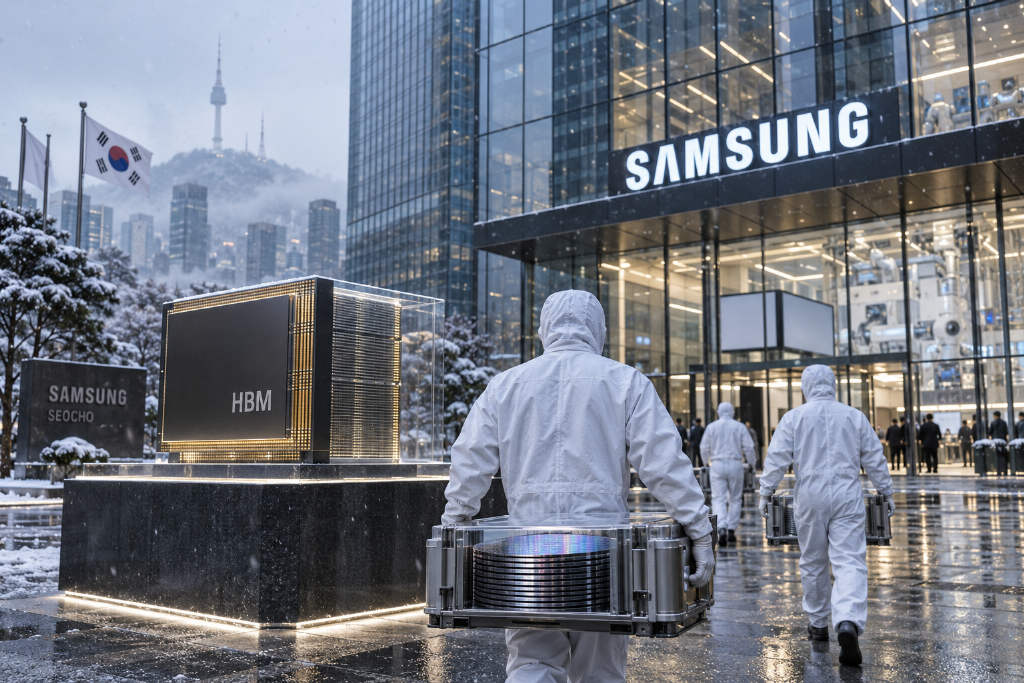
Samsung Electronics has reportedly put forward a mid-to-high $4 per Gb price for 2027 HBM4 supply in negotiations with major customers, a level that is more than three times the roughly $1.5 per Gb price attached to current mainstream HBM3E, according to a report by South Korea’s Maeil Business Newspaper on Oct. 2.
Samsung opens 2027 HBM4 talks at a much higher level
The report said HBM differs from conventional DRAM because annual long-term contracts account for a large share of business, with customers and suppliers typically locking in volume and pricing about a year in advance. A substantial portion of next year’s HBM capacity has already been discussed, and price negotiations are expected to conclude within this month. The final terms are set to feed directly into Samsung’s average selling price and earnings performance for next year.
Timing is also part of the company’s pricing stance. Samsung is expected to shift its flagship lineup from HBM3E to HBM4 next year, and the report said the company is using the generational transition to pitch what it calls top-tier industry performance in an effort to lift profitability.
Micron says most of its 2027 HBM bit supply is already under contract
While Samsung is pushing for higher pricing, Micron has offered a view of actual demand conditions. The Seoul Economic Daily reported that Micron said during its fiscal 2026 fourth-quarter earnings call on Oct. 1 that it had signed contracts covering most of its 2027 HBM bit supply.
CEO Sanjay Mehrotra said HBM prices next year would be "well above 2026," and added that HBM profitability, which had recently trailed conventional DRAM, would recover as pricing moves higher.
The HBM market is dominated by three suppliers: Samsung, SK hynix, and Micron. If Micron has already pushed through higher pricing in contracts, that gives Samsung and SK hynix more leverage in their own negotiations. For the two Korean chipmakers still in talks with customers, the report described that as a positive signal.
TrendForce sees average HBM prices in 2027 rising 121%
Market research firm TrendForce estimates that average HBM selling prices in 2027 will rise about 121% from this year. It cited three main drivers:
- continued tightness in HBM supply
- a larger share of higher-priced HBM4 products
- volume ramp for HBM4E, the seventh generation, starting in the second half of next year
TrendForce also estimated that a 12-layer, 36GB HBM4 stack could rise from about $600 this year to about $1,300 next year, more than doubling. The report noted, however, that actual pricing will vary by customer, specification, and contract terms, and that these figures are industry estimates rather than official disclosures.
Samsung gains share, though SK hynix remains No. 1
Pricing is not the only point drawing attention. Counterpoint Research data showed Samsung’s global HBM market share by revenue rose from 21% in the first quarter of this year to 33% in the second quarter, an increase of 12 percentage points. Over the same period, SK hynix fell from 58% to 50%, while Micron slipped from 21% to 18%.
SK hynix still holds the top spot, but Samsung’s catch-up has accelerated. The report said Samsung has already started mass production and shipments of HBM4 this year and has provided 12-layer HBM4E samples to major customers. If HBM4 shipments increase and contract prices move higher next year, both volume and pricing would show up in financial results.
SK hynix, for its part, has been mass-producing HBM4 since the second quarter and continues to expand output. In July, the company said HBM4 yield and quality had approached HBM3E levels, and it is also negotiating 2027 volume and pricing with major customers.
Wafer capacity remains the key constraint
Supply-side limits are another reason prices remain supported. HBM is built by vertically stacking multiple DRAM dies, and the larger die area means it consumes more wafers than standard DRAM. That makes rapid capacity expansion difficult.
TrendForce said memory makers have taken a tougher stance in 2027 HBM price negotiations than in previous rounds. One industry source cited in the report said AI memory demand continues to rise, and supply-demand conditions, including for HBM, are likely to stay tight in the near term. How limited wafers are allocated across HBM, server memory, and conventional DRAM, along with the stability of yields and customer qualification, will shape profitability and market share.
The report added that the more wafer capacity is absorbed by HBM, the less remains for conventional DRAM. That is one reason the market is watching whether broader memory pricing will keep rising. Samsung’s final contract prices with customers, as well as progress on HBM4 qualification and yields, remain the main variables to watch.