
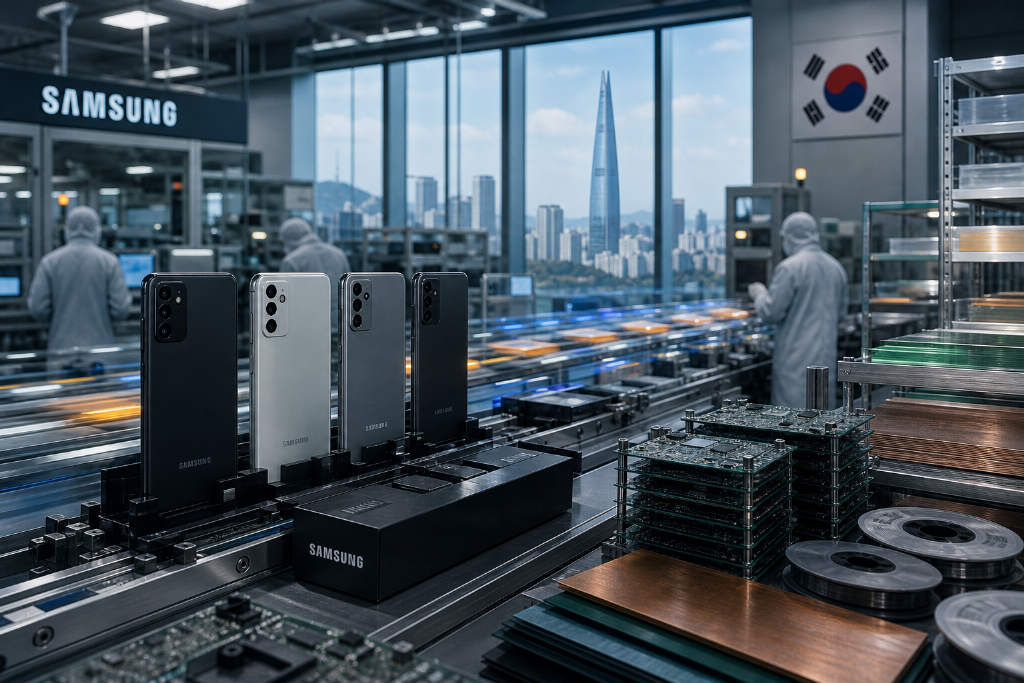
Samsung Electronics has lowered its fourth-quarter production plan for low- and mid-range smartphones, according to an Oct. 15 ZDNet Korea report cited by ChainCatcher. The reasons include rising memory chip prices and supply disruptions affecting glass fiber used in copper clad laminate, a raw material for printed circuit boards.
Nittobo capacity shift tightens E-glass supply
The report said Japan’s Nittobo has redirected more production capacity to T-glass for AI semiconductors, where profitability is higher, while cutting output of E-glass used in smartphone PCBs. That has led to supply bottlenecks and higher prices. E-glass is used in prepregs for smartphone motherboard HDI and RFPCB products.
After memory price increases lifted manufacturing costs, Samsung reduced orders for related components. Lower-priced models such as the Galaxy A series generate thinner margins, making it difficult to raise production sharply. Base-model prices in the low- and mid-range lineup this year were more than KRW 100,000 higher than their predecessors.
Shipment outlook falls below parts industry expectations
The fourth-quarter component order outlook Samsung shared with partners points to annual smartphone shipments of just over 230 million units. That is below the 240 million units expected by the parts industry, and also 20% to 30% lower than before the Chuseok holiday stretch.
The report also said Samsung has not yet shared next year’s mobile business plan with partners in the way it typically does in prior years.
Quarterly production plan revised down by 23%
In mid-September, Samsung’s monthly production outlook for the fourth quarter stood at 14.3 million units for October, 9.5 million for November, and 7.6 million for December, for a total of 31.4 million units.
At the start of this month, that forecast was revised to 9.9 million units in October, 7.6 million in November, and 6.7 million in December, for a total of 24.2 million units, down 23%.
Even as output for low- and mid-range models is being cut, shipment plans for flagship devices including the Galaxy S27 early next year remain at a relatively high level. Foldable phone shipments are also planned to increase next year.
The MX and Networks division posted a second-quarter loss of KRW 735 billion. Securities firms project a full-year loss of KRW 400 billion.