
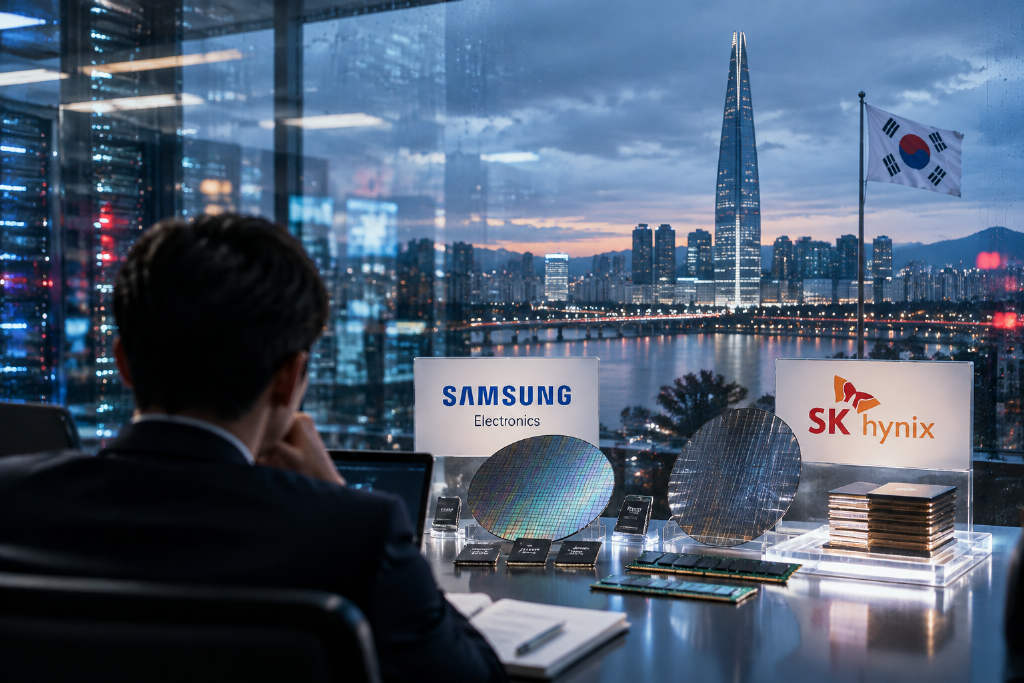
Samsung Electronics and SK Hynix are moving into third-quarter earnings season at the center of the current semiconductor upcycle, with investors looking to their results for evidence on how durable the global AI trade really is.
Strong AI demand and the push into next-generation memory have lifted expectations for both Korean chipmakers. Seoul Economic Daily, citing FnGuide data, said Samsung Electronics is expected to post KRW 199.1 trillion in revenue and KRW 105.6 trillion in operating profit for the third quarter, while SK Hynix is projected to deliver KRW 94.1 trillion in revenue and KRW 74.1 trillion in operating profit. On that basis, their combined operating profit could approach KRW 189.9 trillion.
Even so, consensus estimates have been revised lower in recent months. Over the past three months, analysts cut Samsung Electronics revenue and profit forecasts by 2.6% and 4.4%, respectively. For SK Hynix, the reductions were 5.3% for revenue and 5% for operating profit. The report said the change mainly reflected a stronger Korean won, which reduced the value of dollar-denominated sales, not a downturn in the memory market itself.
Attention is shifting from profit size to profit quality
The coming earnings reports are about more than large headline numbers. Investors are watching whether memory price increases can continue, whether long-term agreements have locked in demand and profitability, and whether next-generation high-bandwidth memory can translate into underlying earnings power.
Memory prices are still rising, but the pace is slowing
A sharp increase in average selling prices for DRAM and NAND flash in the second quarter was a major driver of strong earnings for both companies. In the third quarter, prices are still expected to move higher, but at a slower pace.
Mirae Asset Securities estimates Samsung Electronics’ third-quarter DRAM ASP will rise 16.5%, while the increase in the fourth quarter will narrow to 5.4%. That points to a rebound in pricing that may be losing some momentum.
The broader use of long-term agreements, or LTAs, is also changing the pattern of price swings. Samsung Electronics has locked in 60% to 70% of its memory capacity through LTAs, while SK Hynix completed LTA negotiations with about 10 core customers in the second quarter. Those contracts bring stability to a market known for sharp cycles, though they can also limit upside during fast price rallies because contract prices usually lag spot prices.
HBM4 is becoming a central variable in AI infrastructure
The third quarter is also a turning point for HBM4. As shipments tied to Nvidia’s next-generation AI platform Vera Rubin increase, Samsung Electronics expects third-quarter HBM4 sales to be more than triple the second-quarter level and account for more than 60% of its total HBM revenue in the second half of 2026.
For SK Hynix, the task is to expand HBM4 output while holding on to its leadership in HBM3E. Third-quarter earnings should offer an early look at how that competition is developing.
Demand for high-bandwidth memory is also reshaping the way data centers are built. Global Economy, citing a report from KB Securities, said Meta’s launch of its agent-based AI application Muse points to a new phase for AI services, one that requires continuous, sequential operations and higher memory bandwidth. Traditional generative AI handles about 100 tokens per second, while agentic AI demand rises to 1,000 tokens per second.
KB Securities analyst Kim said: 「In AI data centers, the GPU is the heart, the CPU is the brain, power is oxygen, and memory is the circulatory system that continuously supplies and recycles data. In the end, the key to AI data center performance and efficiency will shift to memory.」
The same pattern is showing up more broadly across the sector. The report said AMD recently joined Nvidia, Broadcom and Micron in the trillion-dollar market-cap club, and its second-quarter data center revenue surged 107% year over year. That was presented as another sign that investor focus on CPUs and memory is catching up with GPUs. Samsung Electronics is also preparing its next-generation zHBM technology, with a plan to stack memory directly on top of GPUs and provide samples by the end of 2027.
Foundry hopes for a turnaround while devices face a cost squeeze
Samsung’s non-memory businesses are also under close scrutiny. After consecutive losses since 2023, its foundry operation is widely expected to return to profit in the third quarter, helped by expanded 4nm language processing unit, or LPU, capacity and improved yields. If that happens, it would remove a long-standing drag on sentiment around Samsung’s broader valuation.
At the same time, Samsung’s Device eXperience, or DX, division is still dealing with higher component costs. In the second quarter, strong sales of premium products such as Galaxy Foldables were not enough to offset rising input costs, and the DX unit posted an operating loss of KRW 8 billion. The same jump in memory prices that supports the semiconductor business has become a burden for the smartphone and TV businesses.
That leaves another key question for the third quarter: whether premium device sales can absorb the pressure, or whether Samsung will remain stuck in a split picture where chips are profitable while end devices struggle.
The bigger debate is whether the cycle can avoid a peak narrative
As earnings season approaches, the market’s focus is moving from absolute profit levels to sustainability. If Samsung Electronics and SK Hynix can show that LTAs have effectively secured demand, HBM4 can generate solid profit, and Samsung’s foundry business is back on track, the current supercycle may look more resilient than previous ones.
If DRAM and NAND price growth slows more than expected, or if HBM4 contributes less profit than investors are looking for, the debate over whether the semiconductor industry has already peaked is likely to return.
Over the next few weeks, these earnings reports will shape not only the short-term valuation path of both companies, but also expectations for global technology infrastructure investment in the years ahead.
This article originated from the WeChat public account Wallstreetcn and was written by Ye Zhen.