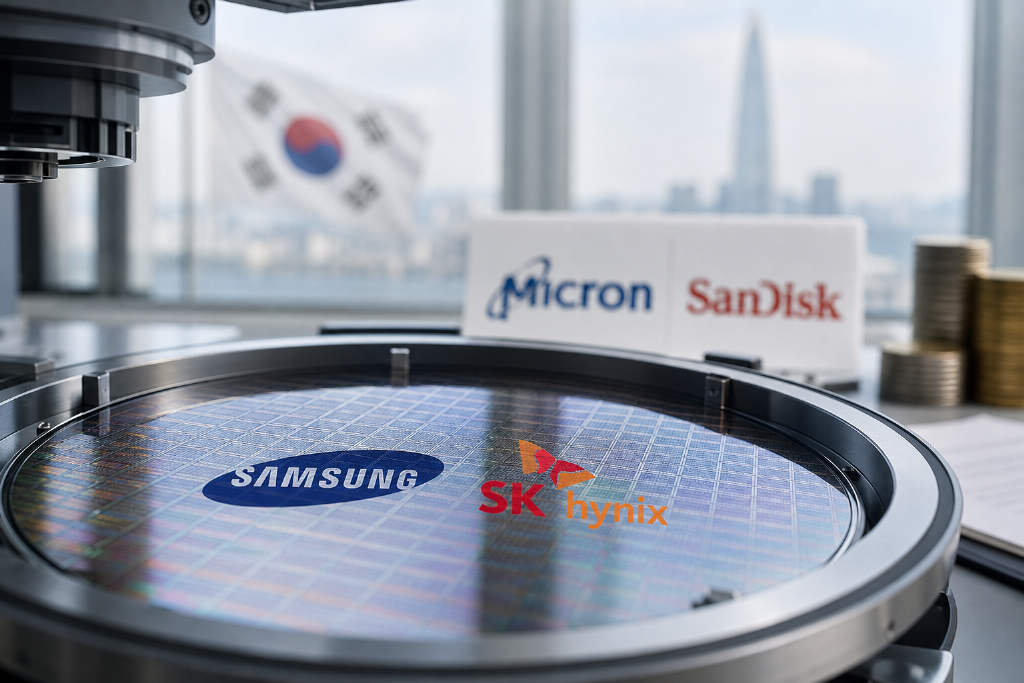
Samsung Electronics and SK Hynix have come under scrutiny after outlining shareholder return plans tied to more than 50% of free cash flow, while SanDisk and Micron have put forward policies to return 100% of excess cash to shareholders. The comparison has fueled questions over whether Korean chipmakers are offering weaker shareholder returns than their U.S. peers. Korean industry sources and financial institutions, however, say the headline percentages are not directly comparable because the underlying cash metrics are different. In their view, payout frameworks based on free cash flow offer more certainty in projected amounts, execution standards, and disclosure. Free cash flow typically refers to cash generated from operations after capital expenditures and other investment spending are deducted, making it a figure that can be calculated relatively objectively from cash flow statements. Samsung has said 50% of cumulative free cash flow from 2024 to 2026 will be used for shareholder returns, while SK Hynix plans to allocate more than 50% of cumulative free cash flow from 2025 to 2027.
Samsung Electronics and SK Hynix are facing questions over the scale of their shareholder return plans after saying they would direct more than 50% of free cash flow, or FCF, to shareholders. The debate picked up after SanDisk and Micron said they would return 100% of excess cash to shareholders.
That contrast has led to criticism that Korean semiconductor companies are offering relatively lower shareholder returns. Korean industry circles and financial institutions, though, say the two approaches are built on different definitions of cash metrics, making a simple comparison between 50% and 100% misleading.
Different payout bases are at the center of the debate
According to industry views cited in the report, shareholder return policies built around FCF can provide greater certainty in projected payout amounts, execution criteria, and transparency.
FCF generally refers to cash generated through operating activities after capital expenditures, or CAPEX, and other investment spending are deducted. The figure can be calculated relatively objectively through data such as cash flow statements.
Timelines disclosed by Samsung and SK Hynix
Samsung Electronics previously said that 50% of its cumulative FCF over the three years from 2024 to 2026 would be used for shareholder returns. SK Hynix also plans to allocate more than 50% of cumulative FCF to shareholder returns during the 2025 to 2027 period.
The report was cited from Yonhap News Agency.
This article was originally published by Bit.Fan. For more cryptocurrency news and market insights, visit www.bit.fan. Disclaimer:
The market information, project data, and third-party content displayed on this platform are for industry information sharing only and do not constitute any form of investment advice or return commitment.
Cryptocurrency trading carries high risks. Users should fully assess their risk tolerance and make independent decisions. All profits, losses, and legal responsibilities are borne by the users themselves.