
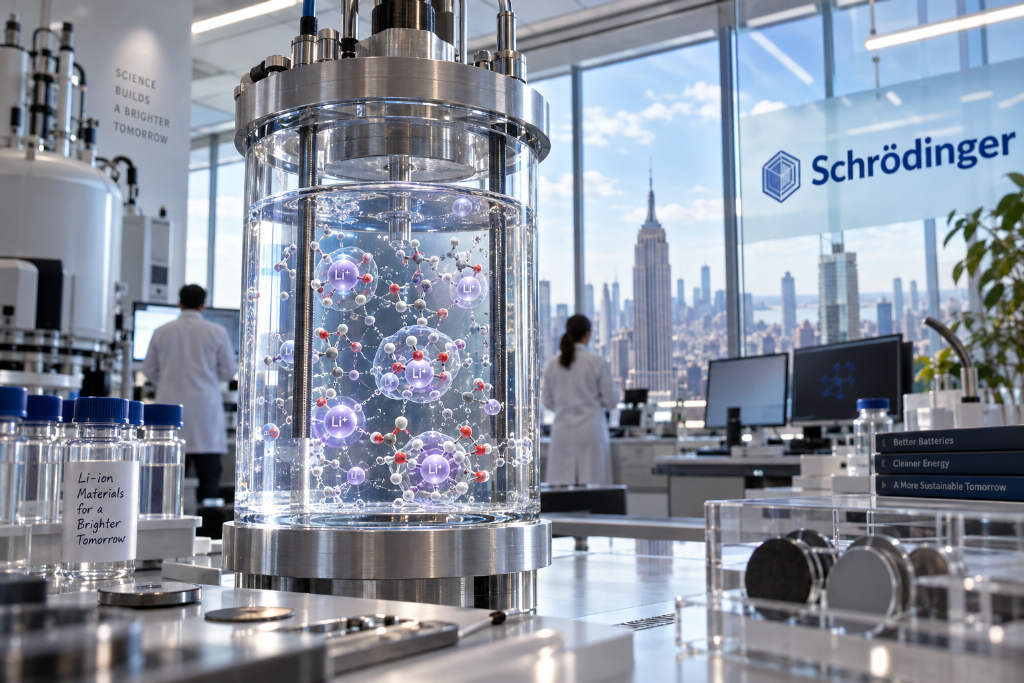
Schrödinger said it has published a new lithium-ion battery study in Nature, reporting atomic-level insights into how battery electrolytes operate. The company said the work was carried out with researchers from Columbia University and the New York Structural Biology Center, and that the results could provide data support for future lithium-ion batteries designed for faster charging, higher capacity, and longer service life.
Electrolyte structure has long constrained battery design
The study used Schrödinger’s physics-based AI computing platform to address what the report described as a long-standing bottleneck in energy storage design.
In lithium-ion battery systems, electrolytes directly affect key physical properties including conductivity, viscosity, the degree of salt dissociation, and electrochemical stability. They also directly drive the formation of the solid electrolyte interphase, a protective layer that forms on the battery anode surface. The stability and quality of that layer are tied to a battery’s cycle life and operating safety.
Schrödinger said scientific understanding has remained limited on how electrolyte structure influences those properties at the atomic level. In earlier attempts to model complex battery chemistry, computational limits often forced researchers to choose between quantum-level accuracy and simulations large enough to capture broader atomic scales and longer time windows. Choosing high-accuracy quantum mechanics restricted the scale and duration of simulations, while large-scale models reduced the precision of interatomic interactions.
Mat Halls, vice president at Schrödinger, said scientists had long been pushed into that trade-off when simulating complex battery systems, and said the company’s machine learning force field technology removed the constraint.
Machine learning force field points to a previously unreported structure
The research team used Schrödinger’s machine learning force field to run molecular dynamics simulations on lithium-ion battery electrolytes. According to the report, the simulations showed that lithium ions in the electrolyte often form clusters coordinated by ethylene carbonate solvent molecules, and that those clusters can exist independently without anion participation. The article described this as a structural phenomenon not previously identified in basic chemistry research.
Richard Friesner, co-founder of Schrödinger, said the team found that lithium ions in batteries cluster even without anions, and that these clusters drive the formation of the protective film on the battery surface.
Friesner also said computational predictions of these chemical reactions were later confirmed experimentally. He said that result showed a physics-based computing platform can accurately simulate hidden atomic details inside batteries. The findings also suggested that most complex chemical mechanisms can be modeled predictively with machine learning force field technology grounded in physical principles.
Experimental comparisons supported the multi-lithium-ion cluster finding
The study highlighted several findings. First, in standard battery electrolyte environments, as much as 40% of lithium ions form multi-ion clusters. Under high-salt electrolyte conditions, the clustering becomes more common. The report said this challenges the conventional assumption that lithium ions mainly exist in solution as isolated species surrounded by solvent molecules.
Second, Schrödinger said the machine learning force field simulations showed high accuracy and closely matched multiple sets of condensed-phase experimental data. The research team compared the predictions with measured values from NMR spectra, electrolyte density, liquid viscosity, ionic conductivity, and diffusion coefficients, and said the results were consistent across those metrics. The report said that agreement provided physical evidence that the predicted multi-lithium-ion clusters are real.
The study also said these clusters have distinctive and readily reducible potential characteristics, and that they play a decisive role in controlling the quality of the solid electrolyte interphase. Schrödinger said the findings offer data support for future battery development.