SemiAnalysis Issues Two Contradictory Reports: Revenue Upside and Flagship Shrinkage
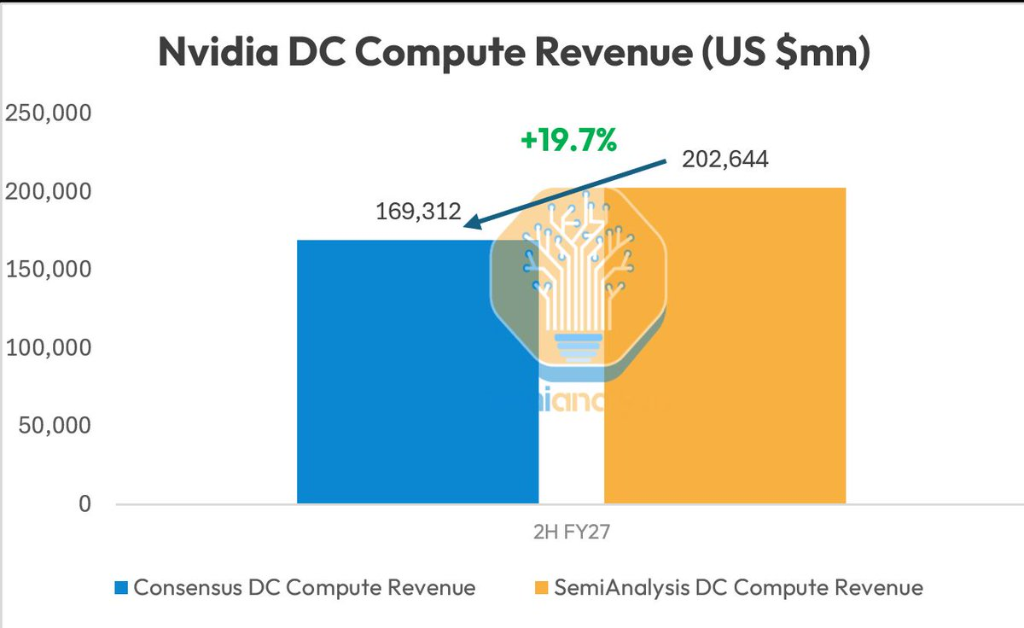
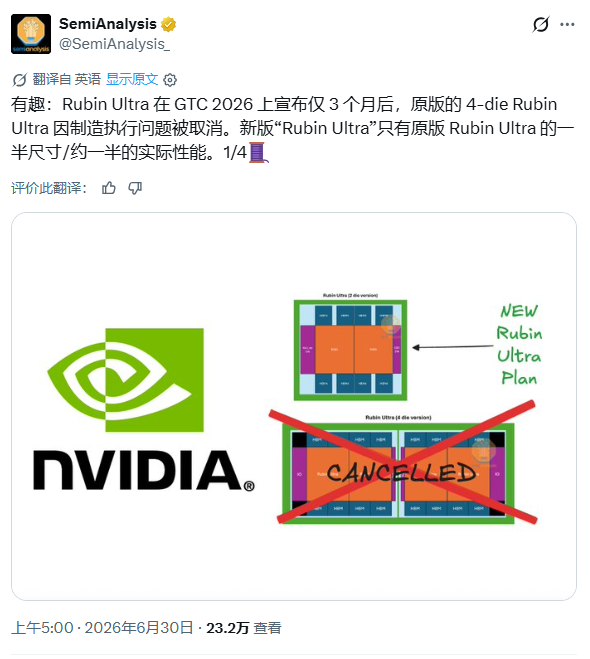
Semiconductor research firm SemiAnalysis published two reports on June 30, 2026, painting a starkly dual picture for Nvidia's near-term future. On the optimistic side, SemiAnalysis forecast that Nvidia's data center computing revenue for the second half of fiscal 2027 would exceed Wall Street consensus by approximately 20%, driven by resolved HBM4 memory supply issues and pre-stocked front-end wafer capacity. However, earlier the same day the firm revealed a negative development: Nvidia's original 4-chip Rubin Ultra design, announced at GTC 2026, was canceled roughly three months after launch. The new "Rubin Ultra" has been downsized to half the original die area, effectively cutting performance in half.
These two diametrically opposed conclusions anchor Nvidia on fundamentally different trajectories: one based on revenue delivery after supply bottlenecks clear, the other on technological moat degradation after flagship product scaling back.

Revenue Optimism: HBM4 Shortage Resolved, Rubin Platform Ramps Up
SemiAnalysis used its proprietary Accelerator Model to predict a massive ramp for Nvidia in the second half of the year. The model forecasts that Nvidia's data center compute revenue for 2H FY2027 will come in about 20% above consensus estimates. Key enablers include the resolution of HBM4 supply constraints that previously delayed the Rubin platform's rollout, and the pre-arrangement of front-end wafer capacity. These factors clear the path for a rapid production ramp.

SemiAnalysis emphasized that its forecasting methodology differs significantly from traditional sell-side analysts. Most Wall Street firms build conservative estimates with room for future "beats," whereas SemiAnalysis relies on bottom-up supply chain research. Its Accelerator Model cross-validates data from material suppliers, wafer fabrication, key components, server OEMs, and also incorporates actual procurement and deployment plans from hyperscalers and frontier AI labs. This model covers not only Nvidia but also Broadcom, AMD, MediaTek, and Marvell, and is complemented by a separate HBM Model to track the entire AI compute chain.

Technical Setback: Rubin Ultra Downsized, CUDA Moat Under Erosion
SemiAnalysis also triggered market debate with its commentary on Rubin Ultra. Nvidia's original design called for four compute chips in the Rubin Ultra package, but roughly three months after its GTC debut, the company revised the design downward. The new version is significantly smaller, with the root cause attributed to difficulties in advanced packaging manufacturing. This scaling back directly undermines the performance expectations for the flagship product.

More troubling is the gradual erosion of the CUDA ecosystem. SemiAnalysis noted that Anthropic has developed a multi-platform compute architecture encompassing Google TPUs, Amazon Trainium, and Nvidia GPUs. A large portion of Claude model training runs on TPUs, while Claude Code inference is increasingly deployed on Trainium. Nvidia GPUs are used more for general-purpose frontier research. SemiAnalysis remarked that a year ago, the rise of TPU and Trainium to their current scale would have been unthinkable, but now the CUDA moat is being slowly chipped away—a long-term risk Nvidia cannot ignore.