

Whether buying and selling virtual currency amounts to the crime of assisting information-network crime hinges on one issue: subjective knowledge. In a MarsBit article, lawyer Shao Shiwei wrote that prosecutors in such criminal cases usually do not point to one isolated fact. They tend to infer knowledge from several facts layered together.
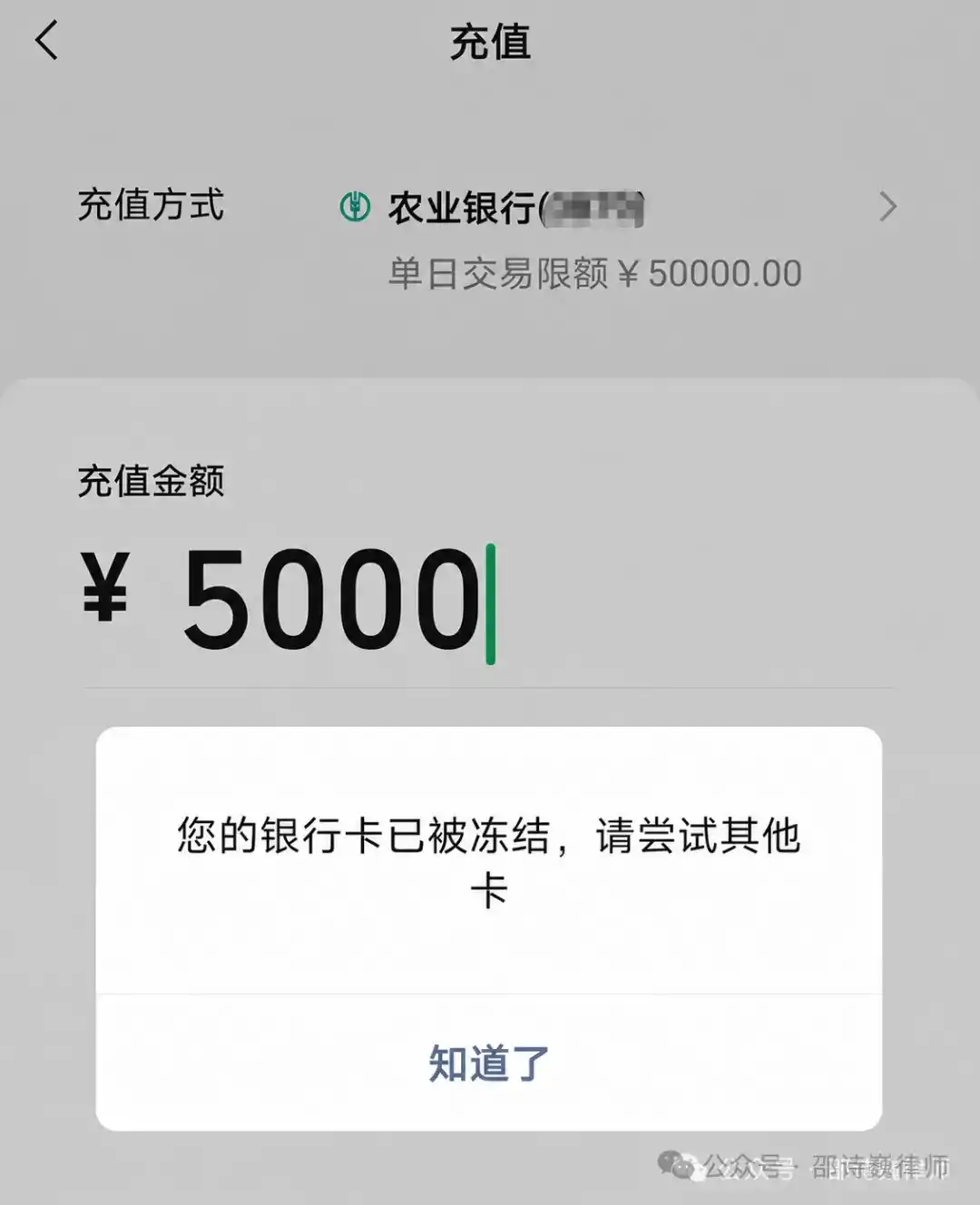
The article says three baseline dimensions had already been discussed in earlier pieces in the series: how much information a trader actually learned when a bank account was previously frozen by judicial authorities, whether the upstream cause in the earlier and later incidents was the same, and whether the counterparties in the two transactions were the same person. Those three dimensions, the author writes, form the basic framework for assessing subjective knowledge.
Still, the article argues that those three dimensions alone are often not enough in practice. Investigators and defense lawyers usually debate a narrower set of variables as well. Taken one by one, those variables may not be sufficient to establish knowledge, but once placed on top of the earlier framework, they can either strengthen or weaken the inference.
The piece says it aims to help parties and their families understand what investigators are actually looking at in cases involving virtual-currency trading and allegations tied to the crimes of assisting information-network crime, concealing or disguising criminal proceeds, or illegal business operations, and how defense counsel may break down those issues step by step.
Author: lawyer Shao Shiwei
Whether the trading price was clearly above market
The article says investigators often look at whether the transaction price in the case significantly deviated from market levels.
The prosecutorial logic described in the piece is straightforward. If a trader sells coins at a normal market price, the trader earns a normal spread. But if the price is several points higher than the market, the question becomes why the buyer was willing to pay that premium. One possible inference is that the buyer's money was "unclean" and difficult to use elsewhere, so the buyer was willing to pay extra to buy virtual currency, while the seller accepted the higher price as compensation for taking on risk.
The article then pushes back on treating that logic as automatic. OTC markets are not exchanges, it says, and they do not have a single unified quoted price. Premiums are common. When prices move sharply, off-exchange prices can differ from exchange prices by several points, and large transactions may naturally carry higher prices because of liquidity costs.
It follows, the author argues, that if price is going to be used to infer knowledge, investigators should at least compare the transaction at issue with real OTC trades of similar size in the same period. The article says it is not enough to compare an OTC deal directly with an exchange spot quote.
The piece adds one more distinction. If the premium reflects a cross-border exchange-rate gap — in other words, if the renminbi price of buying USDT inside China is already several points above the international rate — that premium may reflect the cost of a cross-border capital channel. In that case, the nature of the transaction may shift away from an assistance case built on moving criminal funds and toward suspected illegal business operations involving disguised foreign-exchange trading.
According to the article, those cases usually involve sums far larger than ordinary assistance cases, often reaching tens of millions or even hundreds of millions of yuan. It says the prosecution theory, the proof standard for mens rea, and the defense strategy are different in that setting. The author refers readers to an earlier article discussing whether weak evidence for illegal business operations could lead to a charge being reclassified as assistance instead.
How much time passed between two incidents
The article says that when a trader's account had previously been frozen or involved in an earlier case, prosecutors often use that prior experience as one basis for inferring subjective knowledge in a later transaction. The length of time between the two incidents matters because it affects the strength of that inference.
The piece says a one-week gap and a one-year gap do not create the same psychological warning effect.
To illustrate that point, the article cites a case handled by the Dongsheng District People's Court of Inner Mongolia on Aug. 3, 2023, case number (2023) Nei 0602 Xingchu No. 203. According to the judgment cited in the article, the defendant's bank account was frozen on March 3, 2022 after receiving telecom-fraud funds. Two days after the account was unfrozen, on March 5, 2022, the defendant again traded virtual currency with a stranger and immediately withdrew cash from a bank counter. The article also says the defendant stated in testimony that "many of the funds in the transaction process were illegal." The court ultimately sentenced the defendant to one year in prison for the crime of concealing or disguising criminal proceeds.
The article says the court treated several facts in combination: the account had been frozen because of fraud funds, only two days passed before another trade, the trade was with a stranger, the funds were withdrawn immediately after receipt, and the defendant made a statement acknowledging the illegality of many of the funds. Taken together, the court found subjective knowledge of the abnormal nature of the money.
The author adds a limit to that reasoning. A very short gap may reasonably trigger suspicion, but if the earlier incident took place one year or even two years earlier, and the trader conducted normal business in the meantime without any problems, the warning effect of the old incident becomes much weaker.
The article then cites Shao Shiwei's own case practice. In one matter handled by his team, a trader became involved again three years after a first account freeze, and the counterparties in the two incidents were completely different. Even so, the investigators still inferred subjective knowledge on the basis of the earlier involvement.
The piece argues that if one prior incident in virtual-currency trading three years earlier is enough to infer knowing intent in a later trade with a completely different person, the result would be that anyone once implicated in such a case could never trade virtual currency again, no matter how much time had passed or how many times the counterparties had changed. The author says that would go beyond a reasonable understanding of what someone "should have known."
How many trades took place between the two incidents
This factor is related to the time gap, the article says, but it is not the same thing. The question is not only how much time passed. It is also how many transactions the person completed during that period and how many of them caused problems.
The article gives a numerical example. If a person completed 300 transactions between two incidents and only one of them turned out to be problematic, the ratio of problematic trades would be less than 0.3%. On that record, the trader's working judgment that "the overwhelming majority of transactions were fine" would not, in the author's view, amount to indulgence or willful disregard.
The article says it would be wrong to reason backward from one problematic trade out of 300 and claim that the trader should have known every one of the 300 trades might involve illicit funds.
Whether any risk controls were adopted after the first incident
The article says this is an important variable that is often overlooked in defense work. After a first incident, some traders begin requiring counterparties to provide ID-card photos, explain the source of funds, narrow the set of people they trade with to familiar contacts, set caps on single-transaction size, or even reduce trading frequency on their own initiative.
Those measures may not block problematic money in every case. The article explicitly says no measure can do that 100% of the time. But in the author's view, such steps still show something important: the person did not want to receive illicit funds and made practical efforts to avoid doing so.
The piece draws a sharp distinction between someone who exercised a duty of care and someone who changed nothing and carried on as before. If the former still ended up receiving problematic money, the article says it is harder to call that person "knowing," because knowing intent requires either actual awareness or conscious acceptance, while the conduct instead suggests active efforts to avoid the risk.
By contrast, if a trader made no adjustments after the first incident — same methods, same counterparties, same pricing approach — the article says an inference that the person simply did not care whether illicit funds would be received becomes stronger.
How many earlier incidents existed and what happened in them
The article says the number of prior incidents has a cumulative effect. One incident can still be described as accidental. That explanation weakens after two or three incidents, though some room remains. Once the number rises above five, the defense becomes more difficult.
Even there, the author says the point cannot be separated from industry context. Since the 2020 "card-cutting campaign," the article says, account-freeze rates in the OTC sector have climbed sharply, and many merchants engaged in ordinary business have often been frozen through association.
If traders of similar size in the same period commonly faced freeze rates of 30% or even higher, then several freezes for one person would not necessarily be unusual. The article says that could reflect a systemic industry risk rather than a personal indicator of knowledge. In a defense setting, the piece adds, industry freeze-rate data or similar experiences from peers may help dilute the inference that repeated incidents equal knowledge.
Whether the trade took place on an exchange, on Telegram, or offline
The channel used for the transaction can also affect how a person's duty of care is evaluated, according to the article.
A transaction matched on a mainstream exchange is different from one arranged through a Telegram group, in-person offline, or even through darknet channels. The article names OKX and Binance as examples of exchanges that have their own KYC and risk-control systems. In trades executed there, the counterparty has at least passed the platform's basic review, and the trader can, to some extent, rely on that screening. The article also says it is not realistically possible for a trader to repeat a full background investigation on every counterparty.
Where a trade is arranged through a Telegram group or offline, there may be no third-party risk control at all, and no filtering mechanism for the source of the counterparty's funds. In that setting, the article says, the standard of care expected from the trader becomes higher.
The author still cautions against turning the channel itself into a legal conclusion. Trading in a Telegram group does not by itself mean criminal conduct, and trading on a formal platform does not by itself make a deal lawful. The channel is a contextual factor that affects how the duty of care is assessed. It is not an independent basis for conviction.
Why the funds were transferred out immediately after receipt
In cases involving alleged assistance or concealment tied to virtual-currency trades, investigators pay close attention to how quickly funds move after the seller receives fiat money from the buyer, the article says.
If the money is transferred out in full within minutes, or quickly used to buy virtual currency and withdrawn, prosecutors often focus on that "instant transfer" pattern. The investigative logic described in the article is that ordinary business does not require money to be moved out immediately, so the person may have known the funds were problematic and rushed to move them before a freeze could happen.
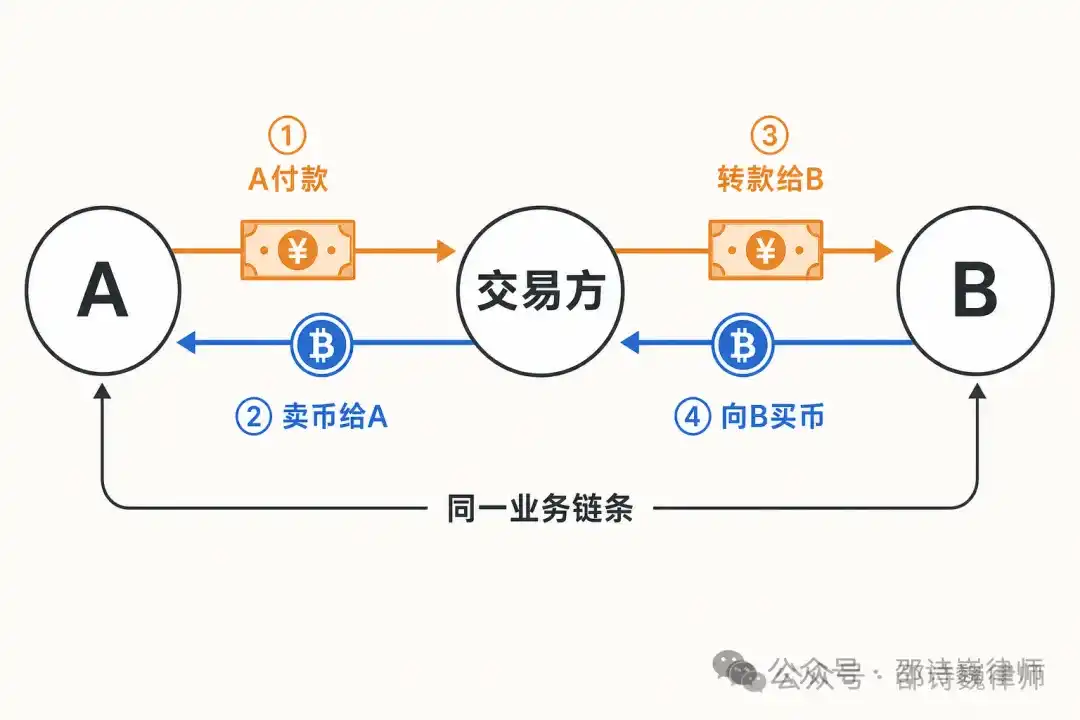
The author argues that this line of reasoning can miss the actual business context. Virtual-currency trading, the article says, is built on buying low and selling high. Money received from A may reflect a sale of coins to A, while the immediate transfer out may simply be payment to B to buy more coins. Selling to A and buying from B are two steps in the same operating chain.
For that reason, the article says, rapidly completing the next purchase after receiving funds should not automatically be treated as helping someone move illicit money. It may be ordinary business turnover, especially because coin prices can move at any time and delays can create losses. The article says investigators should not stop at the fact that money was quickly transferred out. They should also look at where it went and what it was used for. If the money went to another seller's receiving account and matched a normal coin purchase, that would be ordinary business activity.
The article then notes a different scenario. If the post-receipt handling of funds is genuinely abnormal — for example, the money is sent to many unrelated personal accounts, split into small amounts and dispersed, or immediately withdrawn in cash — the analysis changes.
One more pattern receives separate attention in the article. If the full chain looks like "collect renminbi domestically - buy USDT - release coins overseas," then rapid turnover may reflect the structure of the business itself, which needs fast movement of funds to hedge exchange-rate swings. In that model, the article says, the prosecution's focus may shift away from whether the trader provided payment and settlement assistance for another person's crime and toward whether the conduct amounts to disguised foreign-exchange trading under illegal business operations. Different charges, it adds, require different defense logic.
Subjective knowledge should be assessed across all seven variables
The article ends by saying that none of the seven variables is necessarily enough on its own to establish subjective knowledge. In practice, however, they do not appear in isolation.
Investigators often stack them together, the author writes, in a pattern such as: you had a prior incident, you were taking orders in a Telegram group, your price was 3 points above the market, and you moved the money out within 5 minutes. Each added layer strengthens the inference.
Defense work, the article says, follows the reverse path. Each layer should be examined separately to see whether it truly points to knowing intent or whether there is a reasonable alternative explanation. The more layers can be dismantled, the weaker the inference becomes.
That is why, in the author's view, a defense in a criminal case tied to virtual-currency trading is not as simple as saying, "I didn't know." Defense lawyers need to work through the variables listed in this article and combine them with the three baseline dimensions developed in the earlier pieces — degree of prior knowledge, upstream cause, and counterparty identity — in order to respond to the prosecution's inferences one level at a time and protect the client's lawful rights.