
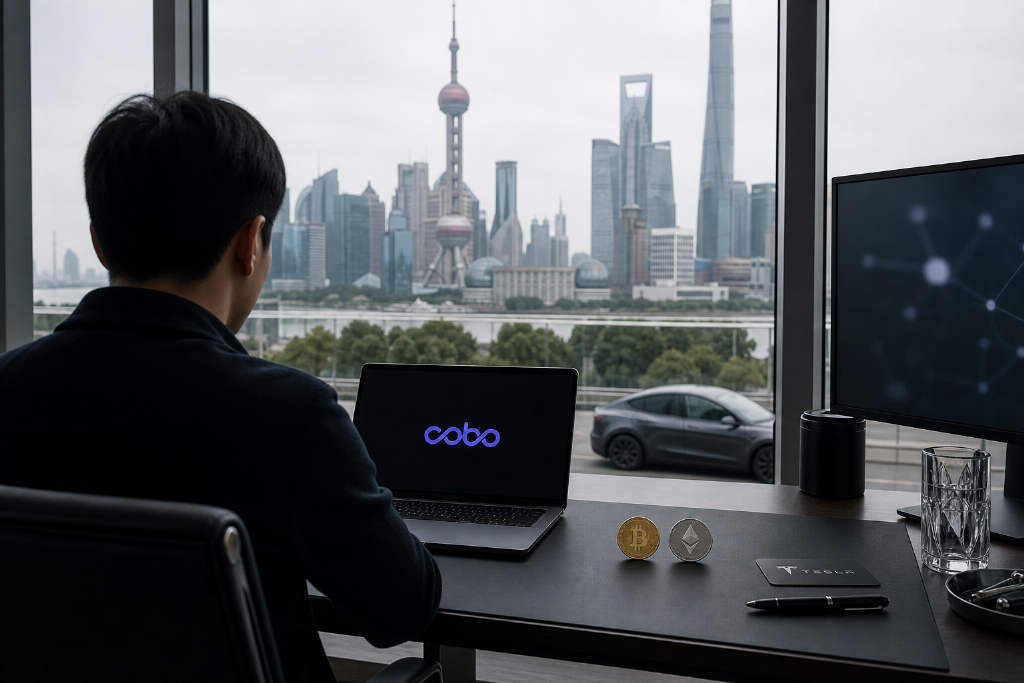
According to a published transcript of a long conversation with Jilian Technology founder Jin Ming, Cobo co-founder Shenyu said Bitcoin, Ethereum and Tesla still make up the main assets in his core allocation, while SpaceX remains in the timing-and-observation stage.
The talk ranged across AI, entrepreneurship, investing, Bitcoin, Web3, agents and personal purpose. Shenyu said AI has slashed the cost of turning ideas into real products. But he also said he is still in an exploratory phase: lots of possibilities in sight, no single fully formed path yet.
Shenyu says AI opened far more room to build
Jin Ming started by saying Shenyu’s previous interview had been around 10 years earlier, then brought up something Shenyu once said in 2017: “With this much money, I suddenly didn’t know how to spend it.” Shenyu replied: “Now I know how to spend it.”
Shenyu said AI changed the economics of execution. Work that used to take serious time and money can now be finished fast, if the idea is clear. Compared with what people could imagine 10 or 20 years ago, he said, back-end execution costs have dropped hard. AI compresses and organizes huge amounts of human knowledge, and people can tap that ability cheaply. In his view, that has created a lot of new possibilities.
Asked whether he is satisfied with his life now, Shenyu said he is doing “okay,” though he still feels somewhat confused. He contrasted that with his early startup years, when his sense of mission was much stronger. Now he sees AI generating all kinds of possibilities and thinks this is, in some ways, the best era. But he still does not see a particularly clear path, whether in mission terms or in a concrete business direction. So for now, he said, he is still exploring and still working on himself.
On how he defines his mission today, Shenyu said he still sees himself as a builder. Since AI took off, he said, he has made many small tools and dashboards, but has not yet found the big, systematic thing he wants to build. He added that after years on the front line of entrepreneurship, people can end up more confused, not less. And sometimes they need to go back to history and philosophy to understand how similar moments played out before.
When the topic shifted to purpose, Shenyu said he does not care much about leaving a legacy, and he is not especially interested in chasing experiences for their own sake either. He said he has used AI to break down a great deal of psychoanalytic material, but at his core, he sees himself as someone with an inbuilt drive to create. “I just want to build something,” he said, adding that finishing something gives him a strong sense of satisfaction. He said one meaning of being alive is that a person’s existence can widen the world’s range of possibilities, even if only by a little.
His early business push came from mining infrastructure problems in 2013
Looking back at what drove him early on, Shenyu said it came from seeing a window open and feeling a very strong creative urge. If there is something that would make you regret it for life if you did not do it, he said, it can feel like a force pushing you forward.
He traced that stretch back to 2013, when the main issue was hash power. Mining began in the United States and later started shifting to China. When China’s earliest ASIC mining machine operators came online, he said, those machines still had to connect to U.S. mining pools. That created two problems: latency and packet loss across the international internet, which hurt mining efficiency, and an industry settlement structure that he said was unreasonable at the time.
Shenyu said his team chose to solve those two problems. In his account, it was simple: they saw unmet demand in a niche market and realized they had the ability to serve it.
He says most of his information flow now comes through AI
Jin Ming said builders often carry some anxiety because their sense of purpose is tied to building. Asked whether that applies to him, Shenyu said yes, at least to a degree, though he has learned how to switch states. Since childhood, he said, he has had ways to clear his mind, including keeping animals and spending time on hobbies. He said he intentionally enters that kind of state almost every week.
On gathering information, Shenyu said AI now sits at the center of almost everything he consumes. He said that when he wakes up, AI tells him it has read everything he went through the day before. He now uses three AI agents: one that is highly practical and tells him what to do, one with a gentler and more inward-facing style, and a third that reviews what he did the previous day and points out blind spots.
He said one of those agents might recommend a history book, then send him to a specific chapter where people in the past dealt with a problem close to what he is facing now, and ask whether he wants to spend 15 minutes reading it. Then the relevant material appears right in front of him.
He also said he has a note-taking system that connects things he has followed in the past with matters tied to his life, using an evolutionary way of thinking. He described his own attention as a kind of “god” that decides which ideas or propositions survive. AI, he said, “hybridizes” a batch of new things every day, then picks one and tells him which article is worth reading.
Because of that, he said, he now rarely reads things in a direct, raw form. He also gets AI-filtered daily briefings and long-form material that is processed first and then sent to him. He usually compresses them into PPT format so he can review them quickly.
He does not care much about the fastest information because he does not trade short term
Jin Ming pointed out that AI may be strong at processing existing information, but some information unfolds in real time and may lose timeliness when filtered through AI. Shenyu said he does not care much about that. The most important information, he said, will reach you anyway.
He added that he does not trade on a very short-term basis and realized early that he does not have talent for that style. Simpler decisions are easier for him, he said, while decisions with a somewhat longer duration may suit him better.
Shenyu said he only really began investing after going through DeFi. In his view, DeFi filled in the missing history of investing for him. He said he moved from the idea of an “underground Federal Reserve” to seeing how traditional finance had been invented over the past 200 years. That process produced many questions, which pushed him to study history and finance more seriously. Only after that, he said, did he begin investing in a serious way.
He described himself as lucky on “day one,” saying he somehow picked up some usable methods early and followed a path that was “not too wrong.” But only after the DeFi wave, he said, did he build a more complete knowledge structure and investment framework. Before that, he did not even think of himself as an investor. He simply had an instinct that he should hold some Bitcoin, plus some basic thinking around position management.
He also said he has an ISTJ personality and tends to abstract frameworks from practice. First comes a rough structure. Then he trains intuition. Then, as new questions show up, he builds new frameworks on top of the old ones. That, he said, is how his investment framework slowly took shape.
DeFi gave him a path into financial product analysis, and RWA pushed him toward U.S. equities
Jin Ming said very few people actually build an investment framework out of DeFi because DeFi often comes down to “farm, sell and withdraw,” which is different from investing. Shenyu replied that he was not focused on arbitrage or mining yields themselves. What mattered to him was what those financial products were actually doing and how they met market demand.
He said DeFi was building a financial market on-chain from zero to one. That process was the main thing he watched. The operational side of DeFi, in his view, was closer to muscle memory and instinct. What mattered more was that the process generated both useful experience and useful questions. At first, he said, you may not understand why the market needs these products. But once you figure that out and compare it with history, a lot of threads start connecting.
Jin Ming then said the current wave of RWA moving on-chain, along with U.S. equities appearing on-chain, has effectively extended the financial product understanding Shenyu built in DeFi into traditional finance. Shenyu agreed. Once U.S. stocks are put directly in front of you, he said, you are forced to understand the logic behind them.
He recalled that 10 years ago, when he was mining, he did not really understand why other people wanted to borrow money from him to trade U.S. stocks. Looking back, he said, he was fortunate to have taken a path that was “not too wrong,” even though he was still feeling his way through it at the time. Later, more questions appeared. Then AI arrived, and his learning speed jumped sharply. He said he could scan large amounts of books and materials quickly and then work backward to understand why events unfolded the way they did.
On Bitcoin: “No change, still digital gold”
Asked how his view of BTC has changed after more than a decade around Bitcoin, Shenyu said it has not changed at all: “still digital gold.”
He said Bitcoin stands out because it may be one of the few assets in the world that can be held without intermediaries, while most other assets sit behind one, two or even three layers of intermediation. Bitcoin’s value, he said, becomes clearest in extreme situations. That is why, in his view, it is understandable that people may not care much about it when markets are strong.
He added that good assets do not need narrative, and that time itself can validate them.
Asked whether he agrees that Bitcoin greatly strengthens the sovereign individual in the classical liberal tradition, Shenyu said one core part of sovereignty is the ability to control and dispose of one’s assets. AI strengthens human capability, he said, while BTC is a core asset for sovereign individuals when it comes to asset control. Both matter.
Jin Ming said some people around him who once had deep conviction in BTC now feel they can no longer see a fresh narrative after this cycle. Shenyu’s answer was short: good assets do not need narrative.
He is watching whether agents can achieve large-scale adoption on Ethereum
Jin Ming said he sees only two major Web3 narratives in the current cycle: Ethena’s all-asset arbitrage model and the tokenization of real-world assets, both still in an early stage. He added that Web3 still has not produced a genuine breakout consumer application.
Shenyu said he has long looked at Ethereum from a different angle. In his view, a system like Ethereum may not, in the end, be built for direct human use at all, but for agents. It may become a network where humans are not the most suitable end users.
He said using on-chain products still demands too much professional knowledge and too much security awareness from ordinary users. If humans remain the direct endpoint, the barrier stays high. If agents become the intermediary layer, that may be a better way to present the system to users.
What he is watching now, he said, is whether agents can reach large-scale adoption in a system like Ethereum. If that happens, he said, it could be a turning point.
Jin Ming also argued that Web3’s value remains deeply underestimated. Moving from read-only to read-write to read-write-own, he said, could reshape how wealth is distributed in society because participants can also become owners. Shenyu said he thinks that kind of structure will appear in the future. He added that data in the AI era may itself produce similar mechanisms. The possibility of technical diffusion is already there, he said, though large-scale adoption still takes time and the fixing of many problems. He added that some successful demos already exist in edge cases, even if broad application has not arrived.
He prefers concentration over classic diversification
When the discussion moved to gold, Shenyu said he does not really pay much attention to it and sees Bitcoin as the better gold.
Jin Ming responded that both gold and Bitcoin are built on consensus, but the groups behind that consensus are different. Bitcoin has formed part of its consensus at the sovereign-individual level, while gold has a stronger consensus at the sovereign-state level, especially among central banks. Shenyu said the split can be viewed as two camps: “digital currency plus AI” on one side, represented by Bitcoin, and “gold plus industrial manufacturing power” on the other. He said his own orientation leans somewhat more toward the former.
Jin Ming then brought up the idea that investors seeking the market’s “free lunch” and a well-diversified portfolio should own more low-correlation or even negatively correlated assets. Shenyu said he does not believe truly negative-correlation assets really exist in the way many people imagine.
He said many assets do look diversified and loosely correlated in normal times, but they still share several core constraints. When those systemic variables change and markets move into extreme territory, most assets start behaving in very similar ways. That is why, in his view, the real problem is surviving the most extreme scenario. Assets that appear negatively correlated in ordinary conditions may fail to protect you when that scenario arrives.
For that reason, he said, he is not a typical advocate of diversification and leans toward concentration instead. The reason is practical. People cannot truly understand too many things, and attention is limited. If the underlying logic is not fully understood, he would rather concentrate capital in a small number of assets he actually understands.
He added that even if an asset has broad outside consensus, it can still damage your psychology when it falls if you do not really understand it. The simplest way to avoid that, he said, is not to own it. If Bitcoin drops and you do not panic, that says something about your conviction. But real conviction, he added, takes a great deal of prior work.
His framework starts with small test positions and scales up toward core holdings
Jin Ming said the people who perform best in the end are usually those who build a framework that is truly their own. Shenyu tied that to what he called a trading lifestyle, saying personality preferences shape investment philosophy and framework, which then shape position management and mental discipline.
He said his team’s thinking can be split into roughly three layers. First, they notice an anomaly — say, a company seems unusual. At that point, they do not put on a large position. The first buy may be no more than 2%, and often just a few tenths of a percent or even less, simply as an observation position while they spend time studying it.
If the thesis proves correct, the position can then be upgraded, moving from fractions of a percent or low single digits into a mid-single-digit allocation, though usually not above 10%.
Going from around 10% to around 20% as a core holding requires what he called a leap of faith. Once an asset enters the core bucket, he said, basic fundamentals and logical deduction are no longer enough on their own. The asset also needs a large enough vision, a very large TAM, strong business logic and real key bottlenecks that support its moat.
He said the team’s more central framework can therefore be summed up as “monopoly plus growth.” For an asset to qualify as a true core holding, its TAM must be very large and its vision must be big enough to pull it forward.
Current core assets are Bitcoin, Ethereum and Tesla
When asked directly which assets currently sit at the center of that framework, Shenyu gave a direct answer: Bitcoin, Ethereum and Tesla.
He said SpaceX is still being timed and observed and has not been upgraded into that group.
On Ethereum, he said it is still on the core list for now, though there have recently been internal discussions about whether it should be downgraded. The key thesis, he said, is that agents may eventually run on Ethereum. At the same time, he noted that this thesis has not yet been falsified.
Jin Ming then asked why agents could not just as easily run on Base or Solana. Shenyu said they could, but added that Ethereum’s system may be a better fit because it still has a deeper layer of decentralized infrastructure beneath it. He said that while many of those pieces have not fully materialized yet, the Ethereum Foundation has been trying to push in that direction, including registries and other infrastructure around agents.
He said nothing truly large has emerged yet. Still, some work has at least been done. Enough, in his view, to leave the market with some basis for hope.