
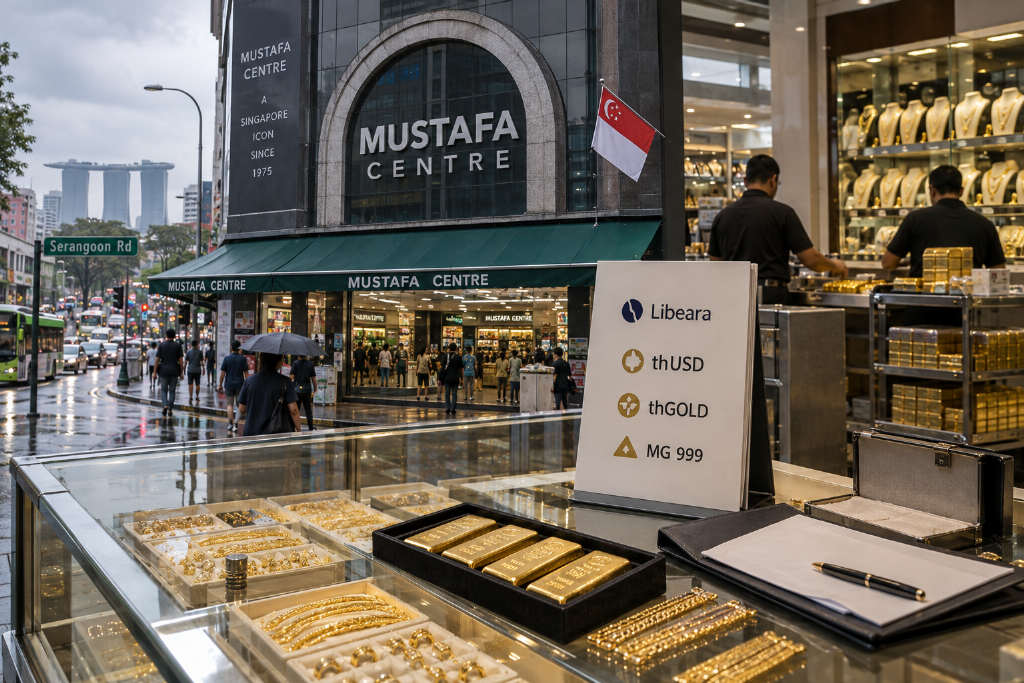
WuBlockchain has republished an article translated by TechFlow that argues a long-established gold leasing business in Singapore offers a practical reference point for on-chain yield tied to real-world assets. The piece focuses on how the assets behind thUSD and thGOLD move from a physical gold retailer into a structure that can feed income to token holders.
According to the article, the protocol channels demand from physical gold retailers such as Singapore’s Mustafa Centre into on-chain yield, linking a century-old leasing market with thUSD and thGOLD.
How Mustafa Centre manages inventory
The article says Mustafa Centre sells about 1,100 pounds of gold jewelry a month from a single store in Singapore. By the retailer’s own account, its inventory at any given time is close to 1 ton and is worth more than $100 million at current prices.
Even so, the business does not materially take on gold price risk. The report describes a simple operating rule: inventory is treated as a constant, not a variable. If 110 pounds of jewelry are sold in a day, 110 pounds of gold are bought back the same day. If sales are higher the next day, replenishment is higher as well. In that setup, the retailer earns the margin on each sale and little else.
The article says that if gold rises 20%, Mustafa does not make an extra 20% on the nearly 1 ton it holds. If gold falls 20%, it does not absorb that loss in the same way either. Revenue depends on how much jewelry is sold, not on where gold prices move.
It adds that a retailer that leaves inventory exposed to market moves is, intentionally or not, making a leveraged bet on gold. Businesses that survive for decades usually avoid combining jewelry retail with commodity speculation because the two require different balance sheets and different investors.
Gold leasing demand comes from operations, not speculation
Holding 1 ton of gold requires paying for 1 ton of gold. At current prices, the article says, that means tying up a nine-figure amount inside a retail business. Buying inventory outright consumes capital that could otherwise support stores and working capital.
That is why retailers do what refiners, processors and mints have done for more than a century: borrow gold and pay to use it. This is the demand side of the gold leasing market. Lenders with access to physical inventory provide the metal, while borrowers pay a leasing rate and post inventory and forward orders as collateral.
In the framework described in the article, borrowers gain access to gold without locking up large amounts of capital and without taking price risk. Lenders earn a return on an asset that would otherwise sit idle. The article notes that this mechanism was discussed in more detail in a separate piece on the gold leasing credit market behind thUSD.
It also stresses that the demand is not speculative. It comes from operating businesses with real order books and exists in all market conditions because consumers buy jewelry regardless of whether gold is relatively expensive or cheap.
Public data is limited
The article says the gold leasing market is opaque and that public information has clear limits. The London Bullion Market Association, or LBMA, stopped publishing the Gold Forward Offered Rate, or GOFO, on Jan. 30, 2015. GOFO had been published daily since 1989 and was a basis for pricing gold swaps, forwards and leases. After it was discontinued, forward and lease rates could no longer be publicly calculated in the same way they had been for the prior two decades.
The piece also says the World Gold Council excludes gold used as collateral, deposits and swaps when compiling official reserve series, but does not disclose the exact amount removed. There is no public dataset showing the total outstanding size of the leasing market.
What can be observed, the article says, is the broader market around it. Citing World Gold Council data, it states that daily gold trading across over-the-counter venues, exchanges and ETFs totaled about $373 billion in June 2026. In London’s settlement system, net daily settlement among four market-making banks exceeded 20 million ounces of gold. Based on LBMA settlement data, those transfers were worth about $87 billion a day in February this year.
The article adds that the figure still excludes a significant amount of real activity because the statistics are netted data and, by London Precious Metals Clearing Limited’s own description, omit several categories of transfers. Above-ground gold stock is put at about 219,900 tons, of which central banks hold about 36,500 tons.
Given those limits, the article says anyone claiming to know the exact size of the leasing market is making an estimate, and the authors say they are doing the same.
Libeara and the MG 999 structure
Every lease has another side. If a retailer wants gold inventory without price exposure, someone else must own gold and be willing to lend it. Historically, the article says, that side was occupied by bullion banks and a small number of funds with vault relationships, credit teams and the ability to assess operating businesses in the physical trade.
The barrier was not the yield itself but market access.
According to the article, the team reached this market through Libeara, a tokenization platform incubated by SC Ventures, the venture arm of Standard Chartered, and developed with FundBridge Capital around the MG 999 on-chain gold fund.
The report describes MG 999 as a structured, collateralized private credit fund that tracks spot gold performance while lending against physical inventory. It says Mustafa Gold was listed as the fund’s first borrower when the fund launched in December 2025. Libeara, the article adds, was the party that first connected the team with Mustafa.
The structure matters more than the footnote. Counterparty due diligence, fund governance and regulatory packaging are handled by institutions that specialize in those functions. The article argues that this is why the income stream can be accepted outside dedicated commodity trading desks.
What this means for thUSD and thGOLD
The article says thUSD and thGOLD are built on top of this market. Their counterparties are businesses like Mustafa: companies with real order books, standard credit underwriting and demand that does not depend on crypto risk appetite.
In the article’s framing, the gold leasing market has financed the physical gold trade for more than a century. Retailers borrow gold and pay a lease rate while avoiding gold price volatility. Lenders earn a return on idle metal. thUSD and thGOLD are designed to pass that leasing income through to token holders. What has limited the model, the article says, has not been the existence of yield, but who can get access to it.