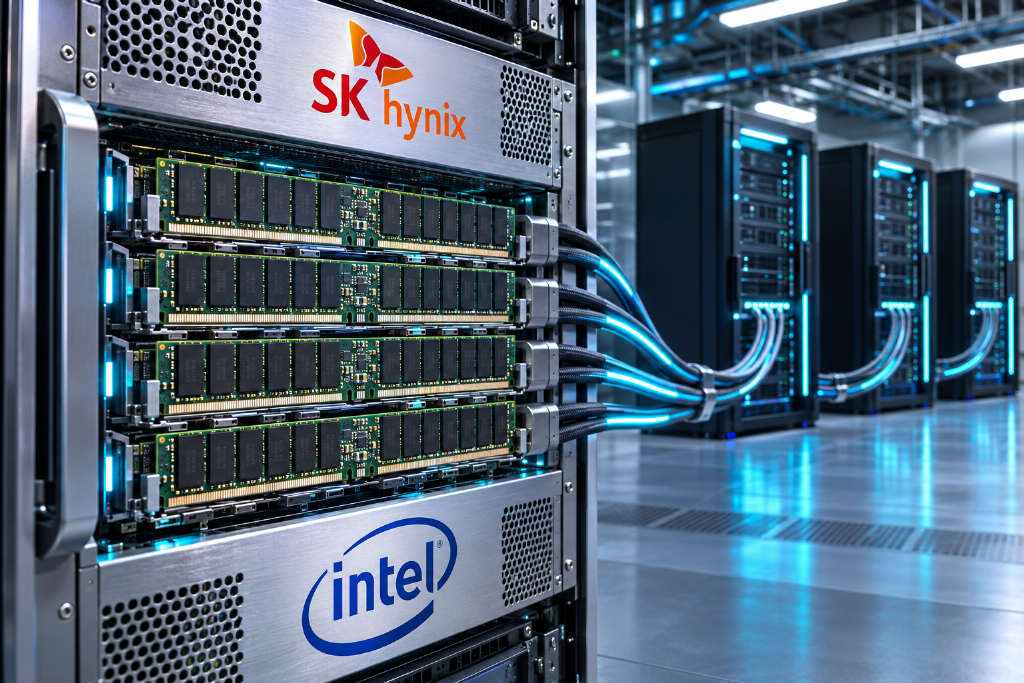
SK Hynix is teaming up with Intel and other partners to develop shared memory pools, allowing multiple AI servers to draw from a unified pool and address memory capacity and bandwidth strains from agentic AI. At the Intel AI Summit on November 12, 2026 (Beijing time), SK Hynix introduced the idea: high-capacity memory housed in dedicated racks, accessed via high-speed CXL and RDMA interconnects. Internal tests showed average first-token latency dropping from 80.76 seconds to 15.45 seconds—a roughly 81% reduction—using remote CXL DRAM. The architecture will undergo further validation with Intel and others.
SK Hynix is working with Intel and other partners on shared memory pools for AI servers. The idea is straightforward: let several servers draw from one unified pool, instead of forcing each machine to rely only on its own memory. That could ease the capacity and bandwidth strain created by agentic AI.
SK Hynix showed the concept at the Intel AI Summit on November 12, 2026 (Beijing time). High-capacity memory sits in dedicated racks, while high-speed CXL and RDMA interconnects handle access.
Internal tests produced a sharp latency drop. With remote CXL DRAM, average first-token latency fell from 80.76 seconds to 15.45 seconds — an improvement of about 81%.
More testing is planned with Intel and the other partners. (Techub News, via Crypto Briefing)
This article was originally published by Bit.Fan. For more cryptocurrency news and market insights, visit www.bit.fan. Disclaimer:
The market information, project data, and third-party content displayed on this platform are for industry information sharing only and do not constitute any form of investment advice or return commitment.
Cryptocurrency trading carries high risks. Users should fully assess their risk tolerance and make independent decisions. All profits, losses, and legal responsibilities are borne by the users themselves.