

SK Hynix’s $26.5 billion U.S. listing fell below its issue price just 17 days after pricing.
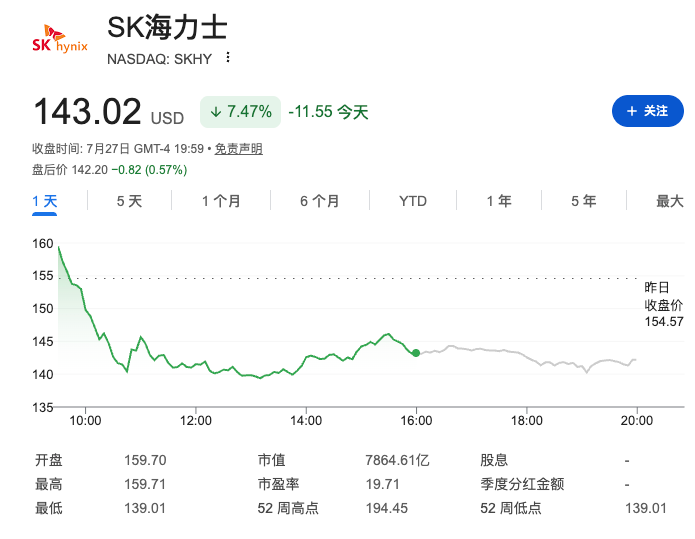
Bloomberg reported on July 27 that the company’s ADR dropped as much as 10% intraday, hit a low of $139.01, and closed at $143.02, below the $149 offer price by 4%. It was the first close below the IPO price since listing. The article said that, alongside Elon Musk’s SpaceX, SK Hynix became one of the biggest new U.S. listings this year to break issue price early.
A record foreign IPO in the U.S. slips below issue price in 17 days
SK Hynix priced 177.9 million ADRs at $149 apiece on July 9, raising about $26.5 billion. That topped Alibaba’s 2014 U.S. listing and set a record for the largest foreign company IPO in the United States. Each ADR represents one-tenth of a Seoul-listed common share.
The stock opened at $170 on July 10 and finished its first trading day at $168.01, up 12.76% from the offer price. Based on that closing level, its market capitalization was about $1.22 trillion.
After that came a sharp sequence of swings. On July 13, the Seoul-listed stock fell more than 15% in a single day, its biggest one-day drop in nearly two decades, while the KOSPI fell 9% and triggered a 20-minute halt. On July 14, the ADR climbed to an interim high of $193.92. By July 20, it had retreated to $151.16. On July 27, it fell through the IPO price.
That same day, the Philadelphia Semiconductor Index closed at its lowest level since May 19. Nvidia fell about 5%, and other recent listings such as Innio also traded below their issue prices.
Using the figures cited in the report, buyers who entered in the secondary market at $168.01 on July 10 were sitting on a paper loss of about 15% by the July 27 close. Those who bought at $193.92 were down about 26%.
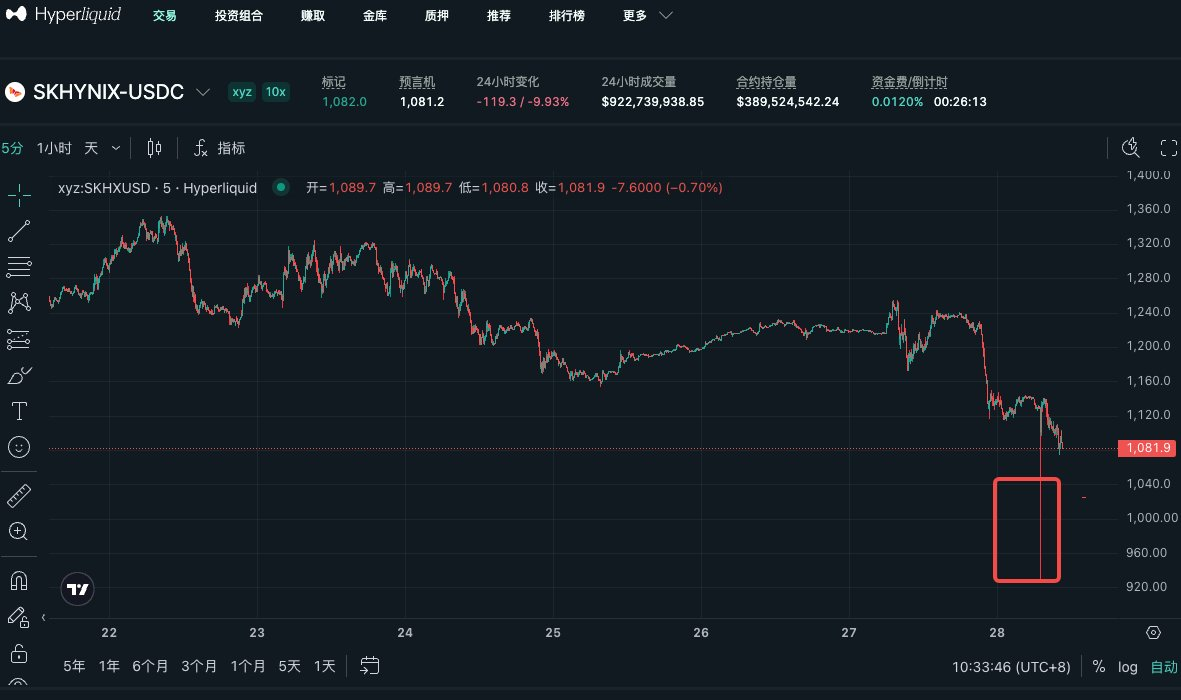
Hyperliquid’s xyz:SKHX dropped in tandem and briefly traded near $1,007
On Hyperliquid, traders can access a stock perpetual tied to SK Hynix under the symbol xyz:SKHX, displayed on the front end as SKHYNIX-USDC. The market was deployed by Trade.xyz through the HIP-3 framework, settles in USDC, and offers up to 10x leverage.
As of 10:09 a.m. UTC+8 on July 28, the contract’s mark price stood at $1,086.5 and the oracle price at $1,084.3. It was down $100.6 over 24 hours, a decline of 8.47%. Twenty-four-hour volume reached $906 million, open interest was $380 million, and the funding rate was 0.0062%.
Third-party platform OAK Research showed similar numbers for the same period: $1,086.1, down 8.51%, with $914 million in volume, $388 million in open interest, and a $1 billion open-interest cap. The two data sets were broadly in line.
The chart showed a long lower wick during the morning session on July 28 in UTC+8, with the contract briefly falling to around $1,007 before rebounding quickly to the $1,080 area. The timing was close to the Seoul market open.
The article said the exact cause of the wick would require on-chain trade records to confirm. Still, the structure of the product leaves little room for delay: liquidations are based on mark price, and with 10x leverage plus limited order-book depth, a brief break lower can wipe out long positions before traders have time to react. Even if price recovers minutes later, the position may already be gone.
CXMT surges on debut while South Korean chip stocks come under pressure
On July 27, CXMT, described in the report as China’s leading domestic DRAM company, listed on Shanghai’s STAR Market under 688825.SH. It was offered at 8.66 yuan, opened at 49.50 yuan for a gain of 471.59%, traded as high as 55.03 yuan, and closed at 49.00 yuan, up 465.82%.
Its market capitalization reached 3.28 trillion yuan at the close, surpassing Industrial and Commercial Bank of China to become the largest stock in the A-share market by market value. Turnover for the day was 141.1 billion yuan and turnover rate exceeded 66%, both records for an individual A-share name.
Nomura initiated coverage the same day with a buy rating and a target price of 116 yuan, implying a market capitalization of about 7.76 trillion yuan. The report added that CXMT’s global DRAM share is about 7.7%, up from about 3% a year earlier.
Reuters reported on July 28 that South Korean chip stocks sold off sharply. Samsung Electronics and SK Hynix were down 9.5% and 11.1% intraday, while the KOSPI was off about 8% at 01:20 GMT. Reuters cited two drivers: rising concern over financing risks behind AI infrastructure spending and stronger competition from China.
At the same time, SK Hynix CEO Kwak Noh-Jung had previously told Reuters that the memory industry would face its worst supply shortage in 2027. The article argued that the appearance of a new rival with a 3.28 trillion yuan market value and plans to use 57.9 billion yuan in proceeds for further expansion could affect how the market values the top of the cycle.
The on-chain perpetual tracks the Seoul stock, not the Nasdaq ADR
Under Trade.xyz’s design, xyz:SKHX tracks the dollar-converted price of SK Hynix’s Seoul-listed common shares, ticker 000660.KS, not the Nasdaq ADR. OAK Research listed the same underlying, showing 000660.KS at $1,103.95, down 10.64%.
That creates an important price gap. The on-chain contract at $1,086.5 corresponds to one common share. The ADR closed at $143.02 on July 27, and each ADR equals one-tenth of a share, implying about $1,430 per common share. The difference runs to more than 20 percentage points.
The article said part of that spread came from timing, because Seoul fell another roughly 10% on July 28 while the ADR had not opened yet. The rest reflected price differences between the two markets, which could not be fully explained from a single source at the time of publication.
This pricing setup is not new for Trade.xyz. Its CXMT pre-IPO perpetual, launched on July 14, used the same framework. Before listing, the contract briefly traded at $8.64 on-chain, implying a market capitalization well above the roughly $85.5 billion implied by the 8.66 yuan IPO price. After CXMT listed on July 27, the contract switched to an external oracle based on the live A-share price. The report noted that such transitions are themselves frequent points for price jumps and liquidations.
A 24-hour stock proxy on-chain comes with three layers of risk
The article’s conclusion was operational rather than theoretical: on-chain stock perpetuals give traders without a U.S. brokerage account round-the-clock exposure, but the trade-off is three separate risks at once — moves in the underlying, cross-market basis, and oracle transition risk.
In this case, traders going long SK Hynix on-chain were watching Seoul, betting on the Korean memory cycle, and facing liquidation on the basis of a single sharp wick on-chain.