


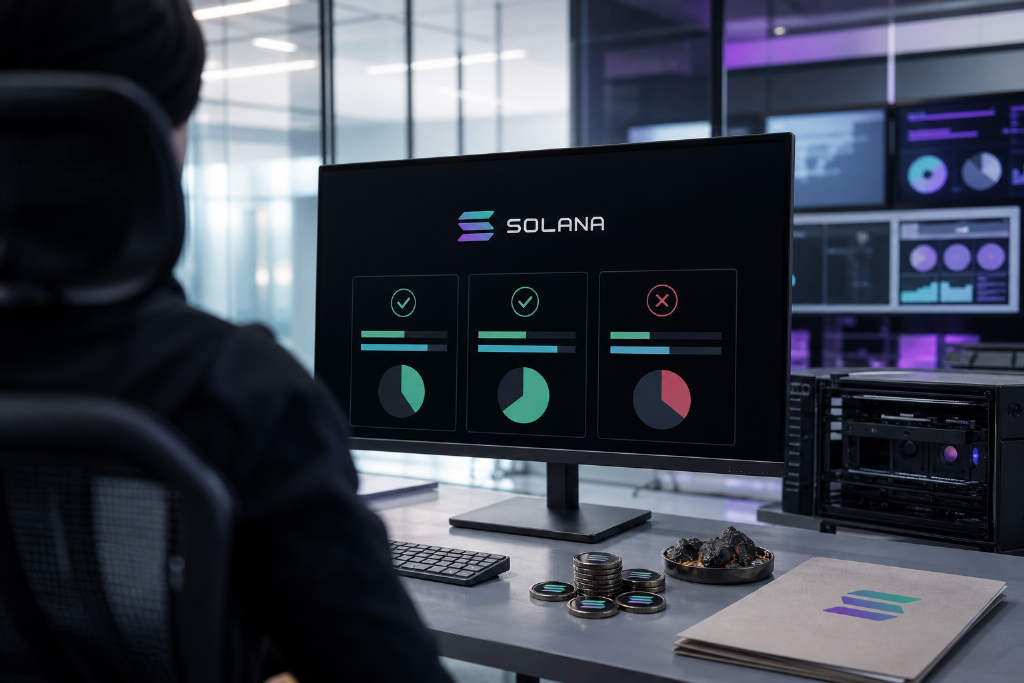
Solana’s first on-chain governance vote has delivered a mixed outcome for proposals tied to the future supply of SOL, with SGP-0001 and SGP-0002 clearing the required threshold while SGP-0003 failed.
The vote marks the first time in Solana’s history that validators have used an on-chain governance process to decide on proposals with direct implications for the network’s economic settings.
Based on the reported results, SGP-0001, the charter proposal, won 95.35% support and passed by a wide margin. SGP-0002, which seeks to accelerate inflation reduction, received 68.77% support, just above the two-thirds requirement. SGP-0003, a proposal to increase fee-based SOL burning, drew 62.72% support and did not pass.
All three proposals met quorum. Under Solana’s governance rules, at least one-third of the network’s staking must participate in a vote, and a proposal must receive support from two-thirds of participating votes to be approved. Abstentions count toward participation but not toward support, which makes them especially important in close contests.
Abstentions weighed on SGP-0003
That dynamic was central to the result for SGP-0003. The proposal recorded an abstention rate of 20.75%, much higher than the figures cited for the other two measures. SGP-0001 was reported with 0.22% opposition, while SGP-0002 had an 11.28% abstention rate.
In effect, abstentions helped SGP-0003 satisfy quorum without helping it reach the approval threshold. The article described that as the decisive reason the proposal fell short.
The voting process had not been completely finished at the time of the report, with the final outcome set to be confirmed on Friday, U.S. Eastern Time, when the last epoch ended. Even so, the reported tally showed a clear divergence between the two supply-tightening proposals: one narrowly passed, and the other narrowly failed.
SGP-0002 passed with a narrow margin
The core of SGP-0002 is a faster reduction in SOL inflation. The proposal would raise the annual decline rate in new SOL issuance from 15% to 30% and move the date for reaching the minimum 1.5% issuance level forward from 2032 to 2029.
Over the six-year period from 2029 to 2035, the proposal is expected to reduce issuance by about 18.9 million SOL. It posted a 47.72% participation rate and 68.77% support, barely above the 66.67% bar needed for passage.
According to the report, that change would slow the dilution faced by SOL holders by reducing future net issuance growth.
SGP-0003 sought a larger burn but did not pass
SGP-0003 took a more aggressive approach by proposing changes to the fee structure so that more SOL would be burned. The plan called for charging based on compute usage and burning that portion of the fees directly.
If approved, the amount of SOL burned each day would have risen from about 650 SOL to roughly 7,500-9,000 SOL. Based on recent prices cited in the report, that would have amounted to as much as $800,000 a day.
The article also noted a practical limit to the proposal’s impact. Solana currently creates about 60,000 new SOL a day. Even at 9,000 SOL burned daily, that would still remain well below new issuance, meaning net supply would continue to increase. SGP-0003 ended with 62.72% support, around 4 percentage points short of the threshold.
Solana Company opposed SGP-0002 and SGP-0003
Solana Company, described in the report as Solana’s listed corporate entity and traded on Nasdaq under the ticker HSDT, issued a statement on Aug. 21 saying it supported SGP-0001 but opposed both SGP-0002 and SGP-0003.
The stated reason was that institutional investors need predictable economic rules for multi-year planning. The article added that HSDT is itself a SOL treasury company with substantial SOL holdings, and that changes to the inflation curve would affect its asset valuation model.
Approval does not mean immediate activation
The report said passage of SGP-0002 should not be read as an immediate network upgrade. Instead, the vote serves as authorization, while the technical changes would still need to be written, tested and deployed by developers in later steps.
Why the vote matters
Beyond the results themselves, the vote established a precedent for Solana’s governance process. The 95.35% support for SGP-0001 showed strong backing for a formal governance framework among validators.
The split between SGP-0002 and SGP-0003 also exposed a fault line inside the Solana ecosystem over how economic parameters should be managed. As described in the report, one side is pushing for greater token scarcity, while another is focused on predictable rules. The article said similar divisions could emerge again if future SGP proposals address other economic variables such as staking rewards or gas fee revenue sharing.
For SOL holders, the report said the approval of faster inflation reduction and the projected cut of nearly 19 million SOL in issuance over six years amount to a concrete supply-side change. It also noted that the bigger factor for price over time will still be whether the Solana ecosystem can continue attracting developers, users and institutional capital.