
As HYPE continued to print fresh all‑time highs, a fierce Twitter war erupted between Solana loyalists and Hyperliquid believers. At the center of the storm was Kyle Samani, former co‑founding partner of Multicoin Capital and a flagship figure of the Solana community, squaring off against BitMEX co‑founder Arthur Hayes and an army of Hyperliquid “faithfuls.”
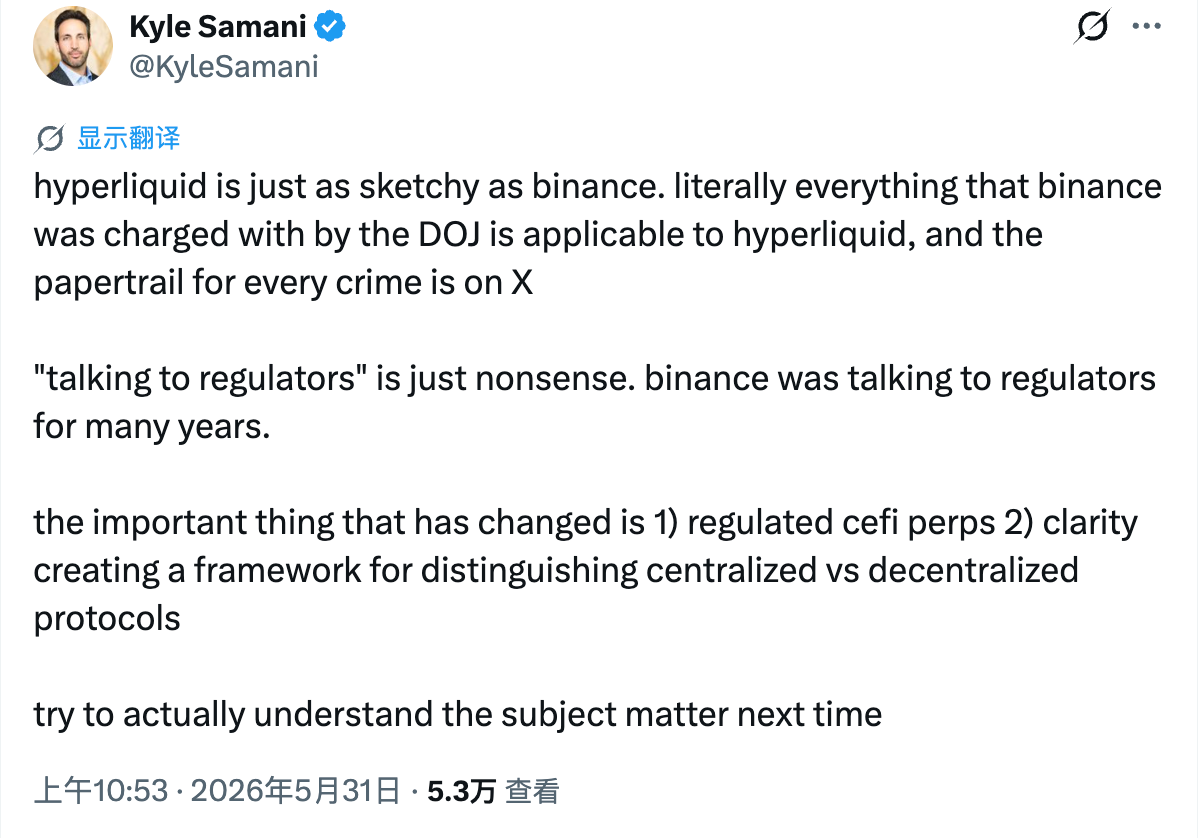
Samani’s Barrage: Hyperliquid Is a Centralized ‘Binance 2.0’
Over the weekend, Samani fired off a series of posts on X, launching an all‑out assault on Hyperliquid. He asserted that the project remains deeply centralized, having made “thousands of technical decisions” suitable only for a centralized environment, not a permissionless, decentralized system. On May 30, he wrote: “Hyperliquid is essentially Binance 2.0 without a marketing team … no real US firm will ever work with them in the future.” A day later, he doubled down, claiming that all the charges the DOJ previously leveled against Binance apply equally to Hyperliquid, with evidence of every offense already documented.
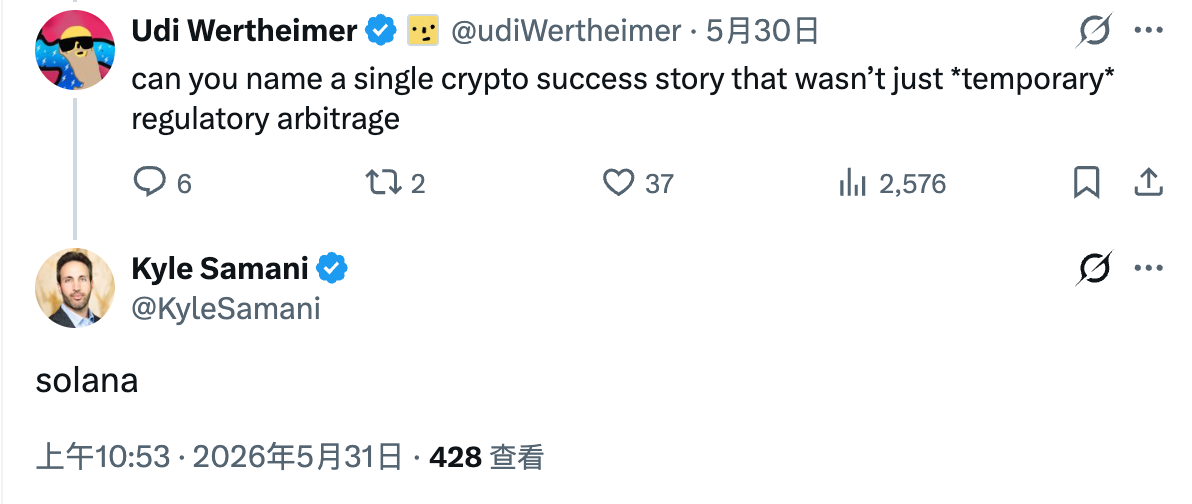
Samani also took a swipe at his perennial rival Ethereum, dismissing it as “credibly neutral but technically flawed”—in other words, “basically useless.” When Bitcoin developer Udi Wertheimer asked which token he considered a true success story, Samani answered without hesitation: Solana.

The Community Fires Back: Hayes Bets HYPE Will Eclipse SOL
Samani’s remarks were met with fierce pushback, especially given HYPE’s blistering price action. Arthur Hayes delivered the most direct counterpunch. He mockingly predicted that “before this cycle ends, HYPE should at least surpass SOL.” He then announced a content competition with a 100 HYPE prize pool, urging the community to roast Samani with humor and offense. In an even more aggressive move, Hayes directly challenged Samani to a $100,000 bet that HYPE would outperform any other cryptocurrency in the top ten over the final seven months of 2026. Traders like Ansem and developers like Wertheimer also piled on, rebutting Samani’s criticisms from various angles.

The Efficiency Flywheel: How Hyperliquid Appropriated Solana’s Narrative
Solana’s greatest success over the last few years has been building a high‑speed, low‑cost on‑chain financial infrastructure, where assets ranging from memecoins to DeFi and AI agents naturally congregate. Its core logic: liquidity gravitates to the most efficient market. Hyperliquid pushes that logic even further. Rather than building infrastructure and waiting for applications and liquidity to grow organically, it cut straight to the industry’s most fundamental need—trading. It amassed users, fee revenues, and depth through perpetual contracts, then steadily expanded into spot, tokenized equities, prediction markets, and beyond. This has spawned an extraordinarily potent flywheel: more traders generate more fee income, which in turn fuels HYPE buybacks and ecosystem incentives. HYPE’s rising price attracts more capital, further deepening liquidity and tightening spreads. Its cash‑flow generation now even surpasses that of layer‑1 ecosystems, Solana included.
For years, Solana’s flagship narrative has been “the internet’s capital market.” But as users, assets, liquidity, and pricing power continue migrating to Hyperliquid, that crown now increasingly fits the latter. In effect, Hyperliquid has become what Solana most wanted to be—a reality its most loyal champion, Samani, is clearly unwilling to accept.

The Irony of the Double Standard: Hoisting the Decentralization Banner
What makes the episode even more striking is the mirror‑image nature of Samani’s attack. In the years‑long battle between Ethereum and Solana, Ethereum advocates routinely questioned Solana’s decentralization—high validator thresholds, taxing hardware requirements, network outages, and a perceived over‑reliance on a handful of core entities. Solana’s counter‑argument was refreshingly simple: users don’t care about those things; they care about speed, low fees, and a better product experience. Solana’s rise was, in this sense, a decisive victory for the “efficiency first” school of thought.

Yet now, as Hyperliquid seizes market mindshare, Samani is brandishing the exact same “decentralization” banner that the Ethereum camp once waved. Centralization risks, regulatory headaches, censorship resistance—the accusations sound eerily familiar, only the defendant is no longer Solana but Hyperliquid. In Samani’s eyes, perhaps, Solana represents the golden mean: Ethereum is decentralized but clumsy; Hyperliquid is exquisitely smooth but resembles a CEX; Solana, by contrast, looks impeccably “clean‑cut.”

At its core, this spat is not about HYPE versus SOL. It is the same decade‑old crypto quandary: should we prioritize decentralization, or product and growth? Ethereum and Solana once battled over this very question. Now Solana and Hyperliquid stand in the same arena. Only this time, faced with a more aggressive challenger, it is Solana’s faithful who find themselves hoisting the flag of decentralization.