
As HYPE continues to notch new highs, the “HYPE vs SOL” debate on Crypto Twitter is heating up. At the center is Kyle Samani, former co-founder and managing partner of Multicoin Capital and a flag-bearer for the Solana community. Over the past weekend, Samani issued a barrage of posts attacking Hyperliquid, while BitMEX co-founder Arthur Hayes led the counterattack on behalf of Hyperliquid’s true believers.
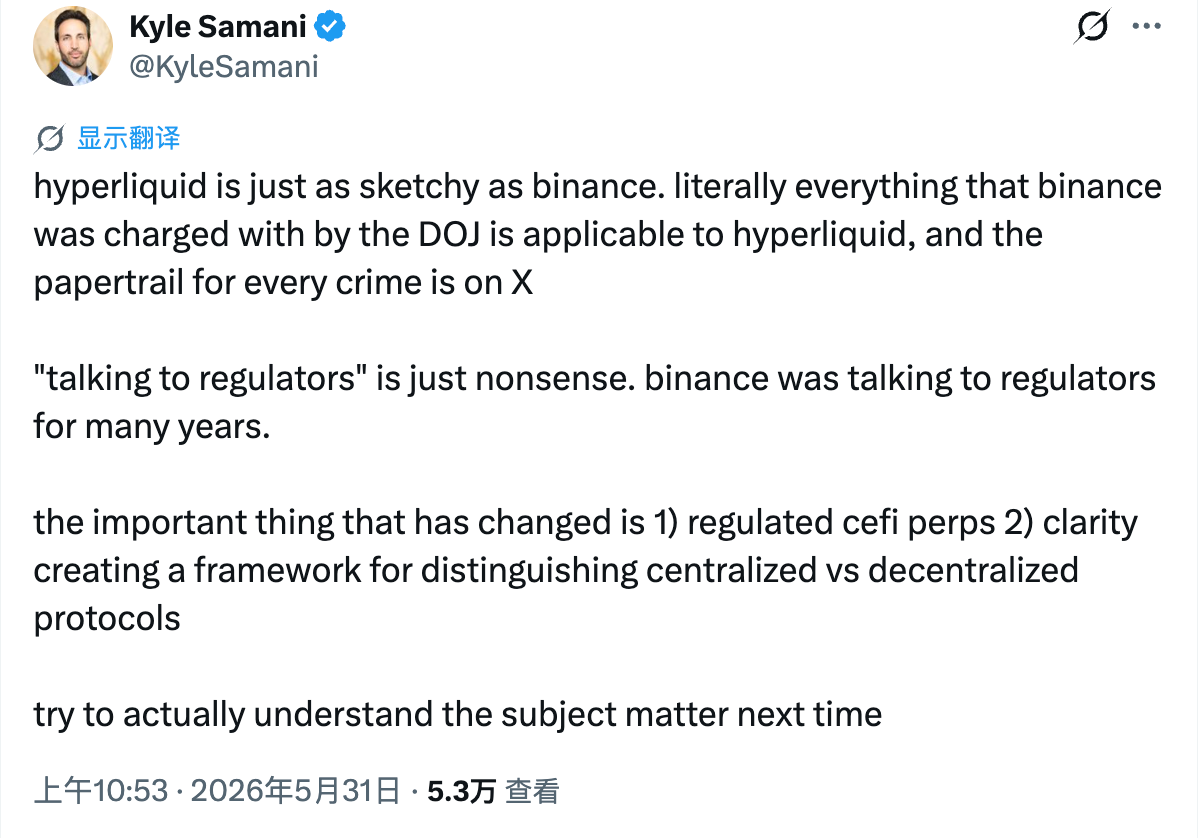
On May 30, Samani wrote: “Hyperliquid is essentially Binance 2.0 without a marketing team. It has made thousands of architectural decisions that only work in a centralized setting, not in a permissionless, decentralized environment. They are now many steps behind on this path, and any real US company will never work with them in the future.” The next day, he claimed Hyperliquid was as suspect as Binance, with every charge the US DOJ brought against Binance applicable to Hyperliquid and documented on-chain, and that the so-called “communication with regulators” was nonsense.
The pushback was swift. Hayes responded on May 31, sarcastically predicting that HYPE would surpass SOL before the cycle ends. Early this morning, he announced a content competition with a 100 HYPE prize pool, challenging entrants to reply to Samani with humor and offensiveness. Hayes also directly challenged Samani to a $100,000 wager that HYPE would outperform the top ten crypto assets by market cap over the remaining seven months of the year.

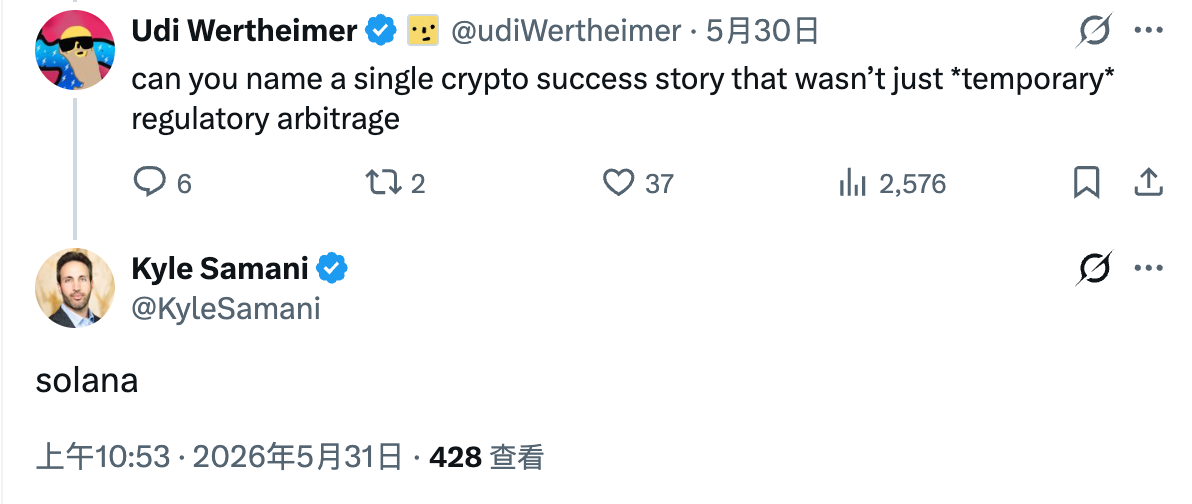
While attacking Hyperliquid, Samani also took a swipe at Ethereum, calling it “credibly neutral but technically flawed.” When asked which token he considered a success, he resolutely named Solana.

The Shifting Narrative of Efficiency
Solana’s success was built on a high-speed, low-cost on-chain financial infrastructure that attracted everything from memecoins and DeFi to AI agents. The core logic was that liquidity flows to the most efficient market. Hyperliquid, however, took this a step further: instead of waiting for applications and liquidity to grow organically, it jumped straight into the most fundamental crypto demand—trading. By building perpetuals first, it accumulated users, fee revenue, and liquidity, then gradually expanded into spot, equities, prediction markets, and more.
This created a rare positive flywheel: more traders generate more fees, more fees fund HYPE buybacks and ecosystem incentives, rising HYPE prices attract more capital, and greater capital deepens liquidity and trading depth. In terms of cash flow, it has even surpassed most layer-1 ecosystems including Solana. Solana’s narrative as an “internet capital market” is being co-opted by Hyperliquid, which now appears to embody that vision more fully.

From the Accused to the Accuser
A striking irony runs through this conflict. The criticisms Samani now hurls at Hyperliquid—centralization, regulatory risk, lack of censorship resistance—are the very ones Ethereum supporters used against Solana for years. Back then, Solana’s community simply said, “Users don’t care; they want speed and low fees.” Solana’s rise was a triumph of the “efficiency first” approach.

Now, as Hyperliquid grabs attention and liquidity, Samani wields the same banner his former enemies did. It may seem like a double standard, but in his view Solana likely represents the ideal balance: Ethereum is too clunky, Hyperliquid too CEX-like, while Solana sits right at the sweet spot between decentralization and performance.

A Decade-Old Question Resurfaces
At its core, the dispute is not about HYPE versus SOL but the same fundamental question that has echoed through crypto’s history: Should the industry prioritize decentralization or product and growth? Ethereum and Solana once argued this fiercely; now Solana and Hyperliquid stand on the same battleground. This time, faced with a more aggressive rival, Solana’s believers have become the ones hoisting the decentralization flag. The debate remains unresolved, but it records the industry’s repeated recalibration of its value proposition.