
As HYPE continually pushes to new highs, a fiery debate centered on “HYPE vs SOL” has erupted across Crypto Twitter. At the eye of this storm stands Kyle Samani, former co-founder and managing partner of Multicoin Capital and one of the most prominent flag-bearers of the Solana community. Surrounding him from the periphery are Hyperliquid's most devoted disciples, led by BitMEX co-founder Arthur Hayes.
Over the past weekend, Samani unleashed a barrage of posts on X, opening an intensive offensive against Hyperliquid by targeting its fundamental centralization and regulatory vulnerabilities. At 6:30 AM on May 30th, Samani wrote: “Hyperliquid is essentially just Binance 2.0 without a marketing team. It has made thousands of architectural decisions that only work in a centralized setting—not in a permissionless, decentralized environment. They are now many steps behind on this path. Moreover, no legitimate American company will work with them in the future.”
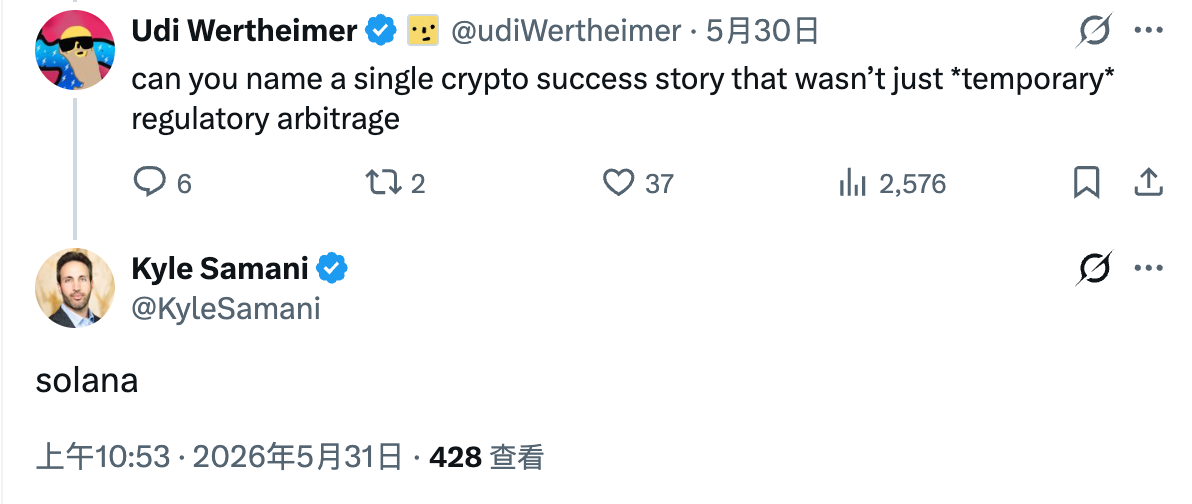
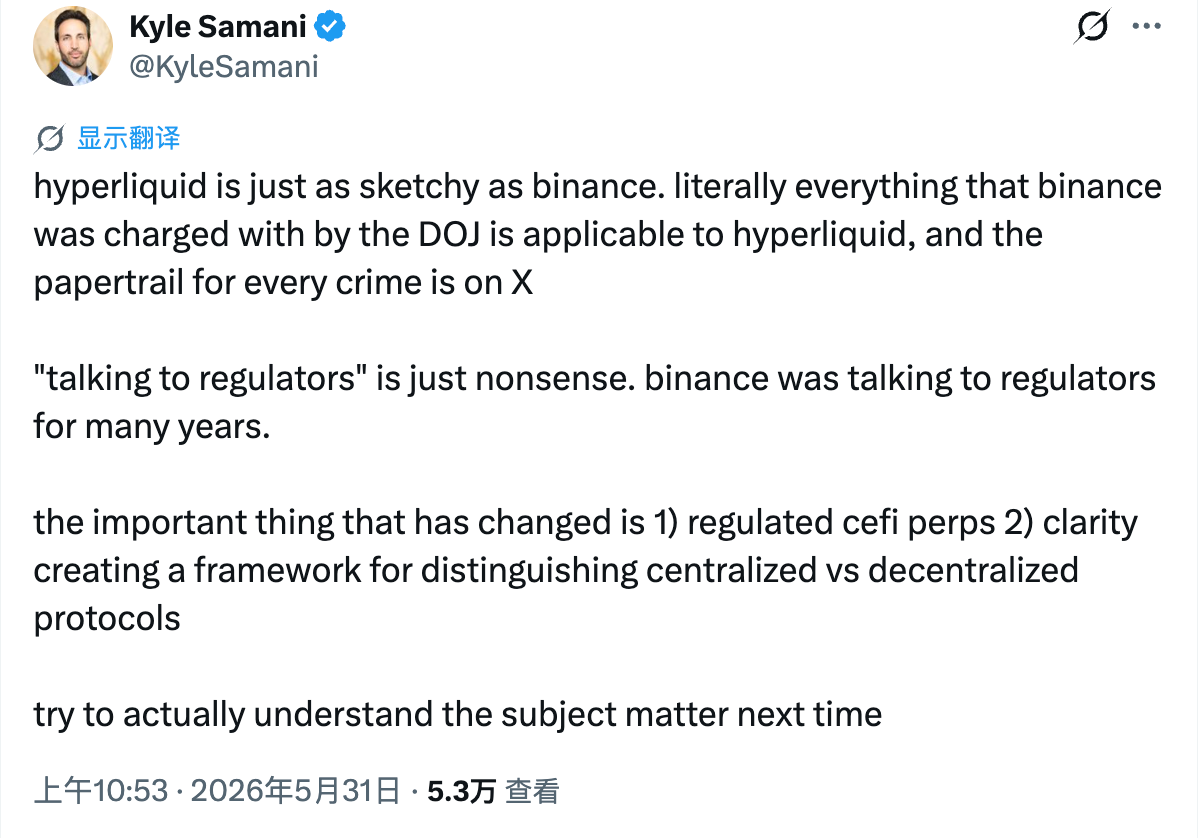
By 10:53 AM on May 31st, Samani escalated further: “Hyperliquid is just as shady as Binance. Every charge the U.S. Department of Justice has ever made against Binance applies to Hyperliquid, with evidence of each crime documented on-chain. The so-called ‘communication with regulators’ is complete nonsense.” While attacking Hyperliquid, Samani also took a swipe at the old rival Ethereum, labeling it “credibly neutral but technically flawed”—in other words, essentially useless. When asked by prominent Bitcoin developer Udi Wertheimer which token he considered a successful case study, Samani gave the unsurprising answer: Solana.

Predictably, Samani's remarks triggered an intense backlash from the community, especially given HYPE's formidable momentum. Investors like Hayes, developers like Wertheimer, and traders like Ansem all fired back with varying degrees of force. Hayes's counterattack was the most direct. On May 31st, he posted a pointed jab: “Before this cycle ends, HYPE should at least surpass SOL.” Early this morning, Hayes upped the ante by announcing a content competition with a 100 HYPE prize pool, calling for entries that respond to Samani humorously and offensively. Simultaneously, Hayes directly challenged Samani to a $100,000 bet that HYPE will outperform any top-ten crypto by market cap over the remaining seven months of the year.
The Liquidity Funnel: Why Hyperliquid Alarms Samani
Beneath this debate lies a head-on collision between two fundamentally divergent growth trajectories. Over recent years, Solana's crowning achievement has been building a high-speed, low-cost on-chain financial infrastructure. From meme coins and DeFi to AI agents, every type of asset and application has chosen to issue and trade on Solana. The underlying logic is simple: liquidity gravitates toward the most efficient market.

Hyperliquid, however, has taken this logic a step further. Unlike Solana, which provides infrastructure and waits for applications and liquidity to grow organically, Hyperliquid entered directly through trading—the industry's most fundamental demand. It accumulated users, fee revenue, and liquidity through its perpetual contract market, then progressively expanded into spot trading, tokenized equities, prediction markets, and more financial products. The result is an extraordinarily rare positive flywheel: more traders generate more fee revenue; more revenue fuels HYPE buybacks and ecosystem incentives; a rising HYPE price attracts more capital; more capital further enhances platform liquidity and trading depth. The cash flow generated by this flywheel has already surpassed that of public chain ecosystems, including Solana's.

In recent years, Solana's signature narrative has been the “Internet Capital Markets,” but as users, assets, liquidity, and pricing power continuously migrate toward Hyperliquid, the latter now appears far more aligned with that narrative than the former. In essence, Hyperliquid seems to have become the very embodiment of what Solana has always aspired to be. As Solana's most loyal standard-bearer, Samani clearly does not want to see this unfold.
Role Reversal: When Solana's Camp Raises the “Decentralization” Banner
Observing Samani's attacks on Hyperliquid closely reveals a deeply ironic phenomenon. Over the past few years, the most common line of attack from the Ethereum camp in the enduring Ethereum vs. Solana debate has been to question Solana's degree of decentralization. High validator node requirements, excessive hardware demands, frequent network outages, and an ecosystem overly reliant on a handful of core institutions—in the eyes of many Ethereum supporters, Solana may be fast, but it fundamentally sacrifices decentralization for performance.

The Solana camp's response to this has always been succinct: users simply don't care. For the vast majority of users, what matters is faster confirmation times, lower transaction fees, and a better product experience—not a research paper on node distribution. In a sense, Solana's rise itself represents a monumental victory for the “efficiency-first” approach. Yet now, as Hyperliquid begins to seize market mindshare, Samani finds himself hoisting the very banner that the Ethereum camp once loved to wave. Centralization, regulatory risk, censorship resistance—these accusations sound eerily familiar. The only difference is that Solana was once the defendant; now it is Hyperliquid.

This may appear somewhat hypocritical, but in Samani's view, Solana likely represents the optimal equilibrium—Ethereum is decentralized enough but too cumbersome; Hyperliquid is exquisitely smooth but too much like a centralized exchange at its core; Solana, by contrast, appears to strike that perfect balance. In a sense, the essence of this debate is not simply a token competition between HYPE and SOL. It is the same question that has haunted the crypto industry for over a decade: should we prioritize decentralization, or should we prioritize product and growth? Years ago, Ethereum and Solana argued endlessly over this. Today, Solana and Hyperliquid stand in the very same position. Only this time, facing an even more aggressive challenger, it is Solana's disciples who find themselves brandishing the banner of “decentralization.”