
While HYPE keeps breaking new highs, a fierce X war has erupted around “HYPE vs SOL.” At the center stands Kyle Samani, former co-founder and managing partner of Multicoin Capital and a banner figure of the Solana community. Circling from the outside are Hyperliquid true believers led by Arthur Hayes, co-founder of BitMEX.
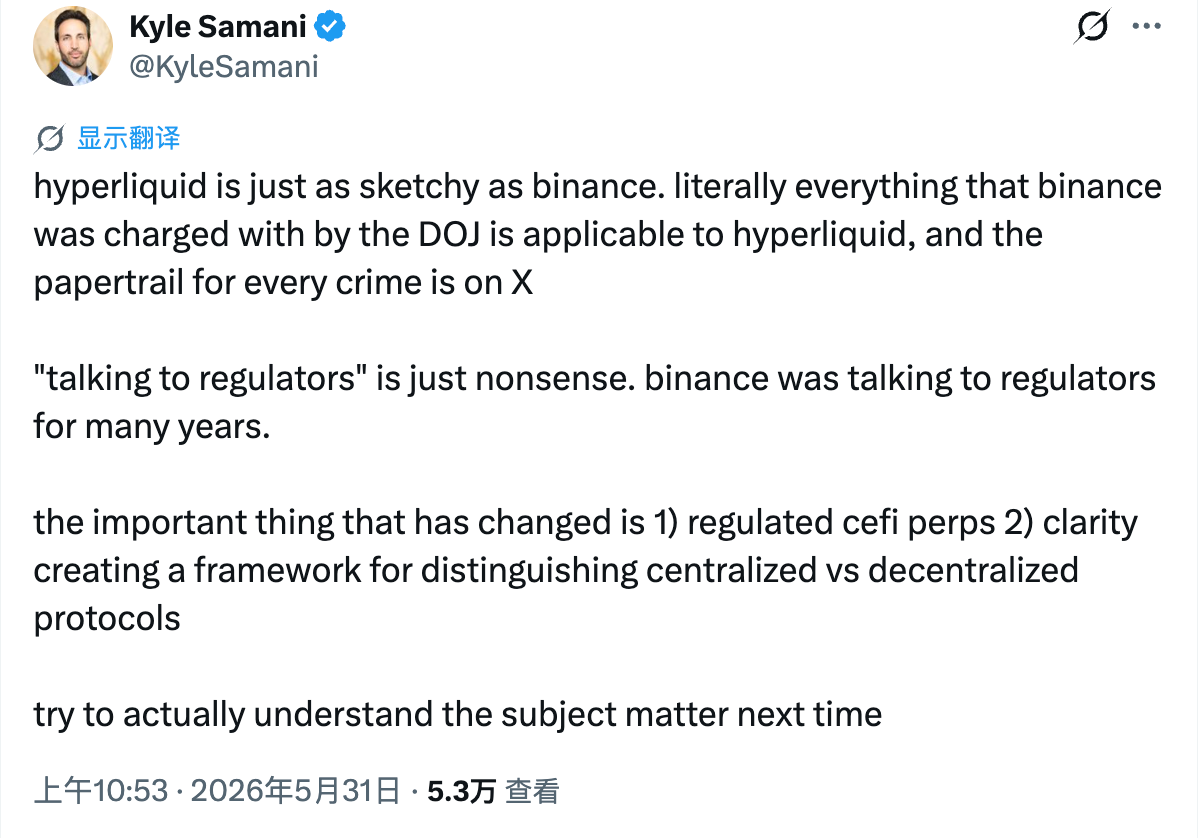
Over the past weekend, Samani personally went on a hard offensive against Hyperliquid. He posted a series of tweets attacking the project’s highly centralized nature and serious regulatory issues. On May 30, he wrote: “Hyperliquid is essentially a Binance 2.0 without a marketing team (sorry Binance). They’ve made literally thousands of architectural decisions that only work in a centralized environment, not in a permissionless decentralized one. They are now many steps behind on that path. Also, no real US company will work with them in the future.” The next day, he added: “Hyperliquid is as sketchy as Binance (sorry again). Every single charge the DOJ laid against Binance applies to Hyperliquid, and the evidence for each crime is on-chain. ‘Talking to regulators’ is nonsense—Binance has been talking to regulators for years too…”
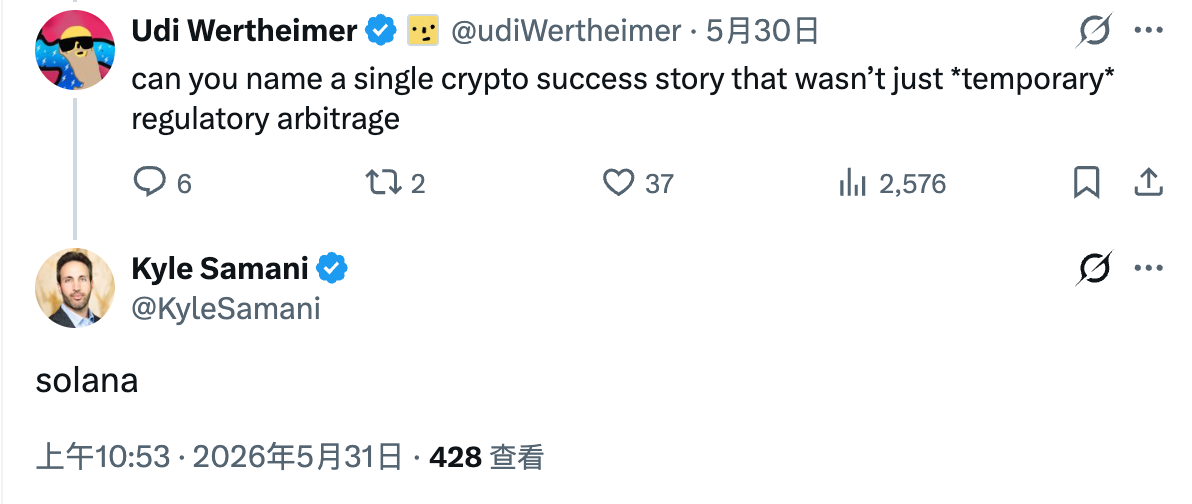
While attacking Hyperliquid, Samani also took a jab at old rival ETH, calling it “reputationally neutral but technically deficient,” which in his words meant “basically useless.” Finally, when prominent Bitcoin developer Udi Wertheimer asked, “Which token in your mind counts as a success case?”, Samani gave the unsurprising answer: Solana.

Samani’s comments drew intense pushback from the community, especially given HYPE’s strong momentum. Hayes, Wertheimer, trader Ansem, and others all hit back with varying force. Hayes delivered the most direct counter. On May 31, he subtweeted Samani: “Before this cycle ends, HYPE should at least surpass SOL.” This morning, Hayes announced a content contest with a 100 HYPE prize pool, demanding humorous and offensive replies to Samani. At the same time, he directly challenged Samani with a $100,000 bet that HYPE would outperform the top 10 cryptocurrencies in the remaining seven months of the year.
From Infrastructure to Trading Flywheel: Why Hyperliquid Is a Threat
In recent years, Solana’s greatest success has been building a high-speed, low-cost on-chain financial infrastructure. From memecoins to DeFi to AI agents, every kind of asset and application has chosen to launch and trade on Solana, following the core logic that liquidity gravitates toward the most efficient markets. Hyperliquid, however, takes this logic a step further. Unlike Solana, which provides infrastructure and waits for applications and liquidity to grow organically, Hyperliquid dives straight into trading—the most fundamental demand in crypto. It accumulates users, fee revenue, and liquidity through a perpetuals market, then gradually expands into spot, crypto-equities, prediction markets, and more financial products.

As a result, Hyperliquid has formed an extremely rare positive flywheel: more traders generate more fee income; more income feeds back into HYPE buybacks and ecosystem incentives; HYPE price increases attract more capital; more capital further enhances platform liquidity and depth. The cash-flow-generating power of this flywheel has already surpassed that of many L1 ecosystems, including Solana.

A Dramatic Reversal in Decentralization Accusations
What’s most striking is that Samani’s current attacks on Hyperliquid mirror almost verbatim the arguments Ethereum maximalists have used against Solana for years. They’ve criticized Solana’s high validator node thresholds, demanding hardware requirements, frequent network outages, and excessive reliance on a few core institutions—arguing that Solana sacrifices decentralization for speed. The Solana camp’s response was blunt: users don’t care. They want faster confirmations, lower fees, and better product experiences, not a white paper on node distribution.
In a sense, Solana’s rise was a massive victory for the “efficiency first” route. Yet now, as Hyperliquid steals the limelight, Samani is waving the very banner that Ethereum maximalists used to love: centralization, regulatory risk, censorship resistance… These charges sound eerily familiar, except that the defendant used to be Solana, and now it’s Hyperliquid.

This might seem hypocritical, but in Samani’s eyes, Solana likely represents the perfect balance—Ethereum is decentralized enough but too clunky; Hyperliquid is silky smooth but essentially resembles a CEX; Solana, on the other hand, looks just right.

The Eternal Dilemma: Decentralization vs. Product Growth
At its core, this fight isn’t about HYPE vs. SOL. It’s about the decade-old crypto quandary: should we prioritize decentralization, or should we prioritize product and growth? Ethereum and Solana once clashed over this very question. Now Solana and Hyperliquid stand on the same battlefield. The twist is that this time, facing a more aggressive rival, Solana’s faithful have become the ones hoisting the flag of “decentralization.”