
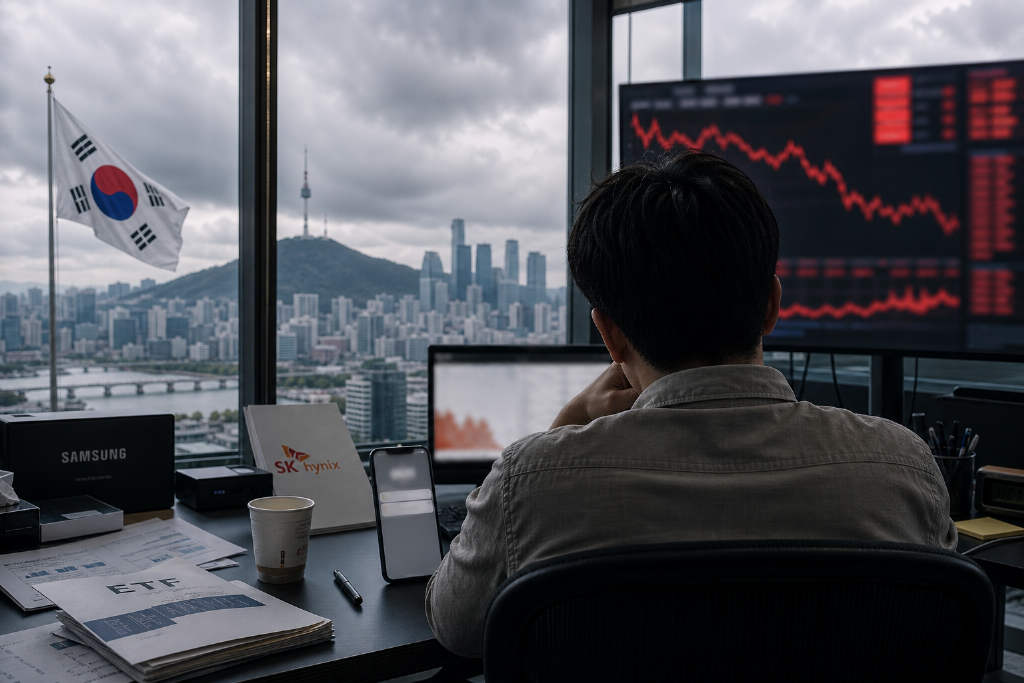
South Korea’s stock-market boom, fueled by artificial intelligence enthusiasm and borrowed money, has turned sharply lower. Reuters reported on Aug. 23 that the Korea Composite Stock Price Index, or KOSPI, has fallen 30% from its June 19 high.
The reversal has also put fresh scrutiny on the government’s attempt to close the so-called Korea discount through broader investment access and improved corporate governance.
On May 27, South Korean regulators allowed single-stock leveraged exchange-traded funds to list. Investors could participate after completing one hour of training and depositing at least 10 million won.
During the rally, Samsung Electronics and SK Hynix each reached a $1 trillion market capitalization. That helped lift the KOSPI to more than double its level from last October and push the index above 8,000. Retail investors borrowed aggressively to chase the AI trade, and margin balances tied to the KOSPI rose about 75% this year, reaching a record 29.8 trillion won on June 24.
Because Samsung Electronics and SK Hynix together accounted for more than 53% of the KOSPI’s total market value, leveraged products linked to them amplified swings in the broader market. In early July, South Korea’s volatility index, VKOSPI, climbed to 97.99, the highest level since records began in 2009.
Reuters, citing a July 28 estimate from Citi, said retail investors had lost $38.7 billion on leveraged ETFs.
The market retreat has also spilled into social stress. A psychiatrist in Seoul said the number of patients seen for stock-investment-related issues rose from seven to eight a day last year to an average of 11 a day since June this year. Police in Busan also arrested a man in his 20s accused of stabbing a YouTuber after allegedly blaming the person for his stock losses.
South Korean authorities have now tightened restrictions on leveraged ETF investing by individuals. Reuters added that analysts believe the volatility could also affect the country’s effort to win inclusion in the MSCI developed markets index.