
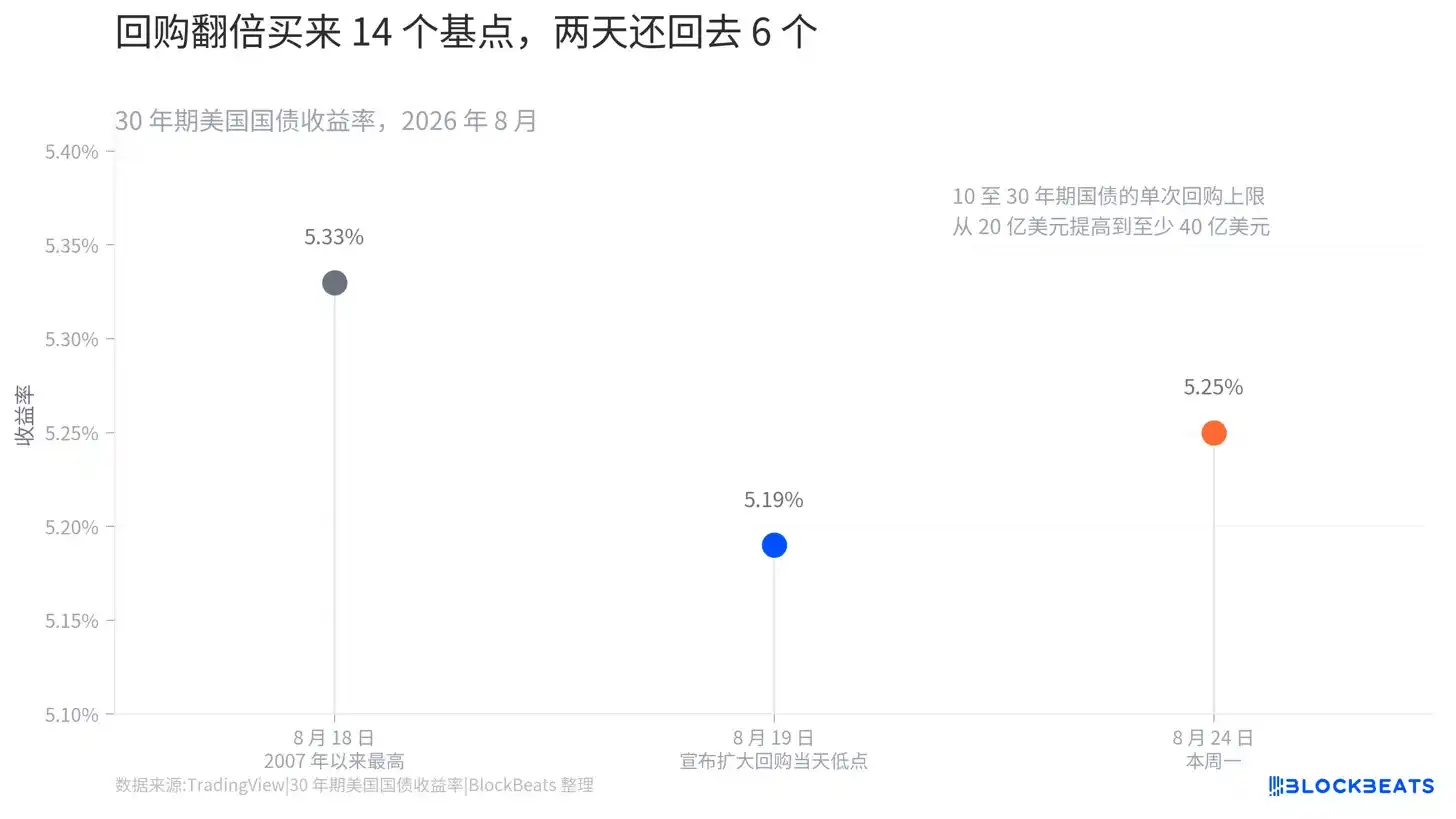
On Aug. 19, U.S. Treasury Secretary Scott Bessent raised the per-operation cap on buybacks for 10-year, 20-year and 30-year Treasuries from $2 billion to at least $4 billion, doubling the limit after long-end yields surged. One day earlier, the 30-year Treasury yield had touched 5.33%, its highest level since 2007.
Bessent called the move a “Treasury twist operation,” echoing the Federal Reserve’s well-known twist operation from the 1960s. His view was that prevailing yields were out of line with “equilibrium” levels.
The initial drop in yields did not last
The announcement pushed the 30-year yield down to 5.19% that day, a decline of 14 basis points. The relief was short-lived. By Monday, the 30-year yield had climbed back to 5.25%. The 10-year yield closed last Friday at 4.73%, near the highest level since Bessent took office.
Other markets reacted far more sharply. Bitcoin climbed to nearly $80,000, triggering billions of dollars in short liquidations. Gold moved close to a three-month high, and XRP rose 51% over the week.
Why Treasury buybacks can, in theory, lower borrowing costs
Treasury yields serve as the benchmark rate for the broader U.S. economy. They shape not only government borrowing costs, but also mortgage rates, corporate loans and a wide range of other debt pricing. Higher yields raise the interest burden for both Washington and U.S. households.
When the Treasury buys back its own bonds in the open market, it effectively adds a new source of demand. Bond prices rise when demand increases, and because prices and yields move in opposite directions, yields tend to fall.
But the Treasury is not the Federal Reserve. It cannot create money on its own balance sheet. The cash for buybacks must come either from existing funds or from new financing, and new financing usually means issuing more short-dated Treasury bills. In that sense, the operation looks more like a maturity swap than a reduction in debt outstanding.
Wells Fargo analyst Angelo Manolatos estimated that financing the enlarged buyback program would require the Treasury to issue an additional $16 billion in short-term bills each quarter.
Why the move did not solve the long-end problem
The basic playbook is not new. Since the start of Donald Trump’s second term in 2025, the Treasury has funneled all new borrowing needs into bills maturing within one year, pushing up short-end rates while avoiding more long-end supply. Before becoming Treasury secretary, Bessent had criticized his predecessor Janet Yellen for doing exactly that.
The larger problem is that the forces driving long-term yields higher were untouched by the buyback decision.
Satori Insights founder Matt King put it this way: “Every road to sustained relief at the long end runs through things this administration does not want.” He listed three of them: a smaller budget deficit, a decline in equities and less AI investment.
None of those conditions is in place. By one measure, U.S. national debt surpassed $40 trillion this week. Bessent’s deficit-reduction plans face weak prospects in Congress. Republicans, who control Congress, have shown no interest this year in net budget cuts, and the fiscal-year deficit is projected at $2.1 trillion.
Corporate borrowers are also competing for capital. The AI boom has fueled a jump in corporate bond issuance, and Alphabet sold bonds earlier this month with maturities extending as far as 40 years.
Inflation pressures have also strengthened. Trump’s war with Iran disrupted energy markets, oil has risen about 30% since early July, and Brent crude reached $93 a barrel.
At the same time, the Federal Reserve has offered little clarity. Chair Kevin Warsh’s strategy has left investors uncertain, and his first Jackson Hole appearance as chair has yet to take place.
Some market voices do not see a market malfunction
Roughly an hour before Bessent announced the plan, Edward Yardeni, who coined the term “bond vigilantes,” told Bloomberg TV: “I think we’ve returned to normal interest-rate levels. 4% to 5% is normal.”
The Treasury said the intervention was meant to support market liquidity. JPMorgan’s rates strategy team wrote in a report last Thursday: “Market functioning has improved materially this year.”
Goldman Sachs, Wells Fargo and others were more direct. Their view was that unless fiscal and inflation pressures ease in a real way, larger long-end buybacks will not reverse the upward trend in long-term yields, and the yield curve will continue to steepen.
Why Bitcoin rallied anyway
The market did not read the move as “problem solved.” It read it as a sign of urgency.
Sygnum Chief Investment Officer Fabian Dori offered a detailed explanation: “The Treasury doubling long-bond buybacks is aimed at calming the bond market and providing liquidity at the long end of the curve… This is not money printing, as the mechanism sits on the Treasury’s balance sheet rather than the central bank’s, but the signal matters: managing the cost of U.S. debt has become an active policy priority, which rekindles the currency-debasement narrative. The fact that gold and silver rose alongside Bitcoin is telling — capital is rotating into scarce, non-sovereign stores of value.”
Citadel Securities was harsher. It said using buybacks to suppress long-term borrowing costs amounts to “financial repression” and could weaken the dollar while worsening inflation. In its view, lower long-end yields would not remove fiscal and inflation pressure, only shift that pressure into foreign-exchange markets.
That process may already be underway. Hedge funds had increased bearish dollar bets before Bessent unveiled the plan. The dollar then posted its biggest one-day decline in nearly three weeks, while options demand for downside dollar hedges rose to the highest level since February. By Monday, the dollar index was still hovering near multi-month lows.
TGA became the next focal point
A new variable emerged this week: where the money might come from.
CNBC reported Monday, citing two senior Treasury officials, that the department could use its cash balance at the Federal Reserve — the Treasury General Account, or TGA — to fund the buybacks. As of Aug. 20, that account held $935 billion.
The TGA is effectively the federal government’s checking account. It is used to pay Social Security benefits, federal salaries, defense contracts, and principal and interest on Treasury debt. The balance was intentionally built up this year, partly because the Treasury must refund about $166 billion to importers after the Supreme Court ruled earlier this year that a major portion of Trump’s import tariffs was illegal.
Using the TGA would avoid the need for more issuance, but it would directly reduce the government’s cash buffer. In 2015, the Treasury set a rule that the account should hold at least enough for five days of outflows, or no less than $150 billion, in case the bond market becomes inaccessible.
After the CNBC report, the 10-year yield fell as much as 4 basis points on the day to 4.69%.
Asked about the issue at a Monday press conference that was otherwise focused on sanctions on Iran, Bessent said the Treasury would keep following the regular auction schedule announced in early August, including long-bond auctions. He added that the expanded buyback program has not yet purchased a single bond, and that buybacks in the 10-year and 20-year sectors will begin on Sept. 10.
Bessent’s yield-curve agenda goes beyond Treasuries
His effort to shape the curve is not limited to the sovereign market.
Bessent also pointed to mega-cap technology companies borrowing heavily to finance AI expansion. He said those investments should eventually deliver faster, non-inflationary growth, but for now “it is causing near-term competition for capital.”
He then offered advice that drew attention of its own: “If I were sitting in the CFO seat, I would think about issuing some of the so-called belly debt,” meaning five-year maturities.
It is unusual in itself for a U.S. Treasury secretary to publicly suggest what part of the curve corporate finance chiefs should use.
Stablecoins sit further down the same road
Another thread runs into stablecoins. The Genius Act passed last year requires U.S.-issued dollar-pegged stablecoins to be backed only by specific assets, including Treasuries maturing within 93 days.
Bessent has cited a forecast that stablecoins could grow into a market approaching $4 trillion, and he has written that “this could reduce the government’s borrowing costs.”
Total stablecoin market capitalization is currently about $300 billion, while U.S. money market funds are close to $8 trillion. A commentary from the Brookings Institution’s Hutchins Center highlighted the leverage in that structure: banks typically hold about 8 cents of Treasuries per $1 of assets, while $1 of stablecoins is often backed by close to 80 cents of Treasuries.
That also forms part of the backdrop to Trump hosting crypto executives at the White House last week and urging Congress to pass the Clarity Act. Circle and Coinbase both rose more than 20% last week.
The cost of breaking with “regular and predictable” debt management
The Treasury has followed a decades-old tradition of “regular and predictable” debt management, meaning meaningful changes in issuance or debt operations are normally discussed extensively inside the department and with market participants. Bessent himself repeatedly endorsed that principle in a keynote speech last November.
This latest escalation came only two weeks after the release of the program’s provisional quarterly calendar.
Lou Crandall, senior economist at Wrightson ICAP, wrote on Monday: “The decision itself to increase long-end buybacks may not have been radical, but the timing and framing of the decision certainly were.”
The irony is that the cost could show up in exactly the market Bessent is trying to manage. If investors begin to worry that auction sizes could change unexpectedly, they may demand a higher premium to buy Treasuries, especially the longest maturities.
In other words, breaking a rule to push long-end yields lower could end up pushing long-end yields higher.
Some in the market have already started talking about a “Bessent put,” a reference to the old belief that Alan Greenspan would step in to support equities.
Trump, for his part, denied last week that he had instructed Bessent to intervene in the bond market.
Bessent did twist something. But what moved most was the dollar, gold and Bitcoin, not the specific stretch of the Treasury curve he wanted to pull lower.